

Bryan Cush: A sense of place
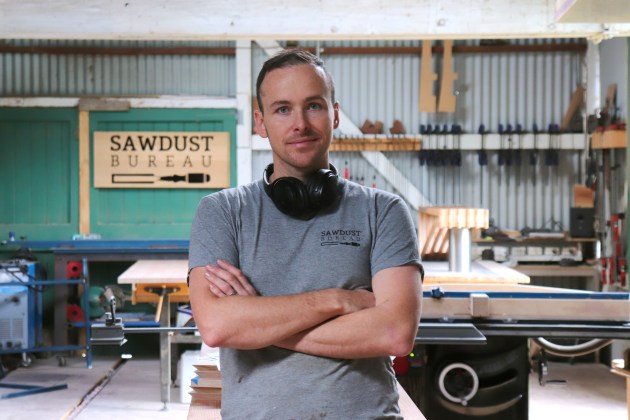
Bryan Cush designs and makes furniture under the name Sawdust Bureau.Photo: Northside Studio
Words: Linda Nathan
First published in Australian Wood Review, issue 104, September 2019
Bryan Cush, 37 is a designer and maker of furniture whose earlier career as an architect is reflected in the structural and built nature of his designs. He doesn’t rely on the traditional hallmarks of fine woodworking – dovetails, veneer layups, frame and panel constructions – but the feel and ethic is all about quality and handcrafted.
When it comes to using Australian native species, this Irish-born maker is all about local. ‘A lot of designers specify American timbers on every job…but I like to offer local species. The only piece of foreign timber I’ve ever cut in this workshop is a piece of oregon to make a workbench,’ said Bryan. ‘Blackbutt is my alternative for American oak. You can soap wash it if you want to get it a bit paler. If you oil it, it goes caramel and beautiful.’ Mostly though Bryan uses spotted gum and Victorian ash eucalypts, but ironwood, redgum and jarrah come into the workshop as well.
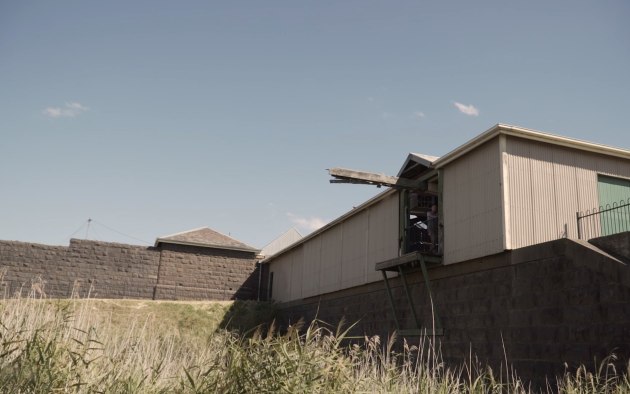
The workshop is situated in a heritage site that overlooks a canal and the grassy Maribyrnong floodplain. Photo: Michael Firus
A remote location for a woodworking shop within far sight of Melbourne’s CBD and the urban creep of apartment blocks seems like a contradiction. And yet in the 1800s Jack’s Magazine was just that, a place far enough out of town to store gunpowder and munitions that were manufactured nearby up until World War II. At that time goods were floated up the Maribyrnong River and then carted in and out by rail from what is now a heritage site that overlooks a canal and grassy floodplain surrounds.
Two and a half years ago Bryan leased this space, overlaid flooring to protect the original jarrah boards, but left access to rails that run its length. With an 1870s trolley these are now the best workshop aid a sole business proprietor ever had for moving work within, and to and from a delivery van.
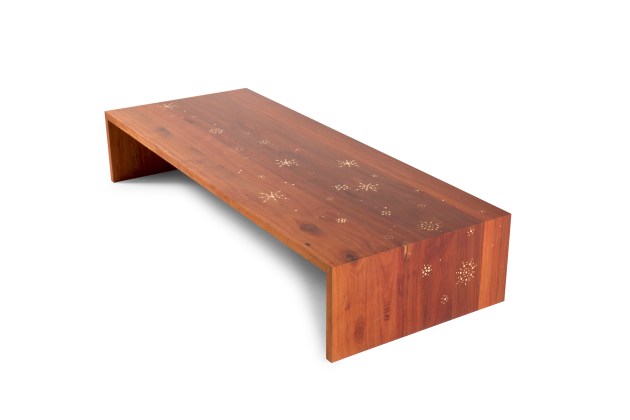
Ancestors Table, ironbark, brass. A collaboration with Gurindji artist Sarrita King. Photo: Northside Studio
Bryan was born in Belfast, studied architecture in Glasgow and Holland, then travelled to Melbourne to work for an architecture studio before meeting his Australian future wife, and settling permanently 15 years ago. Completing his masters at Melbourne University he fell under the spell of woodworking in the architecture school workshop, then headed by Hamish Hill. Influenced by that experience but more so by his grandfather, also an architect turned furniture maker, Bryan eventually changed career.
Making things was more satisfying and suits him better Bryan explained. ‘The main thing I found frustrating about architecture was how slowly everything went. It could be years before we’d broken ground. What with council issues and building permits – you end up begin a project manager. The creative side ends up being 10 per cent of the job, the rest is negotiating and documenting.’
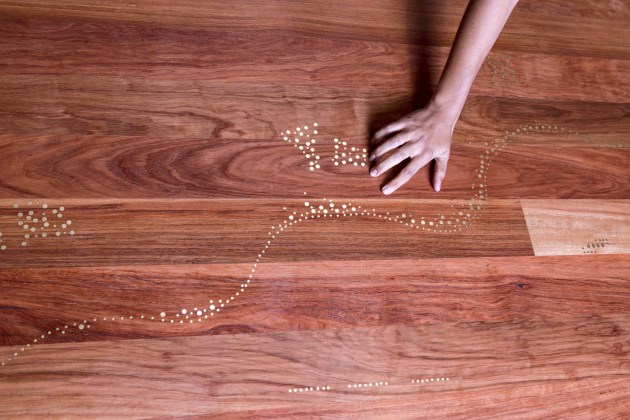
Detail of My Country’s Story, a collaboration with Sarrita and Tarisse King whose imagery was reproduced in Bryan’s signature brass rod inlay. Photo: Keith Murphy
Now it’s different, as a designer maker he can control every stage of the process. ‘I wouldn’t get the same buzz out of designing something if someone else made it, and I wouldn’t get the buzz out of making it if someone else designed it,’ he said.
However training in architecture has given Bryan a better understanding of manipulating space and form. ‘Just dimensionally I think a lot of makers will stick to standards, whereas I would say if you want to design a slender piece, stretch it out to be extra long and svelte. If you want to design a tall piece, make it tower above standard heights and narrow it in at the base to exaggerate the perspective, as opposed to staying within the golden ratio. I find that an awkward way to design, really limiting.’
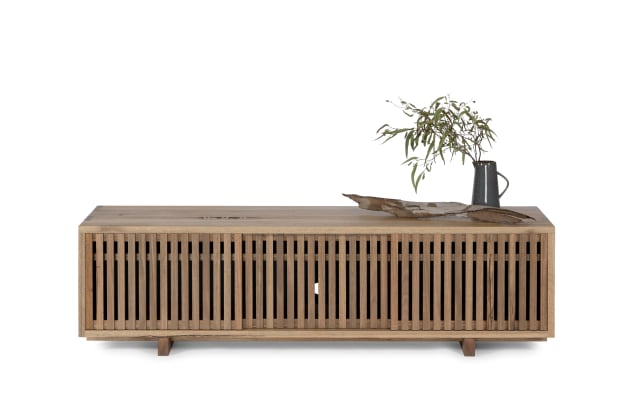
Sudare credenza in spotted gum. Photo: Northside Studio
Despite being adept with CAD technology, Bryan feels he is fortunate for probably being the last generation of architecture students at Glasgow University that didn’t use a computer for the first two years. After that Bryan studied in Holland where ‘it was all very technical, very advanced computer based subjects but their model making workshop was out of this world. They had every piece of machinery you could wish for. That was inspiring, I learnt a lot there.’
His training has been an advantage in other ways as well. ‘When you have a background in architecture clients will be trusting of you and give you very minimal briefs. Finding out their aesthetic tastes and practical requirements (even though it’s harder to budget for) is definitely the most rewarding part of it for me rather than churning out tables for a café.’
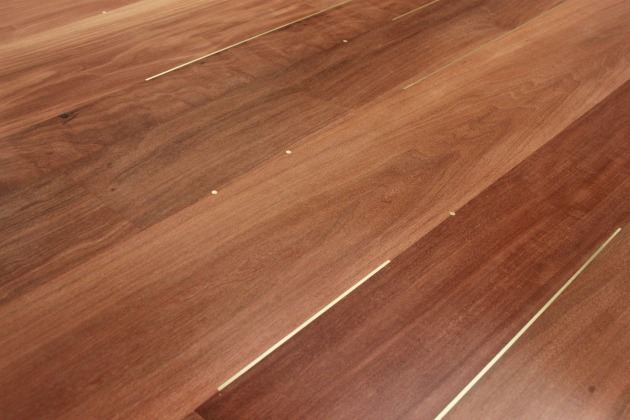
Dot Dot Dash was crafted from salved ironbark for celebrity chef Shane Delia. The ‘Morse code bling’ has a secret message which even Shane doesn’t know the meaning of. Photo: Bryan Cush
There’s a lack of pretension that comes through in Bryan’s humour. His Plonk and Vino bars are just that – places to openly stash your grog. Parasite side tables are made of laminated plywood that is incrementally ‘eaten away’ to show their linear endgrain while playing with notions of balance and solid construction.
Mr and Mrs Brightside are an outwardly conservative couple. These are bedside tables that express their personality with built-in LEDs, lockable drawers and screen printed interiors. ‘The humorous references are definitely inspired by the part of architecture that I didn’t like – the super serious side,’ Bryan said. As with architecture, he is a firm believer that the way you live should inform structures and not the other way around.
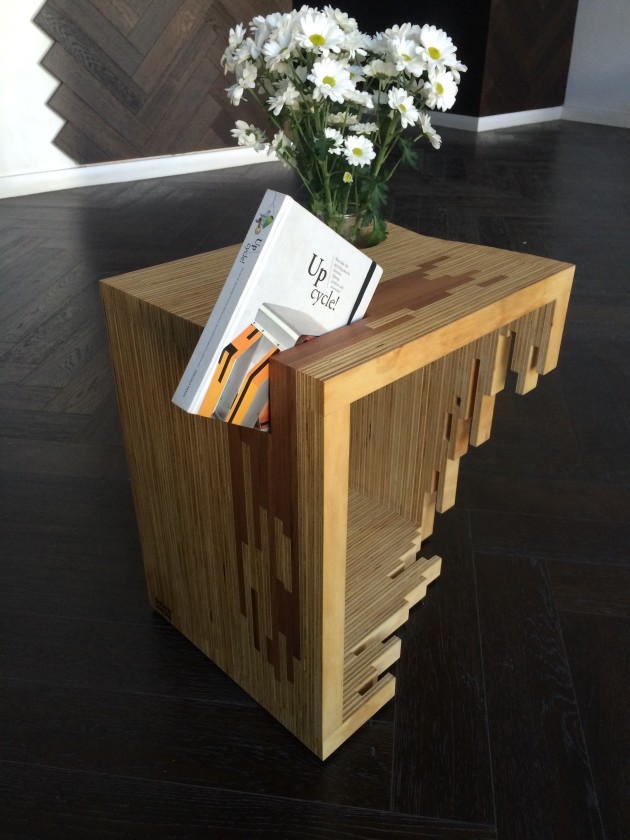
The Parasite side table, made of plywood plays with notions of balance and solid construction. Photo: Bryan Cush
Just as furniture should provide function in a modern context it can also tell stories about the interests, attitudes and influences of the maker and also the person it is made for. Bryan’s star map tables reflect his own interest in astronomy, however clients can commission CNC mapped inlaid brass ‘constellations’ that pinpoint memorable moments in their own lives.
Collaborations with Gurindji artist Sarrita King have produced two tables that combine Bryan’s interest in astronomy with Sarrita’s cultural heritage. Both their Ancestors coffee table and My Country’s Story dining table reference of Indigenous dreamtime stories with inlaid brass ‘dot-paintings’.
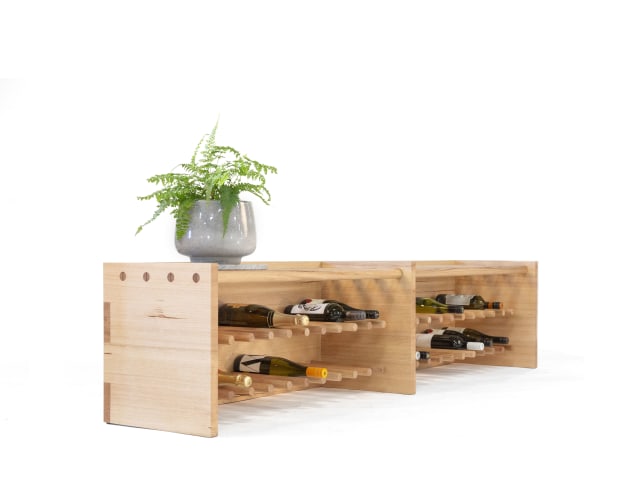
Bryan’s Vino bench is ‘a matrix of cantilevered dowels’ which serve to store wine. Photo: Northside Studio
Even more local is a recent commission that incorporates a World War II shell casing that now holds up the customised end of one of Bryan’s signature Pinch Benches, a tribute to local history made for a client. And there are other influences that manifest as stories told in his designs. A commission for a celebrity chef involved reusing ironbark cladding from a fitout to be replaced. Getting to know Shane Delia, Bryan developed his minimal brief to incorporate ‘a little bit of bling’ which took the form of a Morse code inlay in the resulting Dot Dot Dash dining table he made.
A bespoke maker needs to be a bit of a psychologist at times to give a client what they want Bryan intimated. ‘Rather than telling clients how they ought to live, a really good maker understands how a client lives and how to make it better.’

The Pinch Boom bench features a World War II shell casing, as a tribute to local history. Photo: Northside Studio
Q&A
What and who has been the biggest influence on your work?
Probably my grandfather, having seen him go from architecture into furniture. He built his own house and then a workshop. That’s still very nostalgic to me – when I come into my workshop in the morning, it smells like his workshop. And there are others like Hamish Hill. He’s the kind of person I learn best from; the person that answers a question with a question rather than just showing you how to do something.
Whose work do you admire?
I kind of struggle with favourites. I like chefs – the fact they have access to a fixed range of ingredients but it’s the way you bring them together that requires creativity. Anyone can go to a timberyard and buy the same timber, anyone can own the same tools but it requires a different way of thinking.
Where do you get your ideas from?
I try not to look at (the work of) too many other makers. I sketch a lot. I probably have about 20 pieces in my sketch book that will never be made. There might be ideas that get incorporated into other pieces.
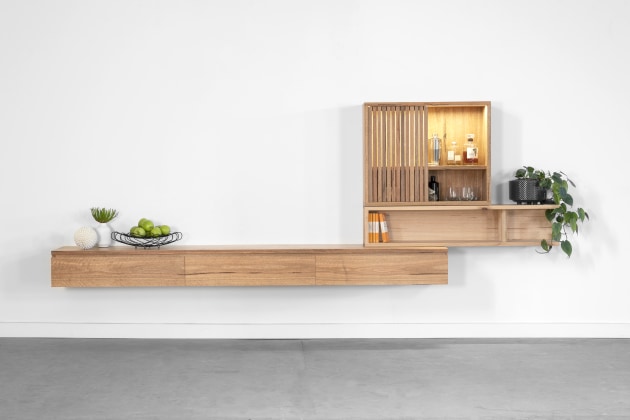
Tetromino cabinet in spotted gum and eucalypt functions as shelving, media or whiskey cabinet. Photo: Northside Studio
Favourite tool?
A tablesaw – the amount of stuff you can do on it, the accurate and diverse joinery you can cut perfectly straight off the tool.
Favourite wood?
Spotted gum because everyone hates it and complains about it being oily and how it delaminates. I think it’s just about understanding the material, and it does take a long time to work with a timber like spotted gum.
What do you dislike most about this work?
It’s something that I dislike but perversely enjoy at the same time – the toll it takes on your body and your hands. There’s not too many jobs that can make you feel exhausted but with a such a sense of relief and reward at the end. You deliver a piece and you see the reaction of the client.
What do you think woodworkers should do better?
Interact with designers and creatives outside the world of furniture – ceramicists, painters, artists, chefs. If you lock yourself away in a very woody world your furniture is going to look very woody.
Your best advice to others who want to make a career in woodwork?
Learn from as many other makers as possible, which is not what I did. Go and work with someone else, do an internship. See different ways of doing tasks and then come up with your own. You’ll also learn about the pace you should be working at and the safety aspects. Learn from other people and try to not copy other people’s work.
Bryan Cush's Sawdust Bureau studio is now located near Ballarat in Victoria. Learn more at @sawdust bureau and www.sawdustbureau.com