

Susan Wraight: Through the Looking Glass
Words: Susan Wraight
First published in Australian Wood Review magazine, issue 2, 1993.

Susan Wraight, 1993
Lying immobile on the heat sodden tarmac, the snake certainly looked dead. I approached it cautiously, however. This was only my first week in Australia, but I’d heard all about the venomous fauna that populated the country and had no desire to return to England two months early in the refrigerated compartment of a cargo plane.
Gingerly, I prodded the dusty body with a stick. Nothing. As I looked more closely I aw the crushed area near the tail. The snake, a copperhead, had been run over recently. I enthused about the beauty of the frosted amber eyes, the sleekly overlapping scales, the contours of the finely overlapping scales, the contours of the finely modelled head. ‘I suppose,’ said Ray wearily, ‘that you want to take it home?’
Ten minutes later we were on our way again, driving through the searing Australian summer, our picnic meal – ousted from the car fridge – warming rapidly in the trunk.

Susan Wraight, Hatching snake
In its place, my prized snake lay cool and quiet on its bed of ice. Later as we ate our flaccid sandwiches and sipped tepid wine, I beamed happily at the long suffering couple sitting opposite, who were regarding me with a mixture of horror and resignation. Fortunately, they were unaware as was I bracket that one day I would marry their son. I was going to like Australia.
The natural world has been a constant source of fascination for me ever since childhood when I would draw and study any hapless creature that came within my grasp. I combined my love of anything that swam crawled hopped ran or flew with a ceaseless urge to make things. This childhood pattern continued into adult life. I attended art school in Brighton, attained a first class honours degree in three dimensional design; applied successfully to the Royal College of art in London and earned my Master’s degree in jewellery and silversmithing.

Feathertail Glider (1991), holly, partially stained, inlaid horn eyes.
Initially, all went well. However, there came a point when I became frustrated with what I felt were restraints placed upon the discipline. My tutor patiently scrutinised my sketchbooks. ‘I think you should work figuratively,’ he said. Take three days off and go around the museums, look at figurative art and we'll see what happens. Thus I found myself wandering through the great museums and art collections in London gazing afresh at works I had only glanced at before and finally coming face to face with my first netsuke.
For a second, I wasn't sure what had startled me, and then all my concentration focused on the objects in the case before me. I drew slowly up to the glass and peered delightedly at the tiny forms that stared back so impressively – so small, but so bold. These miniatures were accessible, small, portable, designed to be handled stop although made in non-precious materials, they had a precious quality and there was great skill in the making and marvellous attention to detail.
But there was more, much more. These tiny works were redolent with meaning; they were intimate and engaging, yet powerful. I'd found it! The masters who created them had met the functional requirements of each piece without compromising their integrity as works of art.
This was what I wanted to do. In these small sculptures I could tie together the loose threads that flapped so disconcertingly in the corners of my mind. I rushed back to college, full of excitement, energy, and purpose.

Crayfish (1983), holly, stained
At first I was unaware that netsuke carving was still alive as an art form. After the briefest of contacts with a few netsuke experts who were solely concerned with antiques, I wondered if my desire to make netsuke was an anachronism, or even cultural piracy, although I was determined not to imitate Japanese style or pilfer an ichnography that was not my own. I wanted my work to be essentially Western to offer more than homage, to contribute to the art form, not just copy it.
I was not finally released from my apprehensions that this might seem arrogant, or, to the Japanese, even offensive, until friends encouraged me to attend the 1987 Netsuke Kenkyukai convention in Miami. There I met and was welcomed by other carvers, both Japanese and Western.

Susan Wraight, Sunbaker, 1998, European boxwood stained, inlaid amber eyes
This is a wonderful time to be a netsukeshi. Netsuke carving is now also irrevocably international. Indeed, the striking differences between Western and Japanese netsuke is one of the most fascinating aspects of contemporary work. At the carver’s meeting in San Francisco, I was struck by the relationship between the type of training each netsukeshi has experienced and the objects they produce.
With no masters to whom they can be apprenticed, Western carvers must find their own way forward. I trained as a jeweller; others have been graphic artists, ceramicists, or sculptors before becoming netsukeshi. In Japan, by contrast, despite the dwindling number of teachers, apprenticeship is still the dominant model. The best Japanese work shows the strength of tradition, discipline, and refinement. The best Western work is lively and inventive, almost anarchic in expression of ideas, reflecting a distinctively western individuality. The two are not a variance, but mutually stimulating.
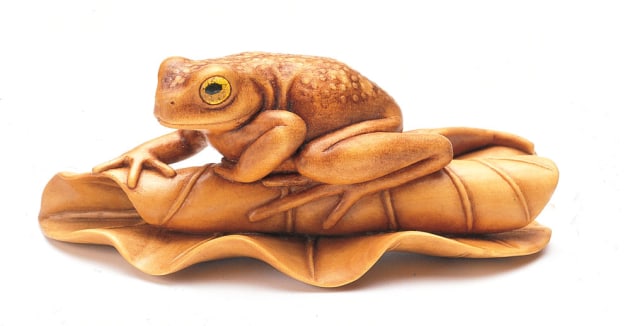
Susan Wraight, Spring: Frog on a taro leaf, 1998, boxwood, amber eyes
Carving netsuke is a voyage of exploration for me. As I travel, I learn more about myself and the world around me. I love the challenge of producing objects that are satisfying as works of art and yet would fulfill their function if worn. (Would that more of us did wear them.) There is a pleasing tension in such a balance.
I enjoy the exercise of skill, although I resist using technique for its own sake, believing this to be a form of conceit which can render a piece sterile. I strive to respect my materials and draw out the qualities they possess, but select them to suit my own purpose and impose my designs upon them.

Gibbons (1993), boxwood stained, inlaid horn eyes.
Although my netsuke are invariably figurative, depicting the natural world, I don’t want to imitate nature – I want to comment on it. Hence, I may distort some features of the subject and ignore others completely, add, change and select. In the Hatching snake I was drawn to the paradox of something as potentially malevolent as a snake emerging from something as innocent as an egg.
Inspiration from my carvings comes from a variety of sources. Most frequently, the work is a joyful response to the beauty of the natural world, although not everyone would agree with me in finding beauty in such creatures as an octopus, a bat, a snake, or a snail. I often deliberately select an animal that many would find repellent in an attempt to show something I believe to be also beautiful. Such creatures can make powerful netsuke, since they are not viewed through a haze of sentimental associations as can happen with the more appealing fauna.
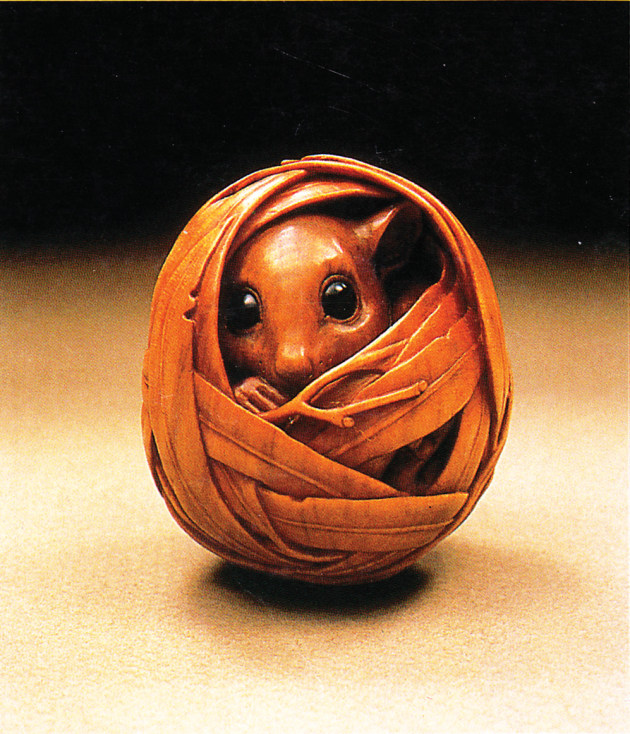
Possum nest (1992), boxwood, inlaid horn eyes
Form is paramount, and I spend a significant amount of time before I begin to carve, making models to ensure proper form. In the early days I was anxious to acquire technical skills, realising that each new technique helped me to be more fluent in the expression of my ideas. However, I soon learned that no amount of carefully wrought detail could obscure a badly conceived form or compensate for clumsy design. I use detail to create movement and rhythm, to generate subtle shifts in emphasis as the eye is drawn around the netsuke. Detail also assists in creating that most important feature – texture. After all, a good netsuke is as much a tactile as visual, however I don't want workmanship to confuse or distract. I want people to see what I am saying and not how I have said it.
This metaphor of speaking through a work of visual art brings me to what is, for me, one of the greatest charms of netsuke – the way in which they engage the onlooker gently and intimately. I take pleasure in large sculptures, often relishing the exuberance of such work and its confrontational nature. However, sometimes it can seem overly insistent, bawling out the message. Netsuke don’t shout – they whisper. The art of netsuke lives indeed, drawing strength from its roots and unfurling new leaves daily. After 12 years I am still enthralled by netsuke.

Turned Huon pine box by Vic Wood with carving by Susan Wraight. Image courtesy Linda Nathan
This article was first published in Australian Wood Review magazine, issue 2, 1993.
Read another article titled ‘Carving Netsuke’ by Susan Wraight, written for Australian Wood Review, issue 20, September 1998. Aside from the Huon box photo, the images shown here were originally supplied by Susan Wraight for publication in the articles referenced.