

Trees Grown on Trees: Japanese daisugi forestry

Above: The oldest daisugi tree in the region resides in the temple garden is over 400 years old, and still producing shoots.
Words and photos: Joakim Rådström
No country combines technology with tradition, or beauty with function, like Japan. A telling example is the cedar industry in the Kitayama region north of Kyoto. Go there in the spring, and you’ll notice how the warmer Japanese May climate gradually gives way to the cooler weather of the mountains, to rain showers and wonderfully fragrant coniferous forests.
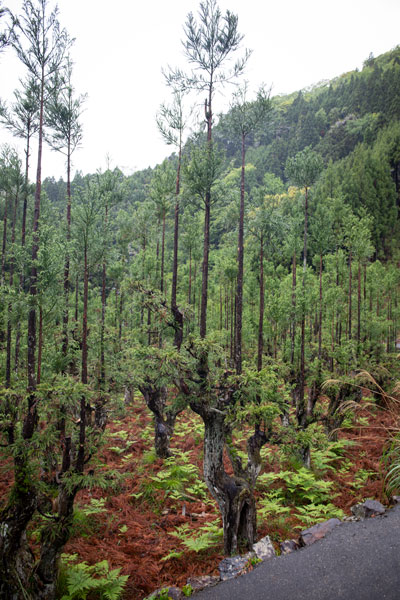
Plantation view of daisugi trees where shoots are cultivated on a host ‘mother’ tree.
Maruta tree production
Since ancient times, so-called maruta (see glossary below) logs of cedar have been produced here, specially designed for use in traditional buildings, tea houses and unmistakable tokonoma walls. A process that requires decades of care, but results in logs with an extremely smooth, straight and knot-free surface.
‘The tradition has existed for 600 years’, says Hiroshi Sumiyama at the small-scale Kitayama Maruta timber mill I recently visited. Production begins with the selection of the right ‘mother tree’, which must be straight and relatively free of knots. When it is five or six years old, foresters cut the best branches a little way down from the top and plant the cuttings in the ground.
After three years, the emerging young trees are tied with soft rope to further promote straight and smooth trunks, and help the young plants withstand winds and heavy snow. When they have reached six to seven years of age, the trees are then pruned for the first time, and outgrowing shoots are removed close to the trunk.
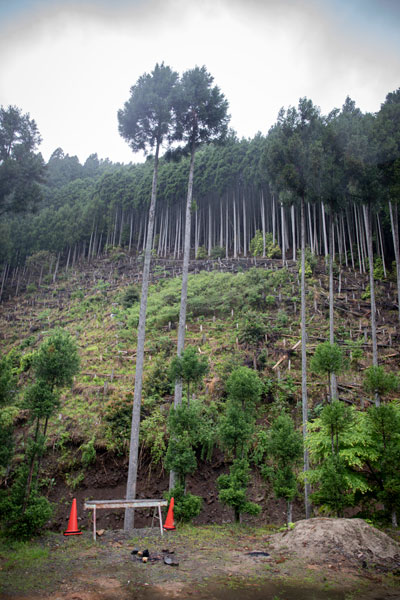
Grown from cuttings, maruta logs are felled and transported with the utmost care. After debarking, the boles are polished with fine sand.
Daisugi trees
Parallel to the maruta production is another tradition: daisugi. Here, a native tree is used as a base for thin, straight shoots that are gradually thinned and pruned into thinner logs for use as battens, among other things.
The daisugi host tree thereby creates a natural ‘platform’ for the shoots to grow from, effectively providing more growing surface for more trees in an area otherwise characterised by steep mountain slopes with small cultivation areas.
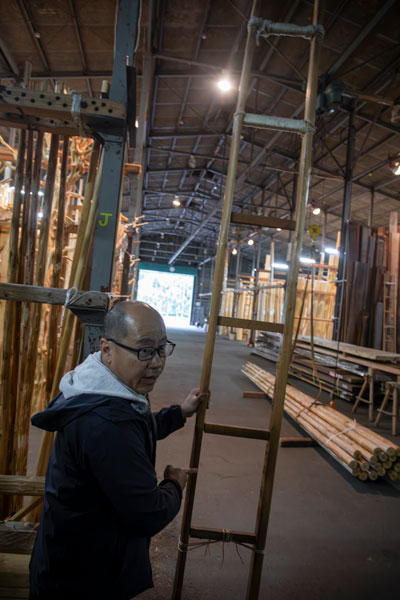
The tall ladders used when pruning are made in-house. With flex, they allow foresters to move ‘in harmony with the trees’. Standard maruta logs sell for up to A$900 each.
Daisugi is also extremely sustainable. As a single host tree can produce many straight tree trunks in the hundreds, the need for large-scale felling is reduced, local ecosystems are maintained and the risk of soil erosion is significantly reduced.
We pass a large daisugi plantation in the area. The trees have an almost otherworldly appearance. Further away we arrive at an old Buddhist monastery. In the temple garden, Hiroshi Sumiyama points out the oldest daisugi tree in the area – over 400 years old, and still producing shoots.

Carpenter Takehiro Morishita trims an already felled cedar. Cuttings can be taken from trees that are five to six years old.
Crafting trees…and ladders
Daisugi trees do not grow very tall, unlike maruta trees. To care for the older maruta plants, physical aids such as specially built ladders are therefore required. ‘They have to be able to do that’, says Hiroshi Sumiyama, showing how the sides of the ladder can move, unlike more rigid metal ladders.
This allows the foresters to naturally move with the tree as it bends while they prune the trunks. The ladders are also adapted to the user’s foot width and stride – all in all, a craft as much as the forestry and carpentry work itself. ‘At first I was scared’, admits arborist Yoshia Matsumoto, who climbs the swaying ladders every season to prune the carefully tended, growing maruta trees.
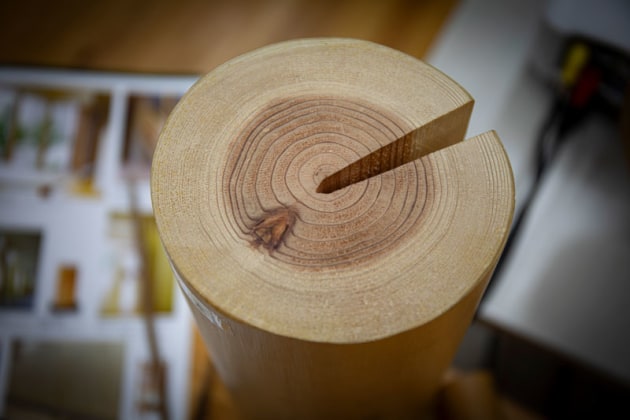
Repeated pruning slows down growth rates, creating tighter annual rings and stronger wood with greater bending strength than comparable products.
Pruning is repeated every three or four years. This also slows down the growth rate, creating tighter annual rings and stronger wood. Research at Kyoto University shows that maruta wood had 1.8 times greater bending strength than comparable products.
With due care
After 20–40 years, the trees are felled – with utmost precision and at an angle adjacent to the mountainside, to prevent damage to the precious wood. The bark is peeled off with a knife or by high-pressure water and the logs are then left to dry, stacked against other trees. This gives a weather-resistant surface and a nice sheen, and prevents cracking.
The logs are then transported down the mountain using light off-road vehicles, self-constructed monorails or even helicopters – all out of care for the delicate wood.
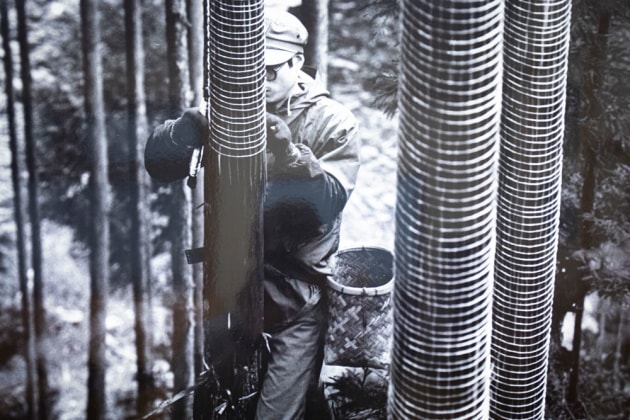
A photo of a photo displayed at the Kitayama Maruta mill depicts the labour intensive process of striation to create patterned shibori logs.
Surface treatments
Finally, the logs are planed and polished with a special sand taken from the local waterfall. Legend has it that it was a Buddhist monk who tipped off the villagers in the area about the coveted sand after he had been given food and shelter in the village.
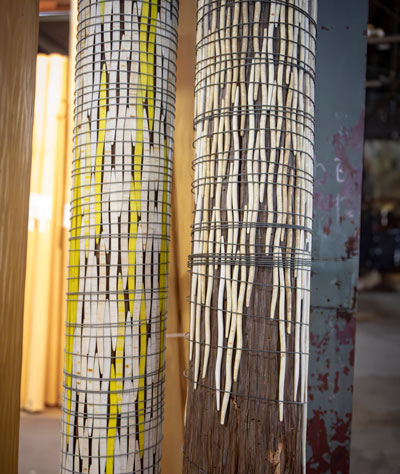
Hundreds of small sticks are tightly wrapped around the trunk in the striation process.
The result is perfectly smooth and straight logs. However, there are even more exclusive varieties, known as shibori, or naturally knotty logs, which can sell for ten times as much as the normal variety.
However, such naturally occurring logs are extremely rare, so to imitate the desirable patterned surfaces of shibori logs, the trunks can be ‘wrapped’ up with special sticks a few years before they are to be felled. The technique, known as striation, involves arborists tying hundreds of small sticks tightly around the trunk. Previously, special wooden sticks were used, while plastic models are common today.
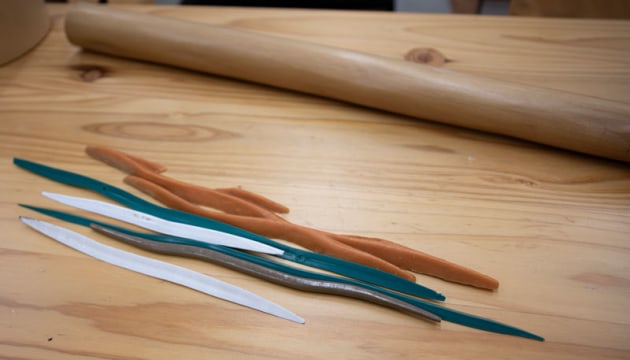
Plastic sticks are commonly used now instead of the traditionally wooden ones.
‘Even experienced craftsmen can only tie up five or six trees in a day. The trees are tied up and then monitored for two to three years’, says Hiroshi Sumiyama. When the sticks are removed, a pattern almost identical to naturally patterned logs is visible – and demand is high.
Where standard logs sell for up to A$900 each, artificially patterned logs can go for well over A$5,000 – and the naturally patterned variants for more than A$10,000. Even then, the logs are usually only a modest three metres long, to suit Japanese homes, whose room height is usually 2.7 metres. ‘The longest logs we have delivered were 12 metres, and that was to an imperial palace’, says Hiroshi Sumiyama.
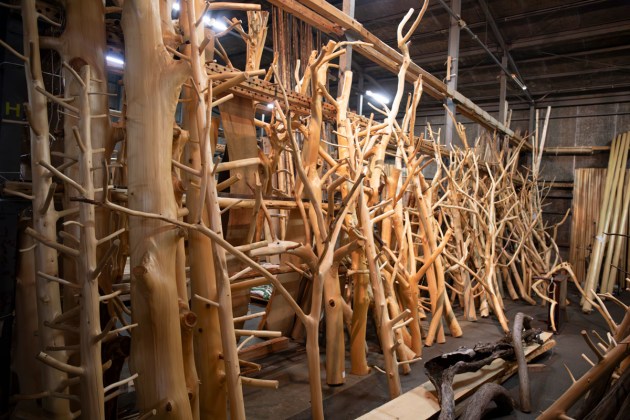
Processed and polished, maruta and shibori logs for sale at the Kitayama Maruta mill. Meticulously cared for, the resulting logs are extremely straight, strong and knotless.
The logs are sold to expert buyers at special auctions. Some buyers specifically ask for logs from certain growing areas that have been maintained by selected foresters, or that have been striated with a particularly large number of sticks. Experienced craftspeople, fine soil and many sticks can drive up prices considerably. ‘The technology must continue to exist in the future. But recently, demand has decreased’, says Yoshia Matsumoto, a fifth-generation maruta worker.
In addition to arborists, there is also a shortage of talented carpenters, as it takes a lot of experience to master maruta carpentry. The logs are used as beams for tea houses, among other things, and need to be supported by support pillars with perfectly bowl-shaped recesses for the maruta logs to rest on – a skilled craft that leaves little room for error.
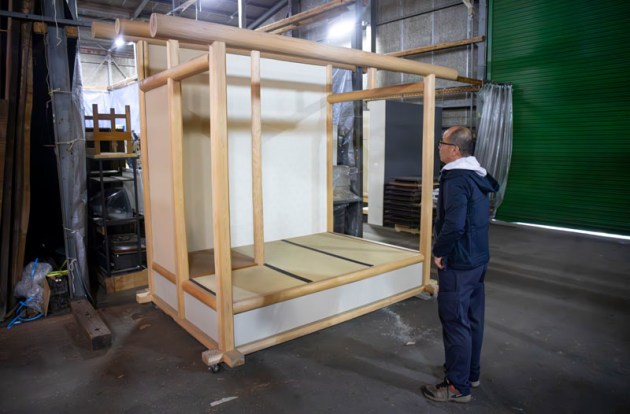
Hiroshi Sumiyama views the construction of a tokonoma, an area of a traditional tea house set aside for display of art and ikebana.
The impressive craftsmanship is put on display in Takehiro Morishita’s carpentry shop along the Kitayama highway. Morishita is now 68 years old, and started preparing maruta 50 years ago. He still works in his well-equipped studio, complete with equipment for debarking using high-pressure water and trestles and sharp knives for precise delimbing of cedar logs. ‘If you leave small protrusions, new buds will sprout’, warns Hiroshi Sumiyama. Not that there is any risk in Takehiro Morishita’s experienced hands.
To support the sector and inspire more people to apply for the profession, the government is funding forestry schools. The question is, however, how long will that last? ‘You get to introduce us to rich people abroad!’, says Hiroshi Sumiyama, laughing.
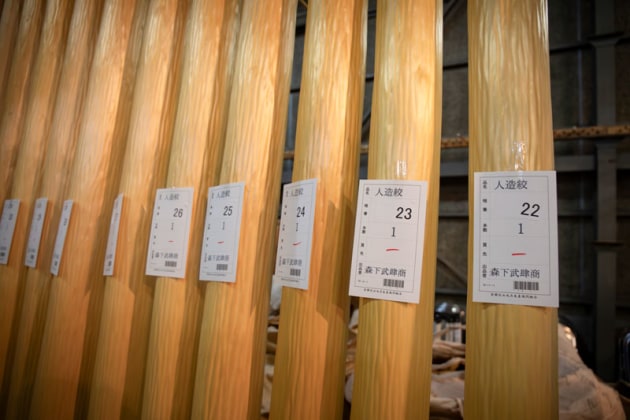
Stripped cedar maruta tree tops are processed and sold for interior decoration.
Kitayama Maruta is trying to export to exclusive clientele overseas but has encountered scrutiny over regulatory frameworks in for instance Europe. These require heat treatment of the logs to ensure that pests and their eggs are completely killed before the products can be released onto the market. ‘But if we do that, cracks will form’, says Hiroshi Sumiyama. ‘The EU doesn’t understand – or they don’t trust us.’
Perhaps Japan’s maruta artists will also arouse the interest of future generations, and find new markets. Alternatively, a 600-year-old tradition risks going to the grave with its practitioners.
Glossary
Maruta: Meaning ‘log’ in English, especially with the bark removed. In international contexts, however, it is often used when referring specifically to traditionally produced Japanese, round wooden logs.
Daisugi: Special technique for pruning cedar (sugi) where tall, straight trunks are grown from selected shoots of an older mother tree. The name translates to ‘platform cedar’, referring to the appearance of the underlying, compact parent trees.
Tokonoma: An alcove in Japanese houses, where small art objects are often displayed.
Shibori: A verb that means ‘to twist, press, squeeze’, and which in the case of maruta logs refers to logs with a striated – that is, beautifully patterned – surface. The result is logs that are sold at many times higher prices than the usual, smooth variety.
First published in Australian Wood Review, issue 128, September 2025
Joakim Rådström is a freelance journalist based in Sweden who specialises in writing on sustainability, building and construction, and architecture – especially in wood. Learn more at www.joakimradstrom.com