Zac Cassinger: Solving the mysteries of puzzle boxes

We don’t have to go back all that far to know where US maker Zac Cassinger’s puzzle box building skills and passion came from – the main reason being his extreme youth! He started making puzzle boxes when he was 16 and is now 18 years old. However for Zac, woodworking goes back a lot further – as you will see in the interview below.

The Rolls Royce Puzzle Box by Zac Cassinger, entered in Maker of the Year, presented by Hare & Forbes. It takes 55 moves to solve the opening sequence which requires 10 drawers to unlock.
Zac, when and how did your whole puzzle box interest begin?
It started about three years ago when I was watching YouTube and saw puzzle YouTuber and magician Chris Ramsay showcase an incredible puzzle desk being made by world renowned mechanical furniture craftsman Craig Thibodeau. I had seen other puzzle boxes Craig had made for Chris before, but this desk was on another level. In that video Craig mentioned his book, The Craft of Veneering, and how it’s a guide from beginner to expert. I thought, if I ever want to make something like Craig makes, that’s where I should start. So I bought his book.
About a year later, while watching Chris Ramsay solve the spinning puzzle box also made by Craig, I decided I wanted to try and make a puzzle box of my own. I loved the spinning puzzle box so much I decided to use it as my inspiration. Now before this, I had made many Lego puzzle boxes as a young kid, and very complex ones, but I had never made a puzzle box out of wood, so I started with a plywood prototype. In about five days, using only scraps of plywood and poplar, plus old bolts, fridge magnets, copper plumbing pipe, and springs from a ballpoint pen, I built my first puzzle box. It was rough and not fine woodworking by any means, but it worked. That was enough to motivate me to build a real version out of quality woods and veneers – something worthy of saying it was inspired by Craig Thibodeau.

Detail of Zac Cassinger’s Rolls Royce Puzzle Box with the final drawer made resting on top – a wenge box with maple inlaid dovetails and a sliding tile puzzle lid on top.
How much woodworking had you already done?
I had done a lot of woodworking for my age. I help make complete kitchens with my dad and siblings in our family cabinet shop, I had also made things like 3D geometric cutting boards, gun cabinets, and many other small projects.
I was pretty skilled at production work – face frames, doors, and made hundreds of dovetailed drawer boxes cut on a router jig. But that’s very different from a puzzle box. With kitchens, everything is repetitive and already planned on how to make it. With the puzzle box, I had to learn about veneering, wood movement, CAD design, and mechanisms all as I went.

Base layout for The Rolls Royce Puzzle Box
Where did you learn your skills?
Most of my skills came from my dad. I’ve been helping in the shop since I was younger than 10 years old, but I really started learning the trade around 13. He’s taught me everything he knows about making cabinets, furniture, running tools, all of it.
After three years of learning at 16, I had a solid foundation of knowledge. But to make the puzzle box I had to teach myself a lot of other things. Craig Thibodeau’s book, YouTube videos, and articles on veneering and fine joinery all helped me get there.
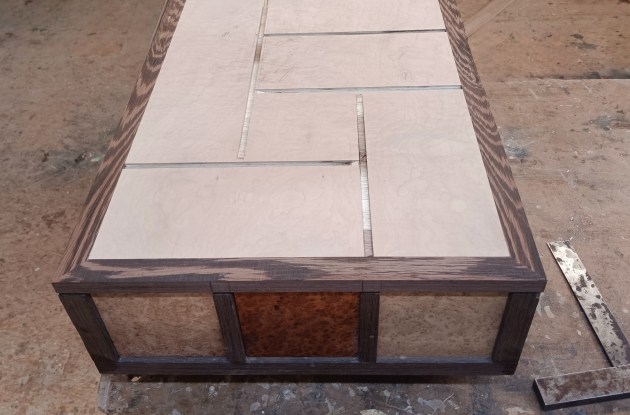
Base and sides coming together
How did you design the operations and their sequence? Are you using digital or manual design tools?
Most of it started in my head. Then I designed everything in Fusion 360 – which I also taught myself how to use. I modelled everything down to the smallest springs and magnets. Some parts still had to be drawn on paper, and a lot of it stayed in my head until I built it.
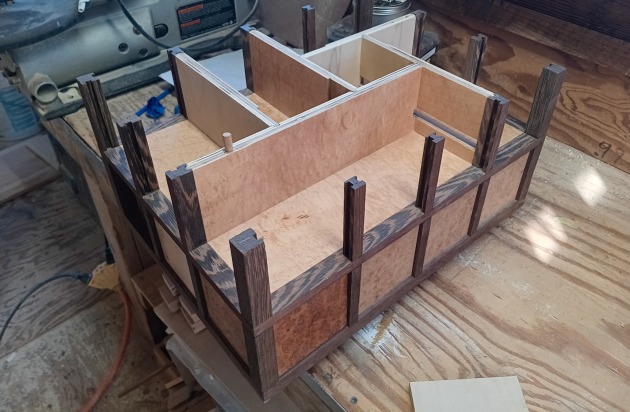
One of the boxes has a maze in its base. How did you figure this out?
The final drawer pops out to reveal a stunning wenge drawer with maple inlaid dovetails. The lid has a sliding tile puzzle. I designed the lid on paper first, drawing each tile and testing how I wanted it to move until I landed on a sequence I liked. It ended up being a 40-move maze before the lid can open. The last tile has a latch on it that locks the lid, and it can’t move until the full sequence is solved. The lid is hinged open on a wooden hinge that makes it nearly impossible to tell it’s a hinge until the lid is opened. I got this idea from the Canadian woodworker Rob Cosman.
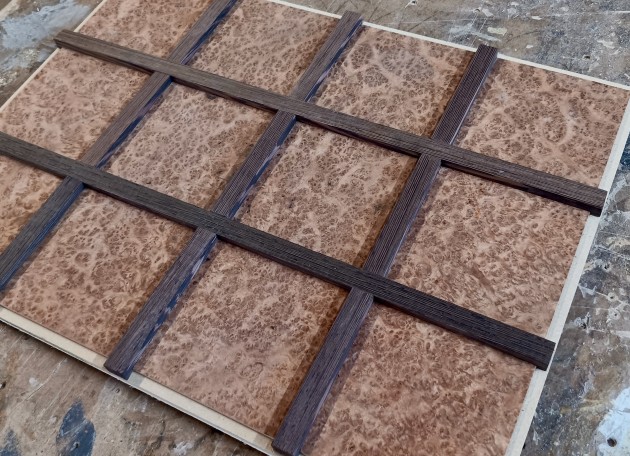
Top panel for The Rolls Royce Puzzle Box
What materials have you used?
The frame is wenge, and the exterior panels are veneered in amboyna burl. The interior is veneered in quilted maple, and all the drawers are birdseye maple except for the final drawer, which is also wenge.

The underside of The Rolls Royce Puzzle Box
How long did it take to make the box?
It took approximately 250 hours over six months, mostly working on weekends. Just the wenge drawer alone took over 25 hours.
You say you are home schooled? What other subjects do you do and what’s your main focus after secondary school?
Yes, I’m homeschooled. My main focus has been learning the woodworking trade and helping run our family business. I also enjoy math and economics. I’m fascinated by ancient history – from Plato to Leonardo da Vinci – and I read a lot of classical philosophy from Plato and Aristotle. I plan to continue learning in all these areas, but my main goal is still to become the best woodworker I can be, and one day be considered a world class craftsman.
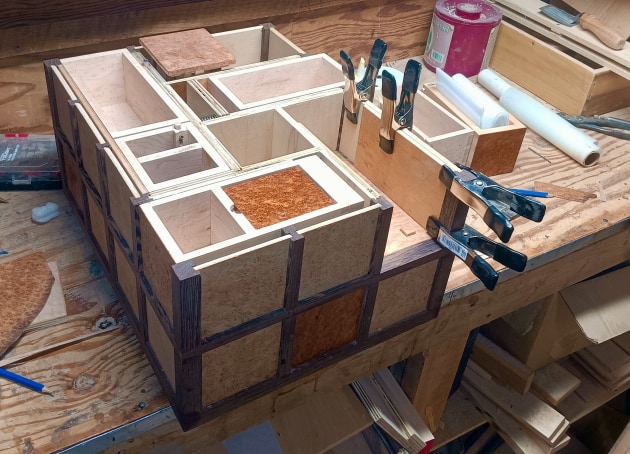
Internal view of The Rolls Royce Puzzle Box
What jigs did you use for the joinery?
I made several jigs throughout the build, and most were only used for one task. The most used was a homemade tablesaw sled for accurate crosscuts and for cutting joints and grooves. I also built a special jig for the sliding tile lid. Every tile needed a 1/8" tongue and groove on each side, the jig helps hold all the tiles together while I cut them, so that jig was essential.
What's your workshop like? How did you process the wood and cut the joinery?
Ours is a medium-sized shop set up mostly for custom kitchen cabinets. The main tools I used were the tablesaw and chop saw. The drum sander was huge for getting parts flat and clean after ripping on the tablesaw. I also used a mortise machine and an orbital sander, along with many other tools.
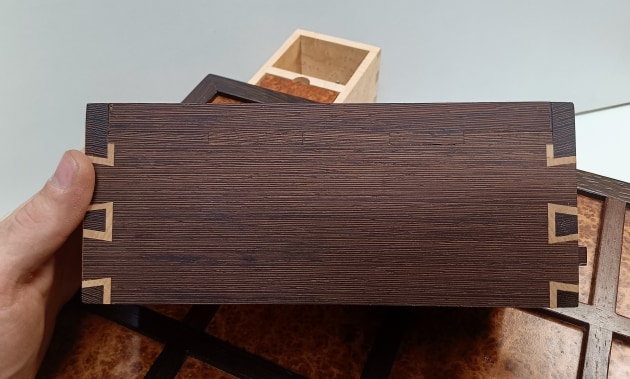
The final drawer made for the box is wenge with inlaid maple dovetails and has a concealed hinge.
What’s the best thing about woodworking in your opinion?
For me, it’s the ability to take just a tree and an idea, and turn it into something people can use and admire for generations. And being able to make a living for my family is very important as well.
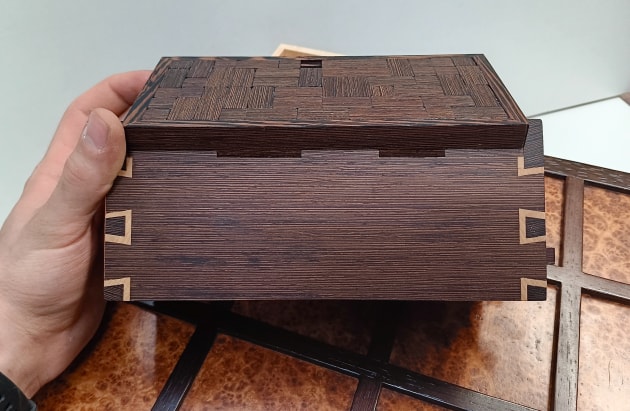
The lid of the wenge drawer opens when the sliding puzzle maze on top is solved.
What are you going to you make next? Will there be more puzzle boxes in the future by Zac Cassinger?
I’m working on several projects right now. One is a new puzzle box – I’m planning to have a small batch ready to sell by early 2027. My biggest and most priority project is a large mechanical puzzle cabinet called The Da Vinci Cabinet. It’s inspired by Leonardo da Vinci and the popular puzzle game, The House of Da Vinci. It will have close to 30 hidden drawers, an automatic mechanical side-lift powered by spring motors, and several puzzles based on da Vinci’s work.
See more of Zac Cassinger’s work on his Instagram page
Entries for Maker of the Year, presented by Hare & Forbes, close 30 August 2026. Find out more and enter here: www.makeroftheyear.com.au