

Vivienne Wong: Dancing With Woods

Above: Vivienne Wong in her workspace at Worco Crafts Co-operative in Thomastown, Melbourne.
First published in Australian Wood Review, issue 111, June 2021.
Photos: Northside Studio
Fourteen years with the Australian Ballet might seem an unlikely training ground for a fine woodworker, and yet, creating furniture for a small but growing clientele is now the daily practice routine for Vivienne Wong.
‘When I left (the ballet)’, said Vivienne, 38, ‘I knew I wanted to do something creative and physical. I’ve always liked making things and working with my hands so I did a short course in furniture making at Melbourne Polytechnic. After that finished I wanted to pursue it further but didn’t know how, so I reached out to a lot of people just to get an understanding of the industry, what was involved, and how to start to learn.’
After that, around four years ago, Vivienne enrolled in a course at Handsome & Co, and at same time was able to do work experience with maker and restorer Liam Thomas. ‘I ended up renting bench space in his workshop for a couple of years after that as well’, she said.
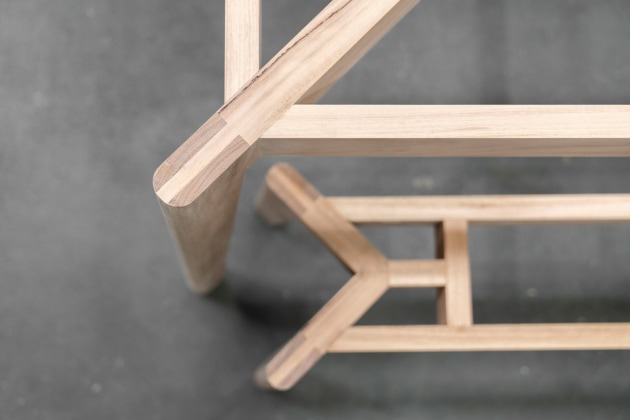
Underframe joinery in blackbutt for a 2.2m long dining table and a three-seater bench.
An internship with Brian Cush (Sawdust Bureau) followed, as did mentoring from Steven Ziguras (Eco Wood Design). ‘These three makers have really been my teachers over the last four years. Going back to uni full time wasn’t a viable option, so for me to be able to learn from these makers who are all so skilled in different ways has been wonderful.’
After the ups and downs of lockdown life in Melbourne during 2020 Vivienne is now fully set up at the Worco Crafts Co-operative in Thomastown, where Stephen Ziguras also shares space.
Training as an elite level dancer usually commences in childhood and rising up through the echelons to perform as a soloist with the Australian Ballet for seven years represents a monumental level of technical and artistic mastery. Surely woodworking would be a breeze in comparison – but are there any parallels to draw? ‘They both have their challenges, Vivienne said. ‘It’s quite funny, but in terms of live performance my biggest anxiety would be gluing up.
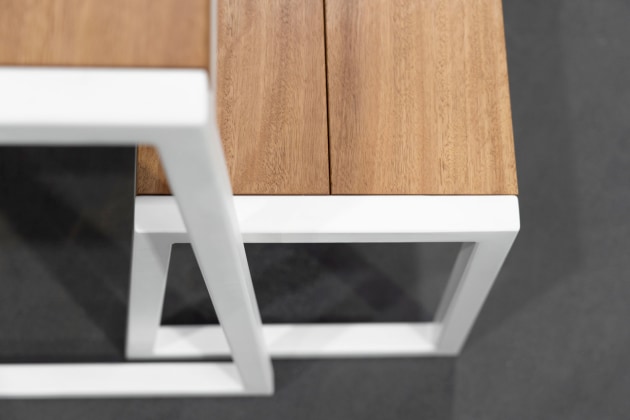
Detail of outdoor courtyard set in recycled blackbutt with powder coated steel frame.
For the woodworker that’s a different kind of dance: ‘You’ve got to be efficient in what you’re doing. You’ve got time ticking away, you can’t let anything go wrong and you’ve got to be quite methodical and well prepared. And the phone goes on silent.’
As a performance ‘partner’ wood must also be treated with respect. You have to work with it, observe what’s happening with the grain, and understand different species. ‘It’s a bit of an abstract parallel’, Vivienne said, ‘but when you work with a partner it’s always about give and take, and working with what’s in front of you. It’s like when you plane an edge and it’s about the amount of pressure put through the plane.’
Mastering the craft of dance requires well tuned powers of observation and the same applies to training in other disciplines. ‘As a dancer you’re trained to visually criticise lines and form and balance. It’s a learning process of how to adapt some of that balance in terms of visual weight and proportion into a design, but it’s something that I’m trying to transfer across into what I make, whether it’s something that’s simple and clean but has a certain amount of balance and elegance.’
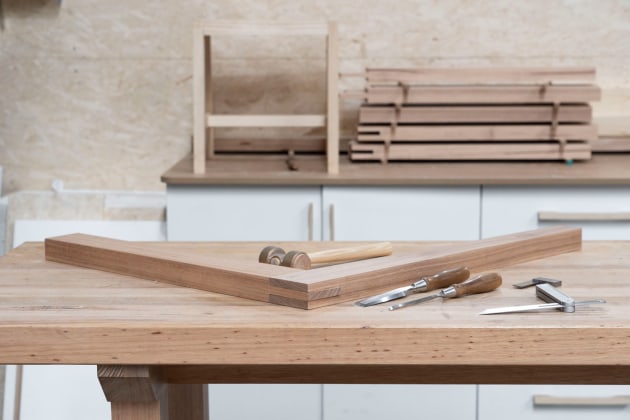
On the bench: fitting off table leg joinery
There’s also the discipline of practice. ‘Knowing that you will not necessarily get something right the first go but with repetition you’ll become more efficient – the more you do it, the more precise you’ll get. I guess transferring that sense of discipline and not being afraid to try again and keep up the practice to achieve the skill.’
What are her priorities as a designer maker? Sustainability is key, Vivienne says. ‘Ethically I’m very conscious of how much we’re conditioned to consume, of the amount of waste that’s involved with that. I’m conscious when I’m in the workshop of every cut I make and how much material I’ve got and cannot waste. I try to source materials in the most sustainable way I can. It depends what the client wants. If I know I can find that timber in the dimensions needed in a recycled timber yard I’ll go there. FSC timber as well – I think we have a responsibility as makers to give back to the environment, and the trees and mother nature, as we’re also taking from them.’
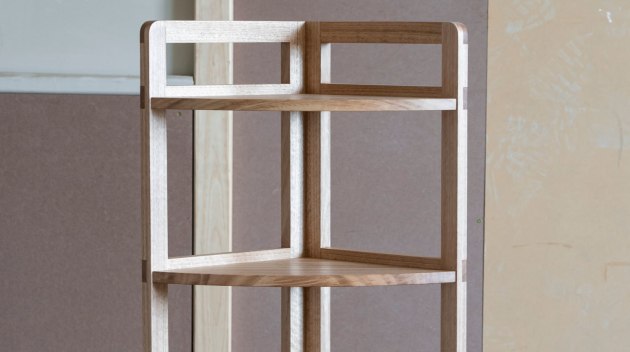
Detail view of corner shelving unit in eucalypt with half lap joinery
And what about using local woods? ‘I always try to see if clients are interested in Australian timbers. I’ve always loved eucalypt trees. I love gum vein and the features they have. They’re not always the easiest to work with for fine furniture but I enjoy working with Australian timbers.’
Making on a professional level has other realities. ‘So far my furniture has been based around what people want’, Vivienne said. ‘I really like to get an idea of what they’re after and what they might like in a piece. That’s what I enjoy most – that process of working down to a design that someone likes.’ To that end, Vivienne uses a mix of pencil, paper and digital drawing tools ‘just to get my ideas out’ and to present something to the client.
Why aren’t there more prominent women makers I asked, and how does being a woman maker sit with her peers? ‘That’s a difficult thing to answer, especially for other people, but my experience is that all the independent makers that I’ve met around here in Melbourne have been welcoming and generous with their time, and in no way fit the macho man mould. They know how tough it is to make a sustainable business out of it.’
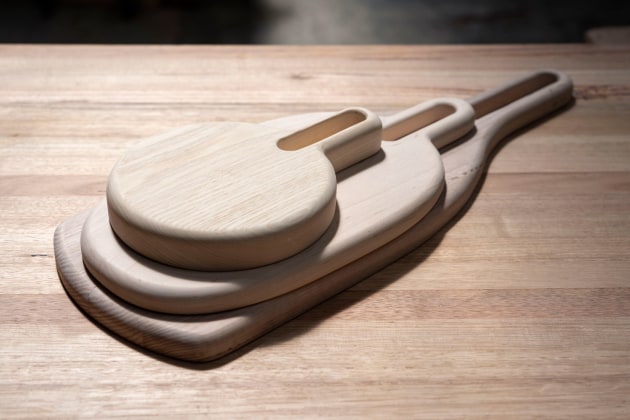
A batch of cutting boards
‘On a personal level as a female I feel I’ve got my limitations with how big a job I can take on, or physically how much I can do. But I kind of take that on board and know that maybe a process is going to take me longer. I’ll do a glue-up in a lot of stages instead of trying to muscle it and do it in one go. I feel that for myself I need to adapt and use different strategies.’
While Vivienne still relies on her income as a photographer, life as full time maker is the plan. ‘That’s what I’m aiming towards. I want to be doing this as a full time thing. I enjoy waking up every day and knowing that it’s the workshop that I’m going to. I feel like I’m developing my language and voice as a designer and maker. I’d like to give myself room to develop these things, and see where the making process goes.’
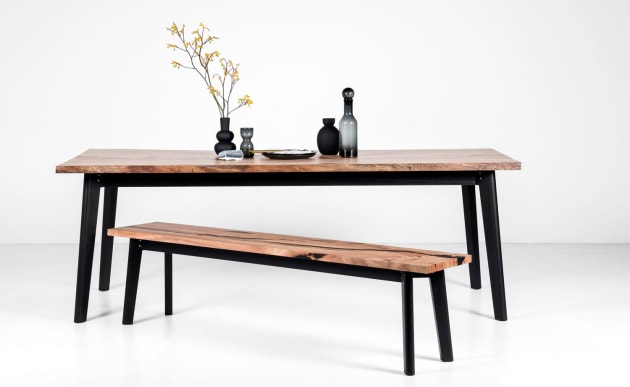
Dining table and a three-seater bench with sugar gum top and seat and brass pin detailing. The frame was ebonised with intial ‘priming’ with black tea followed by several coats vinegar and steel wool solution.
Woodworking is not generally regarded a high paying career but Vivienne’s priorities aren’t based on that: ‘I’ve always felt that if you can do something that you’re passionate about and love, and make ends meet, that makes living so much more worthwhile.’
Referring to her transition from dancer to maker Vivienne said ‘It is unusual for a person to segue across from that industry.’ However woodworkers as a group can have ‘a mixed bag of back skills’, she said. ‘I think people get to the point maybe where the enjoyment of making things takes over. I think it’s a real privilege to be able to do that.’
Learn more about Vivienne Wong at viviennewong.com.au and @vivienne_l_wong
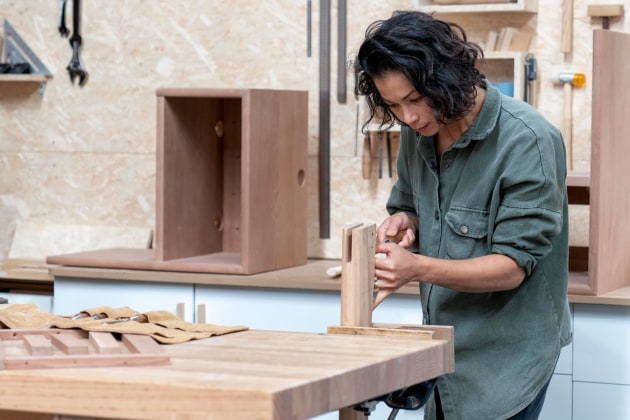
Q&A
What’s your favourite hand tool?
My Lie-Nielsen block plane is my go-to for a lot of things.
Your favourite machine?
There’s nothing quite like freshly dimensioned flat and square timber, so I really enjoy using the thicknesser and planer.
Favourite process?
Isn’t most people’s favourite process putting on that first coat of oil? To be honest, handcut joinery and finishing are the things I most enjoy doing.
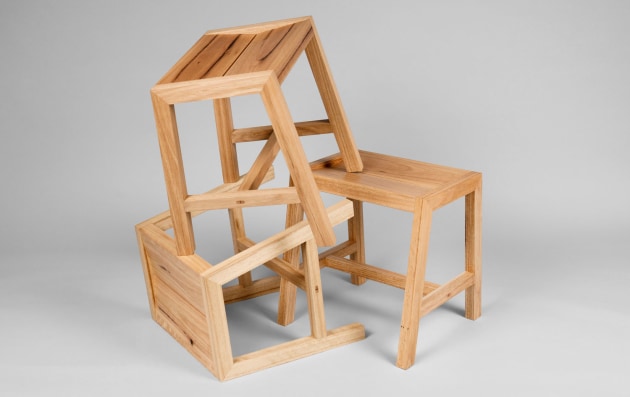
Batchwork: custom order split-seat stools in blackbutt
Is there anything about woodworking that drives you nuts?
I know from working with epoxy resin that it’s not the easiest thing to work with so I like to steer away from it.
Worst thing about woodworking?
You know I’ve ruined so much clothing by getting glue on it. It can also be pretty dusty at times.
Best?
I really enjoy getting into my own groove and being able to concentrate on a process, the timber and what you’re making.