Tyler Schrader: Back to my roots

Tyler Schrader is a US artist who now ‘paints with wood instead of a brush’. His work stems from and reflects a love of nature. He creates wall-mounted and freestanding works using the tonal variations of wood as well as colour, light, and at times sound, to tell stories that ‘invite stillness, introspection, and a renewed sense of connection in an increasingly distracted world.’
Tyler has entered his Electric Baritone Guitar in Maker of the Year, presented by Hare & Forbes. We asked him to give us some insights into the nature and scope of his work.
Tyler, where did this all begin? What’s your background as an artist?
It all began with painting. I originally went to school for drawing and painting, and for the first part of my artistic journey, that’s what I was focused on.
Around 2014, I was selling my photography at a craft fair in little wooden frames that I had made when I met John Swarthout, one of the traditional Adirondack furniture makers. I ended up working alongside him for about four years, learning the craft, harvesting materials from the forest, creating mosaic twig work, and helping with all kinds of projects. That experience completely changed my relationship with wood.

Tyler Schrader, Flight
At first, I started making more sculptural frames for my paintings, but I gradually fell in love with wood as a medium. It opened up a whole new way of creating, and my work naturally evolved toward sculpture, with the occasional piece of furniture as well.
Even though I studied drawing and painting, I spent a lot of time in the incredible woodshop at SUNY Purchase, and after graduating, I really began to develop my own style. My goal became to paint with wood instead of a brush. That’s ultimately what led to the work you see today.
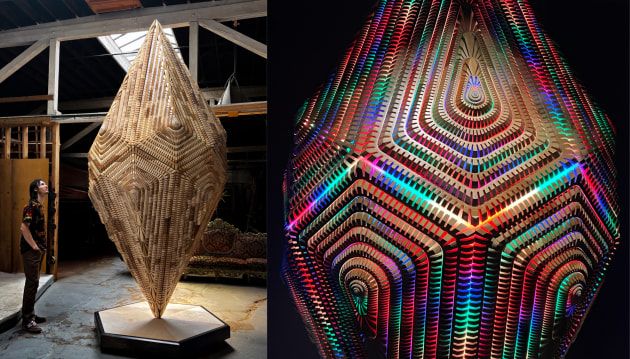
Mesmerite, an LED wooden sculpture by Tyler Schrader, 13 foot high x 6 foot wide. ’A year in the making, this has been one of the most demanding and rewarding projects I’ve ever undertaken.’
How did you develop your designs and techniques for the complex wall art and sculptural works you now produce?
My designs and techniques have really developed through years of experimentation. A big part of that has been becoming extremely skilled with the bandsaw and learning how to use wood almost like paint. I never stain my pieces, everything is created using the natural colors and tonalities of the wood itself. That idea of ‘painting with wood’ has been at the core of my process from the beginning.
My process is very intuitive at first and then becomes more intentional as the piece develops. For years, I worked almost entirely by instinct, letting each sculpture reveal itself as I went. More recently, I’ve started sketching out the design once I find the initial form, which gives me a stronger framework while still preserving that sense of discovery. It’s been an interesting evolution.
Living in the Adirondacks has been a huge influence on my work. I’m constantly inspired by the forests, lakes, and natural forms around me, and I hope my sculptures help rekindle a sense of connection with nature in an increasingly fast-paced, technology-driven world. That’s one of the reasons I love working with wood, it’s such a grounding, honest, and beautiful material.
Above all, my work has been shaped by patience, trusting the process, and pushing through the difficult moments. That’s usually where the magic happens.

Recent works reflect the artist’s interest in biophilic design and finding ways to integrate living plants directly into his work.
What’s your design process?
It really depends on the type of work I’m making. Most of my ideas are a ripple effect from the last piece, each project naturally leads to the next, so there’s always an evolution happening.
For my wall pieces, furniture, and smaller sculptural work, the process is very intuitive. I usually begin with an initial form and let the piece reveal itself over time. As it develops, the vision becomes clearer, and what starts as an intuitive process gradually becomes more intentional.
My large-scale installations are different. Those require much more planning and engineering from the beginning. For example, my most recent light sculpture was a 6 x 13-foot installation that took about a year to complete. That piece was designed almost entirely beforehand in collaboration with my brother, Brett, who helps me develop many of my larger projects in Fusion 360, and with a technology team that goes by ‘The space cadets’ who designed the LED system.
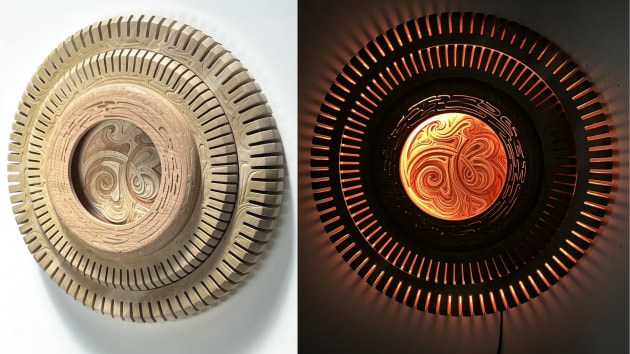
Tyler Schrader, Fusion wall sculpture
What sort of tools and machinery do you use?
The bandsaw is definitely my primary tool. I use an old Delta bandsaw with an 82-inch blade, usually running an 1/8-inch blade. It’s actually my grandfather’s, which makes it especially meaningful to me. He was also a woodworker and had a cabin deep in the Adirondacks, where he built bows and arrows by hand and made rustic furniture, mostly for his home. I feel fortunate to carry on that legacy by using some of his tools in my own work.
Beyond that, my shop includes a Laguna bandsaw, Grizzly planer and tablesaw, a lathe, a Dremel for much of my hand carving, a variety of hand tools, sanders, and a steam box that I use frequently for bent lamination and steambent elements.
One tool that isn’t hanging on the wall is music. I listen to it constantly while I’m working, and it’s a huge part of my creative process, it’s another passion of mine to discover new sounds and the workshop enables me to spend a lot of time doing that while I work. It helps me stay focused and fuels me when I find fresh music vibes to work in.

Froggy Hollow: ‘Recently I’ve been making sculptural pieces designed specifically for certain trees and locations in old-growth forests that inspire me.’
In a world with a growing digital and AI presence, where do you stand? What drives you?
AI is one of the biggest conversations happening right now, and I’ve definitely used it as a tool. I think it can be incredibly useful for brainstorming, organising ideas, and speeding up certain tasks.
At the same time, as AI becomes more capable, I’ve actually found myself leaning further away from it. We’re entering a time where it’s becoming harder to tell what’s real and what’s generated, and I think that makes authentic craftsmanship more valuable than ever.
What drives me is the human hand, the years of practice, the imperfections, the intuition, and the countless decisions that happen in the making of a piece. Those are things that can’t be replicated by an algorithm. Every sculpture carries the story of the hours spent shaping it, the mistakes, the discoveries, and the relationship between myself and the material.
I don’t see AI as something to fear, but I also don’t think it can replace genuine human expression. If anything, it’s reinforced why I do what I do. My goal has always been to create work that feels deeply human, reconnects people with nature, and reminds us that there’s still immense value in human expression.
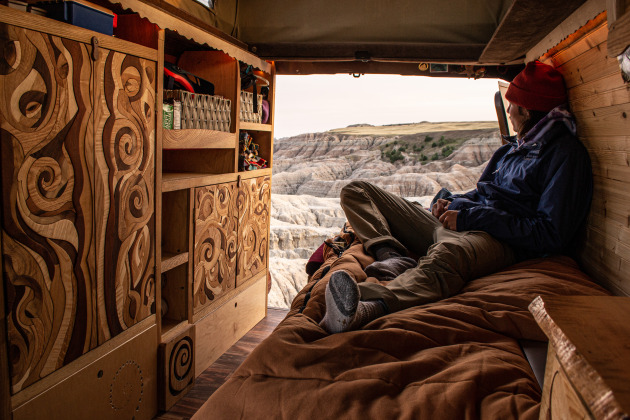
Above: Tyler Schrader in ‘Brown Betty’, a 1991 Ford Club Wagon, showing the interior he rebuilt with his own artistic touches. ‘Brown Betty was a huge part of my evolution as an artist. It was really my first big adventure out into the world on my own, and it gave me the freedom to explore, travel, and see things from a different perspective.’
Professionally how do you work? To commission? For galleries? Or do you work towards exhibitions?
At the moment, most of my work comes through commissions. Over the years, I’ve also exhibited my work through solo shows and other exhibitions, and I’m continuing to build those relationships and opportunities as my career evolves.
A big part of my practice has been creating large-scale installations for botanical gardens, music festivals, and other public spaces. Those projects have allowed me to work outside the studio, collaborate with different communities, and create immersive experiences that people can interact with.

Detail of Electric Baritone Guitar, see more images here
Can you tell us more about the guitar you entered in Maker of the Year, its design and construction, why you made it and how it sounds?
Building a guitar had been a dream of mine ever since I started woodworking after college. I’ve played guitar for years, and since so many of my friends are musicians, it felt like something I eventually had to do.
The body is made from individually hand-cut pieces that fit together. The core is mahogany, and the design builds outward from there using different species of wood. One of my biggest goals was to make the hardware feel fully integrated into the sculpture, rather than looking like it had simply been attached afterward.
It was one of the most technically challenging projects I’ve taken on. Unlike much of my sculptural work, which develops intuitively, the guitar required careful planning. Every measurement had to be precise so the instrument would not only look beautiful but also function properly.
I was fortunate to collaborate with my friend Zack of Grateful Guitars, a local maker, who built the neck and helped with the technical side of the instrument to make sure it played and sounded the way it should. It was a great collaboration, and we’re already talking about building more together. Interestingly, the guitar ended up becoming a baritone almost by accident. We miscalculated the hardware placement, but instead of starting over, we realized it landed perfectly on a baritone scale length.
The result is an instrument with a really deep, resonant, and distinctive voice. I’m incredibly happy with how it sounds, and it opened up a whole new creative direction for me that includes producing a collection of one-of-a-kind guitars that I will sell. Over the past couple of years, I’ve also been learning music production in Ableton, so building my own instruments feels like a natural extension of that journey. To me, it’s all connected, woodworking, sculpture, video, and sound are simply different ways of expressing the same creative impulse.
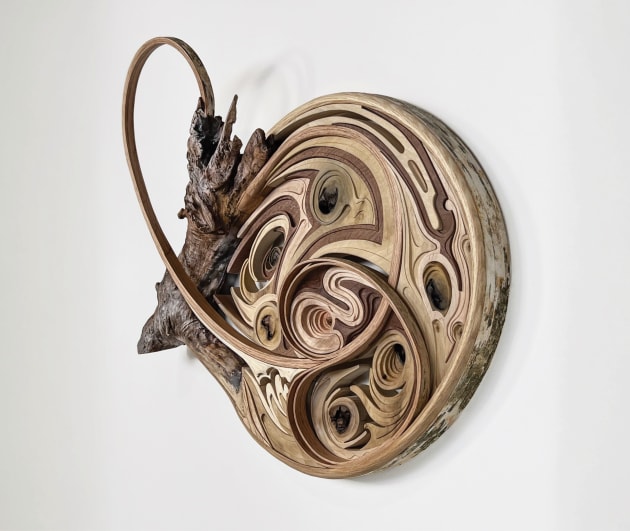
‘Back to My Roots’ underlines Tyler Schrader’s desire to create work that’s even more immersed in nature.
Do you feel your work is heading in a certain direction? What’s next for Tyler Schrader?
I definitely feel like my work is heading in a clear direction. For a long time I’ve been developing different creative skills independently, woodworking, sculpture, film making, photography, and more recently, music production. Now it feels like they’re all beginning to merge into one cohesive artistic practice, which is really exciting.
Lately I’ve also become really interested in biophilic design and finding ways to integrate living plants directly into my work. I love the idea of a sculpture continuing to evolve long after it’s finished, where nature becomes a collaborator rather than just an inspiration. It feels like a natural extension of everything I’ve been exploring, creating pieces that blur the line between sculpture, landscape, and living systems.
I’m also finding myself wanting to create work that’s even more immersed in nature. Recently I’ve been making sculptural pieces designed specifically for certain trees and locations in old-growth forests that inspire me. There’s something really special about bringing a piece back into the place that inspired it, and spending time with it before photographing it. It’s only there for a moment, like an offering, a way of honouring these incredible places that have given me so much inspiration. I kind of think of it as street art for the forest.
I’m also beginning a new body of work called Back to My Roots, which feels especially meaningful to me. I started my woodworking journey building traditional Adirondack furniture, working with bark, roots, and other materials gathered from the forest. Over the years my work became more refined and sculptural, but lately I’ve felt drawn back to those natural forms.
Learn more about Tyler Schrader at www.tylerschrader.com
Entries are open for Maker of the Year, presented by Hare & Forbes. See www.makeroftheyear.com.au