

Terry Martin: Homecoming

Above: Terry Martin (centre) chats with local visitors to his exhibition as Swan Hill Gallery, Victoria.
Words and photos: Terry Martin
As I edge toward my 80th birthday, I find myself looking back over the long grain of my life as a woodworker. The tally of my exhibitions tells one story, 115 in all since my first solo show in a small Brisbane gallery in 1990. But numbers do not measure meaning. Of all those exhibitions, the one I held this year in Swan Hill meant more than almost any other. It was not simply another show; it was a homecoming.

1. The road back to Swan Hill via the ‘vast, shimmering’ Hay Plains in New South Wales.
I spent the most formative years of my childhood in Swan Hill, on the banks of the Murray River in the Mallee region of north-west Victoria. It is a land of extremes. There are good years but there are also blazing summers, biting winters, dust storms that sweep in without warning, and long seasons of waiting for rain that may never come. The land can be harsh and unyielding, and it shapes those who grow up on it. Some of my family remain there still, rooted in the soil. The pressure to settle down and lead a quiet life was strong, but I left at sixteen, restless and curious, and for decades much of my time was spent in distant countries. But Swan Hill never quite loosened its hold.
A few years ago I returned to visit my family and was surprised to find a beautiful Regional Art Gallery beside the river. I stepped inside and saw an exhibition of Aboriginal woodwork. A seed was planted and once I was back in Brisbane I wrote to the gallery Director, Ian Tully, and asked whether he might consider hosting an exhibition of my work. His enthusiastic reply set the journey in motion.

2. Nature’s Work, driftwood, 520mm wide, 250mm high
In February 2026, my wife Yuriko and I packed 80 pieces in the back of our car and drove the 1,700 kilometres inland from Brisbane to Swan Hill. The summer heat was fierce and as we crossed the border into New South Wales, the green gave way to brown, the tree cover thinned, the horizons widened, and the roads grew rougher. Over two long days the landscape seemed to peel away the layers of my adult life. By the time we reached the vast, shimmering plains near Hay, I felt as though the intervening years had fallen from me. The country of my childhood was reassembling itself around me.

3. Uluru Bowl, redgum burl, 255mm dia
Arriving in Swan Hill, my body knew the roads before my mind did: here was the back road I rode along to school; there the old skin store where I sold rabbits I had trapped; beyond it the football ground where I played for the Swan Hill Thirds. Memories didn’t arrive in neat chronology but in flashes – dust on bare legs, the smell of the river, frost that cracked beneath my feet. We visited my sister, shared meals with my niece Narelle in restaurants that would have been unimaginable in my boyhood and laughed with my great-grand niece – the fifth generation of my family in Swan Hill. The town had changed, and so had I, but the thread between us held.

4. Total Eclipse, mango, 160mm high
I chose 50 pieces from those that I had brought with me and set the exhibition up over three days. When it opened in February, the emotion caught me by surprise. Friends had travelled from Brisbane and Melbourne, and my schoolmate and lifelong friend Colin stood beside me. My older sister Joan was surrounded by her children and extended family. For much of his life my nephew Darren has lived within the structured world of NDIS care that makes family gatherings difficult, but on that day he found himself in a rare moment of belonging. Looking out at them all, I realised that this exhibition was less about objects and more about people. I told the audience, ‘I am not going to talk about my work because it can speak for itself. For me, today is about my family, my friends and about my hometown, Swan Hill.’

5. Angie’s Tree, red mallee burl, 230mm wide
The work did speak, and it traced the arc of a journey that began long before I knew I would become a woodworker. One piece, Nature’s Work, was driftwood I found on a beach in Papua New Guinea in 1967. I didn’t shape it, the sea did: wormholes riddled it, salt and sand scoured it, the sun bleached it pale. I was still decades away from committing to wood as my life’s work, but when I lifted that fragment from the sand I glimpsed something essential: the beauty of wood as a living record of time and weather. I have kept it ever since and for this exhibition, I finally mounted it on a stand. Its journey started far from Swan Hill, but it found its meaning there.

6. Heart of the Tree, jacaranda, 410mm dia
Another pivotal work, Uluru Bowl, carried layers of memory. In 1992 I cut a redgum burl on my sister’s farm near Tooleybuc, only 47 kilometres from Swan Hill. I took it to Uluru where I was Artist-in-Residence in 1993. While I was there I met a local Pitjantjatjara woman called Tiku Uluru, who was doing traditional bark painting inside while I worked outside under shade cloth. We watched each other work and chatted quietly until she asked if she could paint one of my bowls. I asked her to choose one and she took the bowl I had just turned from the Tooleybuc wood.
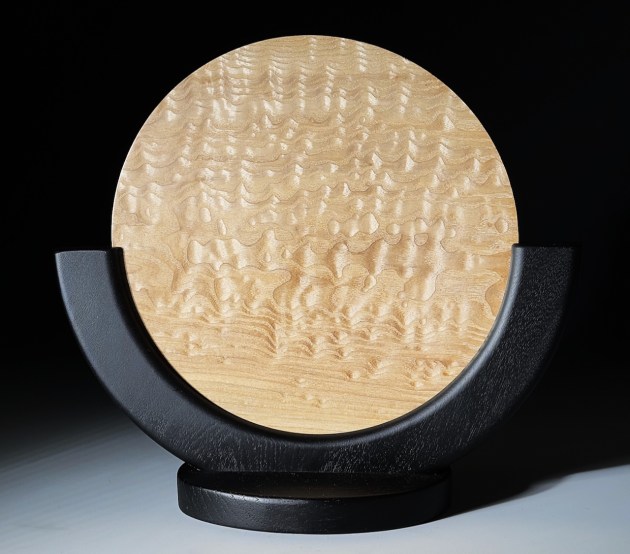
7. Frosty Morning Over the Murray, Japanese maple, 320mm wide
I sat beside her as she worked and we talked about our lives. When it was finished, she handed it to me and said, ‘You keep it!’ Tiku had used the witchetty grub holes to represent digging with traditional sticks. She also painted coolamon bowls, nardoo seeds, a central fire and the shape of buttocks in the sand. On one side was her totem, the snake. The bowl embodies a dialogue between cultures, landscapes, and histories – a reminder that every journey is layered, never solitary.

8. Total Eclipse, mango, 160mm high
After I returned home I started to research the history of Aboriginal woodwork and that extended into the history of European woodwork in Australia. After I obtained a grant from the Australia Council, I travelled the country to do further research and the result was my first book, Wood Dreaming, published in 1995. At the start of the book I wrote, ‘This book is dedicated to the first Australian woodworkers. We all live in the shadow of their Dreaming.’ All this grew out of her gentle offer to paint my work.
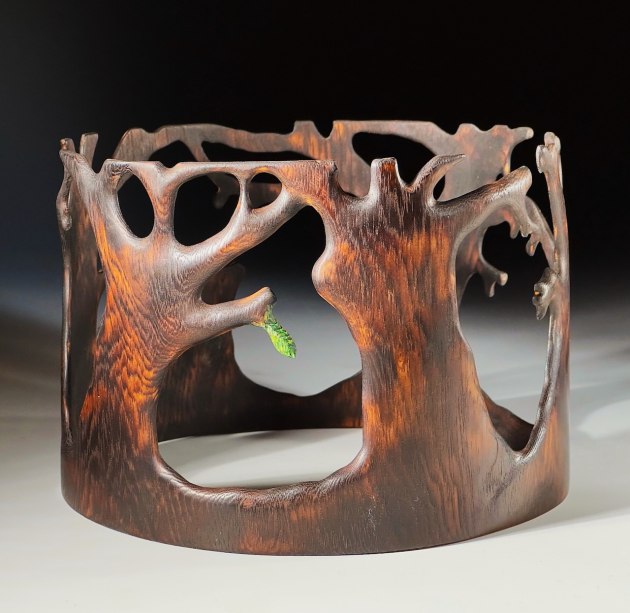
9. Yeah…Nah…, jacaranda, 170mm dia
I included the piece called Heart of the Tree because it highlights my ideas about nature’s work. In 2022 I turned it from jacaranda wood, and the walls are 4mm thin all the way to the bottom. The pattern pierced in the top is taken from a magnified microscopic image of the cell structure of jacaranda wood itself.
Other pieces referred more directly to Swan Hill. I made Angie’s Tree from red mallee burl cut by my niece on the farm. Celtic Roots reflects the Irish ancestry of my family. Frosty Morning Over the Murray recalls how the air fairly crackles over the river in winter. Total Eclipse is how, in the cleanest air you can imagine, I saw the moon over Swan Hill. The colloquial rhythm of Yeah…nah… finds its echo in a burnt forest pierced by a single green shoot – harshness and hope together. Starry Night is the sparkling sky over the Murray – more stars than you can see in any city.

10. Starry Night, blackheart sassafras, 2550m dia
There were other pieces that celebrated simple form, but always with a nod to nature’s unpredictability. Lighting Vessel is a good example. When a jacaranda tree was struck by lightning it surged all the way through the sapwood to the ground. The tree survived and grew over the traumatic scar, leaving the clear pre-lightning wood in the centre of the trunk, while the burnt scar was overlaid with malformed growth.
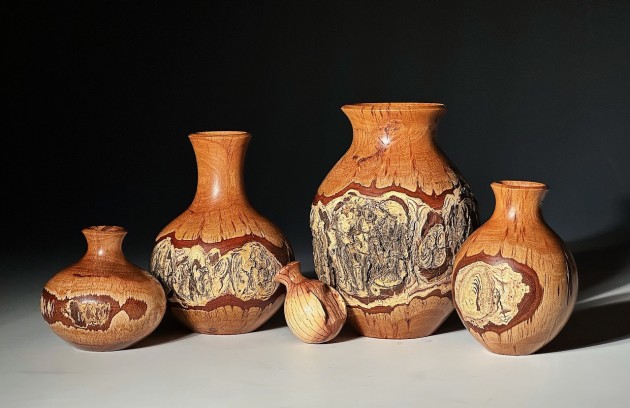
11. The Canthium Family with Adopted Hairy Oak Baby, 2025, canthium and hairy oak, 40–170mm tall
I tried to show my pieces in thematic groups, so on one shelf I placed pieces that belong in the sky: Total Eclipse, Starry Night and Melanoma Rising (a nod to the skin cancers that almost everyone in Swan Hill seems to carry, including me).
I am in Brisbane again now and, looking back, I see more clearly that driving from Brisbane to Swan Hill with 80 pieces in the back of the car was more than a logistical exercise. It retraced my life’s path from the boy who left at 16, to the old man returning after a lifetime spent away.
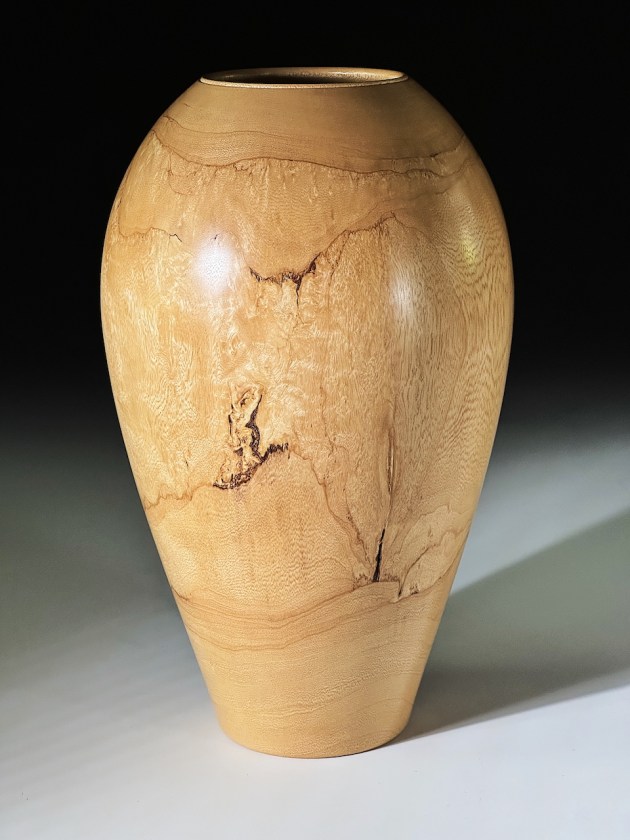
12. Lightning Vessel, jacaranda, 290mm high
On the day after the opening, as I walked the local woodworking club through the exhibition, I noticed my voice shifting so I sounded more like a Swan Hill boy, and the journey felt complete. For decades I have exhibited in other countries, often needing to explain not only what I make, but who I am and where I come from. In Swan Hill there was no need. They accepted me and my work and I felt like I belonged.
I have survived as a woodworker because of the support of my family, but my work has also been shaped by a lifetime of travel and, most importantly, tens of thousands of hours of experimentation in my workshop. This exhibition was not simply a milestone in a long career. It was a circle closing – a boyhood landscape meeting a lifetime’s craft. In bringing my work back to Swan Hill, I realised that I had never really left.
Terry Martin is a woodturner and author who lives in Brisbane. Learn more at www.terrymartinwoodartist.com
First published in Australian Wood Review, issue 131, June 2026