

Rhys Jones: Machines for thinking

Rhys Jones in his Sydney workshop. Photo: Rhys Jones
Words and photos: Rhys Jones
In November 2025, I attended my first woodworking symposium. For two days I wandered the streets of Tarntanya/Adelaide, visiting workshops, meeting other designer makers, and indulging in long-form conversations about the challenges and rewards of our creative endeavour. My contribution included a talk that explored the theme of symbiosis from a theoretical standpoint. It was a deluge of ideas, from Plato’s cave to neoclassical realism in Australian art. Now the dust has settled, I have had time to reflect on the core message. As it turns out, I was trying to articulate an approach to making that is about doing more with less.
Performance driven design has shaped my thinking since childhood. One of my earliest memories of material called to action took place at the Avalon Airshow. I was taken on a flight in an ultralight aircraft – little more than a thin shell suspended in a web of tubes and wires. Hurtling through the air, I was struck by the improbable coherence of the machine. Despite the aircraft’s haphazard form, every part was doing something, and for that reason it felt unified.
That awareness manifested as a desire to make that led me to the Wood Workshop at the ANU School of Art. In the years that followed, I discovered the deep, shared experience of craft. It was this unifying connection coupled with the dedicated physical act of making that drew me firmly into studio furniture.

A collection of prototypes in wood, metal, plastic, fibreglass, leather and fabric for ‘Machines for Thinking’, a year-long investigation into the interrelationship of form and function ‘exploring new chair typologies by combining craft methods with contemporary materials.’ Photo: Charlie White
Several years later, I returned to university to study architecture. It was a radically different experience from art school, but I maintained a connection to furniture by teaching woodwork in the evenings. Eventually, the two scales of making converged while working in a laboratory in Switzerland alongside architects, engineers and artists. Piece by piece I came to realise that my obsession with function was the tail wagging the dog. Like many other makers, rethinking my approach was inspired by nature.
We intuitively accept that nature is as connected as it is diverse. We experience delight in all its forms rather than think of them as being useless. Nature operates through relationships – a dynamic equilibrium where value is defined by participation, not utility.
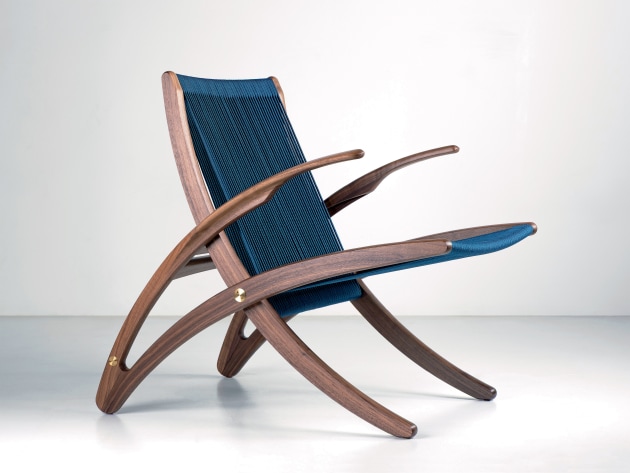
Gesto Armchair, black walnut, brass, braided cord. ‘How can we live better with less? Gesto Armchair is my response. Centred on an economy of movement – with a simple gesture, the chair, the user, and the space transform together to support multiple ways of living.’ Photos: Rhys Jones
These relationships operate at every scale as an indefinitely extending graduation of parts that make up a relative whole. We can observe this as a series of nested systems: cells to leaves, leaves to trees, trees to forests. This idea is expressed both poetically and mathematically in the 1977 short film Powers of Ten, written and directed by Charles and Ray Eames, which depicts the relative scale of the universe by moving through magnitudes of ten. It invites us to consider that perspective is not fixed, but contingent on the relative whole that we feel connected to.
To create something is to uncover the unifying conditions that shape the parts. Recognising the embedded wisdom in natural systems and revealing them in our work can be referred to as material intelligence. It is the dialogue between material necessity and creative intent that helps us to participate in natural order. The architect, Louis Kahn, humorously conveyed this approach by asking ‘What do you want, brick?’ No matter what alternative Kahn proposes, the brick responds with, ‘I like an arch.’

CH11, jarrah, celery top pine, metal, coated wire. ‘An early exploration of material economy. The chair’s weight is reduced physically and visually through careful profiling of each component. Carbon fibre rods reinforce select structural elements to maintain tension in the woven seat.’ Photo: Stuart Hay
For a time, I would often introduce woven fibreglass into laminated timber forms. In the chair, Inter se, these invisible supports add tremendous resilience to the curved profiles, challenging our expectations of how the material should behave. The exploration taught me a lot, but perhaps not as much as if I had used timber alone.
Being ‘true’ to material is not a constraint. It expands possibilities by revealing the invisible significance beyond the visible form. Anni Albers explains this beautifully in her 1944 essay, ‘We Need the Crafts for their Contact with Materials’ where she says, ‘Formed things and thoughts live a life of their own; they radiate meaning...Learning to form makes us understand all forming.’
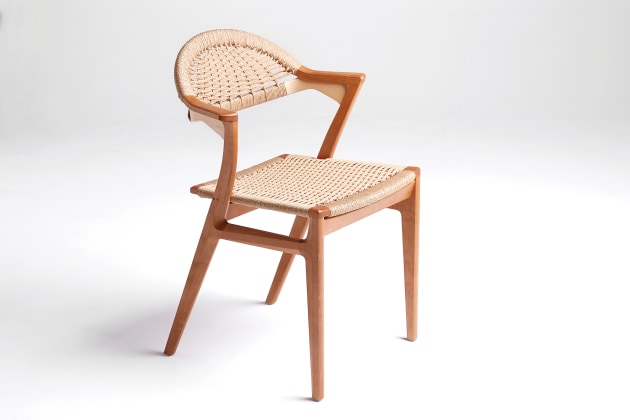
Wannan Chair, American cherry, rock maple, Danish paper cord. ‘Unique weaving methods allow a traditional Danish paper cord system to span the two sweeping rails that form the backrest.’ Photo: Rhys Jones
This way of thinking flipped the script on my function-first approach. A hand does not exist to hold a chisel; holding a chisel is simply one of the many possibilities of its form. The same is true for the objects we make and use. If chairs existed solely for sitting, then I would pack up my workshop and move on.
I continue to make chairs because they are mediating structures that hold us for the many rituals of human experience. They are rife with meaning. Like architecture, chairs can crystallise broad cultural and social conditions with individual experience in time and place. With every chair I am searching for unity in its expression, hoping to uncover a set of relationships so tightly woven that no detail seems superfluous.

Wannan Chair (detail), American cherry, rock maple, Danish paper cord. Photo: Rhys Jones
My interest in chairs is tied to a fascination with weaving. At a certain point in my learning, I came to realise that joinery is, in essence, about weaving timber fibres. A woven seat adds another layer of complexity by introducing a new dimension of forces alongside the significant stresses exerted on a chair. It is a design challenge that makes you consider the structure as a unified whole. The rhythm, structure, and tactile quality of woven surfaces have me revisiting their possibilities with almost every chair I make.
The chairmaker’s chair, to me, is the Superleggera, designed by Gio Ponti for Cassina in 1957. Informed by 150 years of craft tradition in the Liguria region of Italy, Ponti and his team distilled the vernacular of the Chiavari chair until there was nothing left to take away. In the process, they revealed an impossibly thin timber structure married to a finely woven seat.
The Superleggera is instructive because it demonstrates how the integrity of the object and the intelligence of its making is linked to the depth of its relationship to people and place. By recognising the unique systems and environment in which we operate, we can create work that enhances the favourable characteristics of its context. Further still, the resilience of craft continues by building and sharing innovation within an established body of knowledge.
This field of relationships radiates from material. How and where it grows, how it is processed, formed and used all belong to unique systems or patterns of life. I believe that when we call every fibre to action, we strengthen these invisible bonds. It is an approach that considers the performance of an object to be a possibility of its participation in life.
My most recent work was guided by this approach. To link the environment with the contexture, I contemplated the patterns of contemporary living and asked myself the question: How can we live better with less?
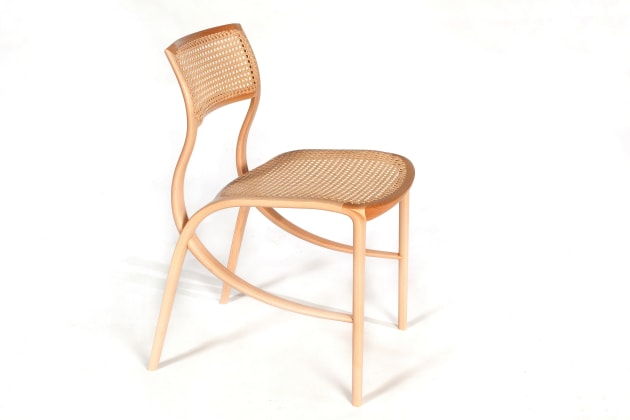
Inter se, rock maple, rattan cane. ‘A synthesis of the naturalistic forms in Chinese furniture and Western ways of thinking, Inter Se reverses the idea of the continuous arm that is characteristic of the horseshoe armchairs first produced during the Ming dynasty.’ Photo: Stuart Hay
Gesto Armchair is my response. It is a chair that actively participates in the rhythms and rituals of inhabiting space through its ability to be folded into a compact profile that stands unsupported. The design is centred on an economy of movement – with a simple gesture, the chair, the user, and the space transform together to support multiple ways of living.
To achieve an ergonomic and lightweight form, I explored techniques and details that would work with the underlying structure rather than obscure it. Curved timber elements were steam bent to reduce waste while enhancing structural resilience through the continuous fibres that span each member.
The use of braided cord further contributes to durability, weight reduction, and long-term repairability. The open weave creates a dynamic transparency and allows the seating surfaces to interlock when folded. Embracing material honesty led me to express the brass folding mechanism at key pivot points.
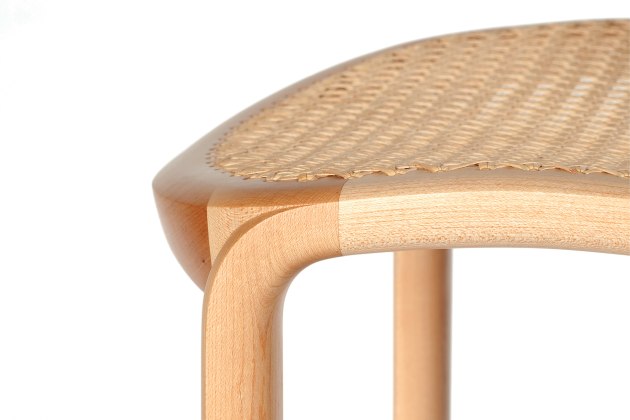
Inter se (detail), rock maple, rattan cane. Photo: Stuart Hay
Gesto Armchair marks a shift in my approach to making. Honouring material by considering its place in a set of relationships can lead to not only meaningful outcomes, but also the responsible stewardship of natural resources. When we work with the logic of material, we use it efficiently. When we find an economy of form, we gain clarity in its expression.
I share my work and my story in the spirit of craft, knowing that my approach is one of many that turn to material intelligence to counter the excesses of modern living. Many institutionally funded projects have explored the same questions through forming timber, from silvicultural harvesting to computationally predicted drying methods. These developments are promising, but they do not complete the full picture because they are often products of applied research conducted to achieve a specific, predetermined outcome or practical objective.
Over the last 15 years I have watched institutions, galleries and workshops that support the arts and crafts steadily contract or close completely, despite an increasing number of digital practitioners seeking tactile engagement with material. This pattern of change is evident across multiple sectors, most recently with cuts to pure science – the pursuit of fundamental knowledge about the natural world, without concern for immediate application. It signals a preference for funding bodies to support applied research, ignoring that many of the greatest discoveries are born from unbridled curiosity.
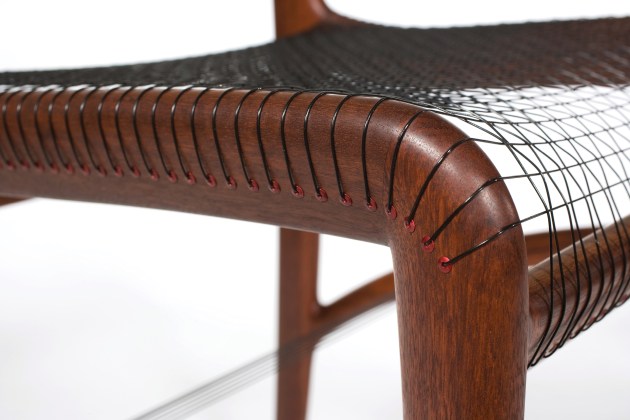
CH11 (detail), jarrah, celery top pine, metal, coated wire. ‘An early exploration of material economy. The chair’s weight is reduced physically and visually through careful profiling of each component. Carbon fibre rods reinforce select structural elements to maintain tension in the woven seat.’ Photo: Stuart Hay
These changes mirror a function-first mindset that limits the scope of our creative potential and therefore diminishes our connection to the world. An objective needs to be framed by a set of relationships, but the outcome is what we leave to be discovered. In my experience, the further it diverges from initial expectations, the better the work.
I would never call ornament a crime, nor would I discourage the celebration of human labour. Doing more with less is not about austerity or limiting ourselves. It is about getting to the core of the question by being open to possibilities. It is an approach that sharpens curiosity and encourages us to interrogate the parts until the connections between them reveal themselves. Even through something as specific as chairmaking, we can uncover unique expressions that serve as an allegory of our being.
First published in Australian Wood Review, issue 130, March 2026
Rhys Jones is a designer maker working at the intersection of studio craft, industrial design, and architecture. His practice positions making as a mode of inquiry, informed by more than a decade of teaching and leading workshops internationally. He is a director of Studio Woodworkers Australia and a member of Splinter Workshop in Sydney. In November 2025, Rhys Jones spoke at Studio Woodworkers Australia’s Symposium entitled Symbiosis. Learn more about Rhys Jones @rhysjonesworkshop at https://rjworkshop.com