

Raf Nathan, Woodworker

Above: Raf Nathan in the workshop. There was rarely a day when he didn’t spend time there.
Words: Linda Nathan, Editor
Writing eulogies, much less an article about someone you’ve loved and lived with for over four decades is not a welcome task, however Raf Nathan has certainly been an ‘influencer’ in the woodworking world. There are things you say and talk about with some people, and not with others. Personal, private, public – there are many threads to untangle, and even as far as woodworking goes, in Raf Nathan’s woodworking life there were many.
An incomplete index shows Raf has written hundreds of articles for this magazine – tool and machine reviews, how-to projects and technique explainers. His first was in the very first issue ‘A wholly resolved way – impressions of Japan’. This was a pictorial article which followed a trip he made on his own in 1992. Thinking back to life with three very small children I’m not quite sure how he pulled that one off. From Japan he hopped over to Europe and visited the Milan Furniture Fair (iSalone di Mobile).

Raf’s ‘personal tool box’ (as he called it) featured on the cover of his first collection of projects, Handmade Furniture Projects. He wrote how to make it in issue 43 of this magazine. It’s still emblematic of his life.
Wood came into Raf’s life in his early 20s and never left it. He died suddenly on 2 April, 2026 at the age of 73; put simply his heart failed. Even months later, the workshop is still as he left it. Tools laid out on his bench, open sketchbook, two projects on the go which my son and I will finish (in good time), his drums and headphones (the shed was also his practice place), timber, machines, more tools, half finished components, scrap bins, sharpening gear on the outside step where he liked to sit when he did that. Woodwork was a huge thing in his life. It anchored him, he was lost until he found it. It fed his spirit and for a good period of time, put food on our table.

Wall boxes in celery top pine with bookmatched blackheart sassafras door panels. They featured on the cover of his second book and remain in the family collection. He made many variations of these.
Looking through Raf’s files, I found these words, that hint where it all started: ‘Woodworking has been a lifelong thing for me. In my early 20s I was somewhat lost and, after travelling through Asia bounced around from job to job – everything from a senior computer operator (it was the 60s) to grave filler (lower than a digger), I finally found a pursuit that absorbed and challenged me.
‘The turning point was a night school class in woodcarving where the first thing I made was a small dragon. It was enough to get me hooked. After that I devoured woodworking books and magazines, and devised my own practice exercises to steadily acquire the skills that then became my full-time livelihood for next 20 odd years. Making kitchens and cabinets were a mainstay until custom orders for furniture and the odd restoration took over.
‘Twenty-five years ago I then took another path and earned a degree in health sciences, and now work as an acupuncturist. It would still however be a rare day that I don’t spend time in my workshop.’
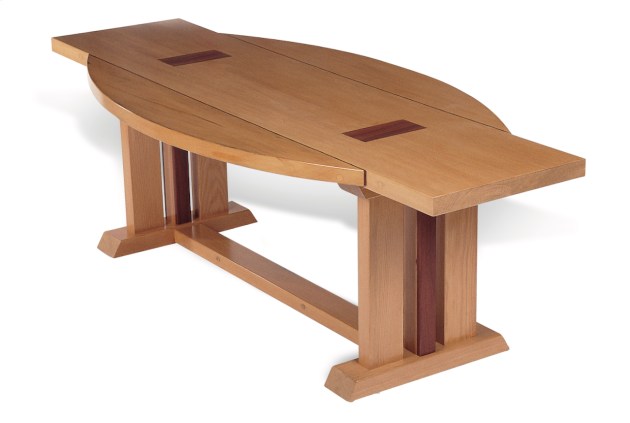
Named after the recycled wine vat kauri wood used, this ‘Wine table’ was used by our family until I came home one day and it was gone, sold to someone while I was out. It wasn’t the first time that happened.
Self taught, woodworking was a profession that didn’t fit the family mould, in fact Raf didn’t really fit any mould as such. He was a self-made, self-taught and self-driven kind of guy. For some reason, his father wanted him to be an optometrist – that was never going to happen. Raf studied law and business at uni but dropped out after a year – it just wasn’t his thing. He hit the hippy trail. Hitched to Darwin, caught a plane to Timor and then went overland throughout Indonesia, Thailand, Malaysia and Laos before eventually returning to Australia.
When we met, he had a job in a small furniture factory in Melbourne. He got the sack for being late (intentionally!) but was then reemployed there and later ‘promoted’ to manager. The owner went overseas, and discovering the business was broke, Raf was left to oversee its liquidation.
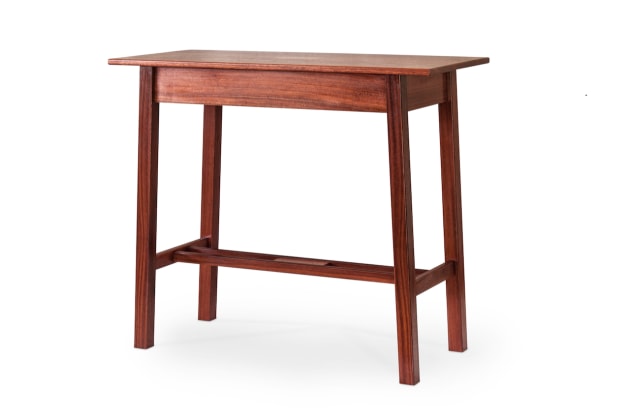
Raf’s Altar table in jarrah is a personal favourite with its subtle grain selection and use of figured jarrah in the frame. It’s understated and it’s mine.
Raf told the story in a journal: ‘“Nathan, if you are late again tomorrow you are sacked.” That’s what the boss said one morning. It was a pine furniture factory and it was exciting to be working full time at furniture making. I was living the dream as an aspiring woodworker. Not only that I was the lackey, the assistant to the trade guys. I had to sweep, sand, learn to spray polish and clean the lunch room. This would be good humility training as well, as they say in the martial arts.
‘But arriving on time at 8am in the morning was a drag and you had to do it every day. Plus I had a new girlfriend who stayed over a lot. So for the fifth time apparently he is telling me that I will be sacked if it happens again. All the other guys working there can hear all this and are keenly listening in. The next morning I was deliberately late and was sacked on the spot. It always feels so free when you leave a place.’
After ending that business he set up his own custom workshop behind a bakery before moving to the larger one we had in Ripponlea. Kitchens, built-ins and then mostly ‘colonial’ furniture made from recycled Baltic pine floorboards were then the bread and butter stuff of our lives. I assisted to a degree and had my own picture framing business alongside.

Over the years, Raf came up with designs that he made limited editions of. This large-scale Cabinetman or Barman was a one-off. It’s made of Vic ash.
In those days he moved fast in the workshop. He wore khaki King Gee overalls and always had a sharp pencil point-side up in his top pocket. He sketched and wrote sizes to cut on scraps of wood. He could make a table in a day. I know it’s not amazing in terms of woodworking, but I always marvelled at how he would run around gluing up frames and carcases, knowing just how much to tweak long pipe clamps to square things up. And best not to speak to him at those times!
Around that time Raf had an idea that nagged him. How great would it be to go to a giant wood show, like the ones that had started happening in the USA? I’ve written in this magazine before how he arrived home from work one day and announced that he had hired the Royal Exhibition Building in Melbourne. For me, it was one of those frozen-in-time moments. Across the kitchen table I could see his mouth moving as my life flashed forward trying to comprehend the enormity and doubtless folly of his latest ‘initiative’.
Short story, we worked hard and in 1988, around 22,000 people turned up to the Timber & Working with Wood Show. It was massive. The Timber Promotion Council sponsored it and the woodworking industry came on board. There were paid independent demonstrators and an amazing exhibition of fine woodwork.
We ran the show three times but after that Raf declared he didn’t want to become ‘a suit’ and truck his concept around the country to other states – so we sold it. Others owned and ran it for years afterwards. Large consumer wood shows are a thing of the past now for various reasons – things change.
After that Raf returned to making furniture in our workshop, then in Gembrook, and we looked after our kids together. He was a very present father.
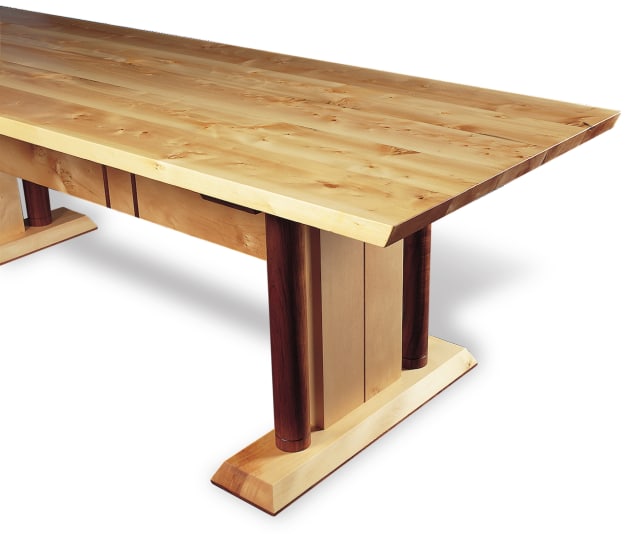
Refectory table in Huon pine. Raf made several of these over years for different clients and his brother Greg owns a blackwood variation.
The idea for starting this magazine grew out of somewhere and came to both of us – obviously woodworking was the connection point for both of us. The first issue came out in 1992 and we sold the publishing of the magazine to Yaffa Media in 2013, for whom I continue to work.
As a woodworker (and as in real life), Raf was a fairly no-nonsense kind of guy. He preferred solid wood and native species – blackwood, silky oak and Huon pine were favourites, though he did have a soft spot for oregon. He liked fairly substantial proportions, not too heavy though. He liked cabinets with frame and panel doors and not overly busy design. His past commercial life as a cabinet and furniture maker made him keep highly labour intensive processes in check, and sometimes he just didn’t have the patience for it.
He didn’t particularly like making drawers and at various times this had been a discussion point. Knobs were another issue. To this day, the house we built that I still live in has foot (toe!) operated sliding doors, i.e. no knobs or handles, and to be honest this works just fine. There’s the odd door, fitting or fixture made from cut-off components that were repurposed or dimensioned – because why would you buy that when you could make it? Our kitchen is also minimal (which suits me) and includes one of Raf’s free-standing two door cabinets in oregon, in the style of the frame and panel door cabinet shown here.
He also wrote about his own learning: ‘Whilst I spent years studying how to make woodwork and to make a living from it, sadly I never spent enough time studying how to design. Therefore many of my particularly early works weren’t very good at all. Of course I studied, searching out museums and galleries and read books constantly. There were no woodwork classes as we have today back then. Imagine how many years and how many awkward pieces would’ve been saved had I created the opportunity to enrol in art and design courses.’
Hand tools were a love of his, and he had a fascination for measuring and marking tools. He designed and made many iterations of squares and rules. An article about developing and getting his popular ‘Multi-Square’ and ‘Supersquare’ locally manufactured could indeed have been written.
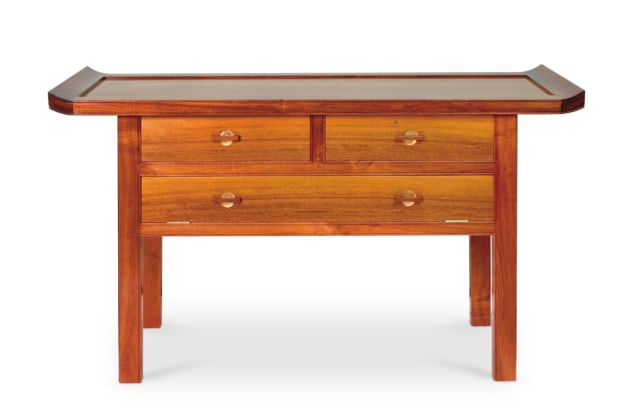
This China cabinet in blackwood has a fold-out ‘door’ front. Chinese and Japanese joinery and furniture styles were an inspiration for him. His brother Greg owns and loves it.
Raf, the man
The more I reflect on Raf, the more I see that he was lots of things, and sometimes he was both ends of many spectrums. Overwhelmingly Raf was a good man, and as with all of us, there were shades of character, and some people saw what they might call eccentricities. He was authentically himself and believed in honesty and caring about other people without necessarily feeling sorry for them.
In the most straightforward way Raf was a life builder, a creative. He designed furniture and tools and he made life plans. He was a woodworker who also worked as an acupuncturist. For over 20 years, as a volunteer, he treated people at QuIHN and regarded it as one of his most important jobs – he hated missing his Monday appointments.

This three-door frame and panel cabinet won a design award from the Victorian Woodworkers’ Association way back in time. Raf was very chuffed about that and I was too.
He was a fantastic entrepreneur but as an employee, not so much – having been sacked from a string of lesser jobs. He was however a very good boss. Not mine of course, neither of us is very good at being told what to do. However we made that work. We carved out our own areas and conferred with each other.
Sometimes he came across as cynical but then he would seem almost naïve and somewhat of a mystic. He changed his name, wouldn’t eat meat or tofu and didn’t like foods that were too red. He did his yoga and breathing practices every morning and later had a puff on a cigarette. He loved his shed – it was kind of synonymous with him. It was place to make things in and play his drum, a place to just be.
Oddly, his sinner/saint duality made him the rock of our family. He was definitely ‘real’ – you could tell him stuff. The things that he often said became family mottos. If he had issues with someone he wouldn’t hesitate to (quietly) confront them to discuss. He believed in telling it like it was. ‘The truth will set you free,’ was one of his sayings, even though we often wished he would just keep some things to himself. ‘Recovery is everything’, was another of his lines that we often quoted to each other if something went pear-shaped.
It’s been difficult writing this so soon after losing Raf, but without overstating, he did make an impact in the woodworking world. He was a great character and an innovator, and could be hugely fun to be with. He loved his family intensely and made beautiful things that we will cherish. We only have good things to say about him now.
Is the maker’s identity reflected in the things they make? It’s easy to construct a narrative in hindsight but I like to think the things we make and do reflect our character and attitudes.
I’ll let Raf’s words as a woodworker be the last here: ‘While woodworking is no longer my main livelihood, it will always be my creative outlet and a source of enjoyment for me. Wood is an amazing medium and when you buy a piece of functional crafted woodwork you get a product but also some spirit of the tree and the maker.’
As I write, Raf’s workshop is still frozen in time, as are nearly all his belongings in the house we built. I know we are supposed to move forward but to just keep moving is the initial goal. For the moment, I’m still living in his world and take comfort from it.
Photos of furniture by Raf Nathan and Rebecca Nathan, with the portraits taken by Linda Nathan
First published in Australian Wood Review, issue 132, September 2026