

Nev Jones: Wellbeing and woodwork

Words: Nev Jones
Photos: Kate Wall
My relationship with woodwork is rooted in childhood. I grew up on a banana and cattle property at a WWI returned soldier settlement called El Arish in Far North Queensland. Out of a combination of necessity and curiosity, my childhood was spent in the bush making cubbies, toys, and the occasional weapon out of rainforest timber from our property. As I got older and my farm responsibilities grew, the things I made evolved into furniture, fences, and tools These days, we would call that ‘green woodworking’, but back then it was just called living.
After completing an apprenticeship as a mechanic in 2000, I decided to join the Army. I was looking for something meaningful and was inspired by the Australian Defence Force’s peacekeeping efforts in East Timor after its 1999 independence vote. In my mind, there was no greater cause than standing up for the oppressed.
I was accepted into officer training at the Royal Military College, Duntroon, as part of the College’s 100th graduating class. Halfway through training, the 9/11 attacks occurred. I still remember standing next to a mate, late at night, watching the TV screen as the second plane hit the World Trade Centre. He turned to me and said, a little naively, ‘We’re going to war.’ He couldn’t have been more right.

Adjacent to his practice as a psychologist, Nev Jones runs Halcyon Woodcraft as a social enterprise that offers free workshops to veterans and first responders.
I graduated into the Australian Intelligence Corps, beginning a 20-year career with an operational counter-terrorism focus. Much of that time was spent overseas with multiple deployments to Iraq, Afghanistan, and Timor-Leste where I led intelligence teams with a mission to ‘find the enemy’. During those years, I completed a psychology degree, not with the intention of becoming a psychologist, but to better understand people, their motivations, their decisions, and their minds.
By the end of my army career, I was burnt out. I had missed most of my young daughter’s life, and my family was paying the price for my service. I was also haunted by memories that refused to fade. I vividly remember one period during my third deployment to Iraq. It had been six months without seeing anything green, and all I wanted was to lie on the grass at home and look up at the trees. It’s funny how our body communicates with our mind like this. Eventually, I was diagnosed with Post-Traumatic Stress Disorder (PTSD) and medically retired from the Army.
In the months that followed, I rediscovered my love for nature and woodworking. Combined with support from my family and some excellent health professionals, I found my way back. My career of service did not end with the Army, it simply took a new direction. I became a registered psychologist specialising in supporting veterans and first responders.
I now run Tamborine Mountain Psychology, a small private practice in the Gold Coast Hinterland. Halcyon Woodcraft grew naturally out of that work. Many of my clients found it exceedingly difficult to talk about deeply personal issues while sitting indoors, face-to-face with someone they did not know.

Nev Jone’s outdoor and indoor classes in green woodworking skills are combined with cognitive behaviour therapy principles as a vehicle for regaining mental health.
To make things easier, I started introducing simple hand tool projects like carving a spoon or making chopsticks into therapy sessions. These activities broke down barriers to communication without distracting from the conversation. Over time, some clients asked to hold sessions outdoors, saying they felt too confined inside four walls. The results were incredible.
The positive response encouraged me to transform my waiting room into a hand tool woodworking studio, filled with vintage tools and projects in various stages of completion. Clients waiting for their appointments could ground themselves through touching, smelling, and hearing the feedback from pieces of wood as they curiously played with a hand plane or drawknife. They did not have to sit still in silence, grappling with spiralling anxiety, as we all can do before a medical appointment. I noticed that clients who spent time in this environment prior to their sessions were more relaxed and engaged once sessions began.
In response to growing interest and support, I officially launched Halcyon Woodcraft in 2024 – a social enterprise funded entirely through my psychology practice. Halcyon Woodcraft provides free, wellbeing-focused hand tool woodworking programs for veterans, first responders, and vulnerable community members. Each program blends technical woodworking skills with Cognitive Behavioural Therapy (CBT) principles and focuses on themes like resilience and personal growth. Participants do not need a mental health diagnosis, just a desire to be a better person today than they were yesterday.
Most programs centre on green woodworking, with spooncarving being a favourite. Others have a more specific purpose: for example, one program involves building a mitred shadow box to display service medals. This program is aimed at veterans and first responders transitioning to civilian life. The theme is about honouring the past while accepting it is time to move forward to ‘hang up the medals’.
Last year, I was honoured to be awarded a Churchill Fellowship to investigate the mental health benefits of green woodworking in therapeutic settings. My goal was to explore why green woodworking has such a positive impact beyond the obvious satisfaction of creating something tangible. While its wellbeing benefits are widely acknowledged, there is surprisingly little research explaining how it works on a psychological or physiological level.
Between June and August this year, I travelled to Japan, the USA, England, Sweden, Latvia, and Scotland, meeting with green woodworkers, researchers, and veteran organisations. I visited incredible institutions like the Gifu Academy for Forest Science and Culture and the Mt Fuji Wood Culture Society in Japan, Peter Korn’s Centre for Furniture Craftsmanship in Maine, and the Sätergläntan Institute for Slojd in Sweden. I also met with inspiring charities such as Plane Wellness (USA), Clervaux Fold (England), and Garvald Woodworkers (Scotland), who all use woodworking to improve the wellbeing of participants.
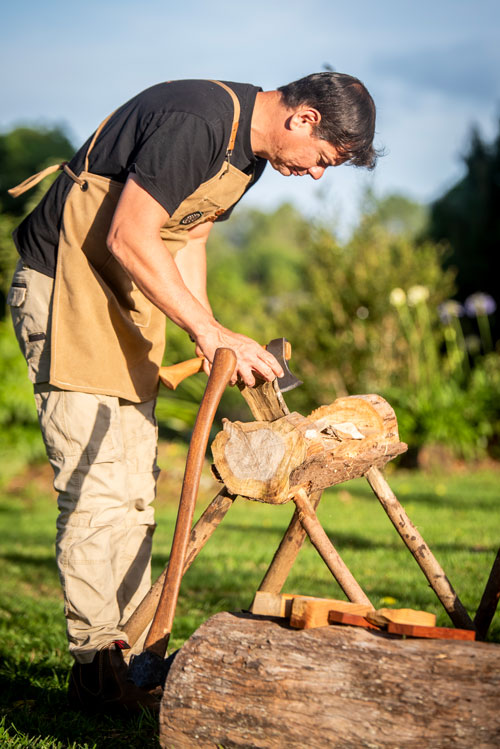
Most of Nev Jones' programs centre on green woodworking, with spooncarving being a favourite.
Along the way, I attended international green woodworking festivals Spoontown in rural Kent, Spoonfest in Derbyshire, and Taljfest in northern Sweden. These were a wonderful opportunity to immerse myself in the micro-culture of the green woodworking community. These festivals were an opportunity to meet and learn from iconic green woodworkers such as Samuel Alexander, Robin Wood and Barn the Spoon amongst others. Importantly, these festivals were an opportunity to meet many people of diverse background who use green woodworking as a tool to manage their own wellbeing.
Another highlight of my Fellowship travels was meeting and interviewing veterans and first responders from almost all countries visited, who use green woodworking to manage their mental health. Their insights confirmed what I had observed locally: green woodworking is an appropriate, accessible and effective craft which can be used to support therapeutic outcomes – it helps people heal.
Through my Fellowship, I identified four universal therapeutic mechanisms through which green woodworking can improve wellbeing- the ‘Four Cs’:
Calming. Green woodworking can downregulate the nervous system through its meditative rhythm. The focused attention, repetitive movement, and connection with nature promote relaxation and mindfulness.
Connection. The tools and techniques used in green woodworking connect us with previous generations and their craftsmanship. Additionally, due to green woodworking being about ‘handmaking quality items that last’, it also connects us with the future and our role as custodians of knowledge.
Creativity. Creative expression has long been linked to improved mood and emotional regulation. Green woodworking offers a practical and accessible creative outlet, something real you can hold and use.
Competence. Most green woodworking projects have a utilitarian purpose. We use the spoon we carve or the bowl we turn. Making something useful instils pride, confidence, and a renewed sense of capability.
The Churchill Fellowship has reshaped my practice and inspired the future of Halcyon Woodcraft. From 2026, we will continuing to offer free wellbeing programs for veterans and first responders and also develop new programs for people with disabilities. In addition, we will launch a community youth mentorship program offering free short-term woodworking mentorships for young people under 18.
We’re also exploring multi-day programs and greater access for participants outside our local region. To achieve this, we’re seeking corporate partnerships and collaborators who share our vision for using handcraft to increase human resilience.
Learn more about Nev Jones and Halcyon Woodcraft at www.halcyonwoodcraft.au Read about Nev Jones’ Churchill Fellowship experience at www.churchilltrust.com.au
First published in Australian Wood Review, issue 130, March 2026