

Morphology: The art of collaboration

Art project collaborators Hannah Cheetham and Jono Everett. Photo: Jono Everett
Words: Jono Everett
Photos: Edwina Richards Photography
Morphology is a nine metre long sculpture created in-hand with collaborator Hannah Cheetham. Its name refers to the study of form and structure, however its artistic theme centres on ‘memory’ – exploring themes of ‘harmony and dissidence’. A complex and rich puzzle.
Our memories hark back to home, a concept as much as an actual place. A refuge from the world, home is not simply a physical space where we eat and sleep – it’s the place where we can be ourselves. The evocative notion of ‘home’ conjures feelings of warmth, a place we can dream and a place where memories are made.
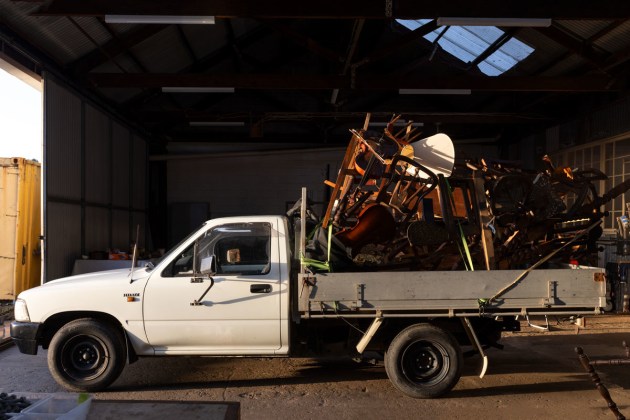
Parked at the Soap Factory in Newcastle, Jono’s ute is laden with some of the components used to form Morphology.
I’m a furniture designer maker and artist with 30+ years on the tools and co-manage the Soap Factory Artists Studio in Newcastle. Hannah’s practice, Built In-Kind, is a synthesis of architectural design, workshop and fabrication education, material recovery and community development.
The real heroes of this project though were the 170+ members of the public who bravely came to assist in the sculpture’s fabrication, (probably not really knowing exactly what they were up for), carefully guided by the artists and assisting technicians. Zero casualties!

Bent laminated straps formed a skeleton for the attachment of reclaimed and discarded wooden furniture components. Participants worked in groups of ten in straight sessions over a seven day period.
Morphology instils, embodies and wraps itself around the emotionally charged feeling of memories, relatives and childhood experiences past – inviting the viewer to explore the details and concepts woven into the form.
Morphology was fabricated from hundreds of reclaimed and discarded wooden furniture components, disposed and no longer considered valuable. The salvaged furniture was collected from the roadside or donated to the project.
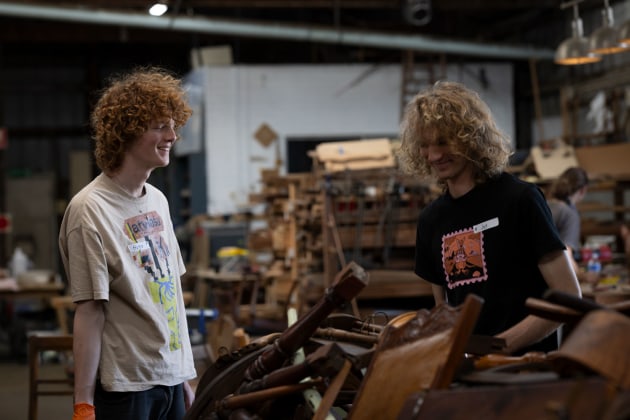
For some, it was first-time exposure to a workshop environment and learning basic skills.
Discarded furniture pieces, are simply that. However each one is imbued with a history, a life before of function, design, meaning and memory. Once ubiquitous, wooden chairs and tables were in every Australian home, lasting through generations. The look and feel of antique, often dark walnut-stained timber furniture is so instantly recognisable and evokes this feeling of home, somehow familiar and reassuring but perhaps something now lost.
The pervasive dark staining of these table and chairs is a leftover from our European forefathers where the mission statement was to ‘stain first and ask questions later’. Often hiding the beauty and spectacular colours of Australian timbers to give way to a look reminiscent of English walnut, a longing for home, which in this case, was somewhere very far away.
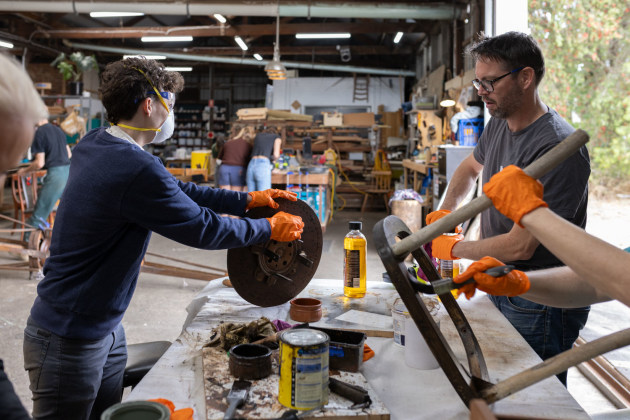
Participants brought along some of the sculpture’s components.
Furniture components for the sculpture were selected to evoke memories of childhood, grandparents, holidays and stuffy homes. During the fabrication process, participants were chatty, silly and hugely fun but regularly were often stirred by strong feelings of melancholy and nostalgia – immediately apparent in the work. Memories are not necessarily always good. Morphology allowed for the artists and contributors to express feelings of longing, loss and yearning.
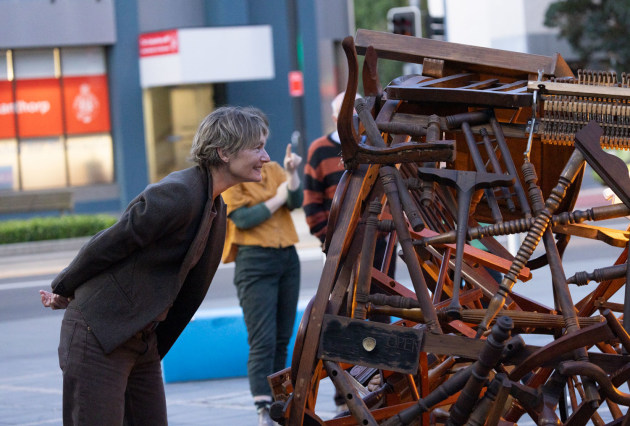
The sculpture’s zoomorphic form was designed to be evocative of a ‘living’ siren or a horn, speaking out these voices and memories. ‘Teethed’ at its snout, with an idiosyncratic whipping tail and given the large scale, the work has a powerful presence. The sculpture has two distinct personalities – complex during the day and a softer, ambient appearance at night, with the timber warmth highlighted from within.

Freestanding floor lamps are woven into the structure which very slowly illuminate and die down in tempo with the ambient soundtrack, paced to give the perception of the breath of a giant slumbering beast, hopefully invoking a reaction that is off-kilter or slightly disturbing. Small children will ask: ‘Is it dangerous…? Am I allowed to…? Why is that…?’ They will fully engage.
The project was hosted in the former Sunlight Soap and Candle Factory (1886) – now the Soap Factory Arts Studio on Awabakal land (Newcastle). I co-manage this beautiful historic space, housing 11 artists, working in different mediums – bronze, fibreglass, jewellery, ceramics and photography. We try hard to ensure the Soap Factory is inclusive and we undertake mentoring, share skills and technical insights with each other, support younger emerging artists and work on projects collaboratively. The Soap Factory has a focus on having the lightest footprint and, for projects such as this, use reclaimed materials wherever we can.

Over seven straight days in 10-person sessions, 170+ public participants experienced something really unique – an explosion of fun, creativity and hopefully learning something new. Broken and preloved items, often loaded with sentimental value, were contributed by participants. Through collectively imagining and making, participants were able to explore ideas, gain hands-on experience and skills in design, construction and fabrication.
Participants were taught basic woodwork and wood finishing skills, including sawing, marking out and simple joinery as well as gaining exposure to a workshop environment. Many participants had never experienced working with their hands, working with timber, making or exhibiting an artwork. We invited them to work toward a singular artistic vision and they were encouraged to engrave a message into their furniture pieces – a line from a poem, a song lyric or a memory or dedication. Hundreds of hidden messages are within the sculpture – a hide and seek for others to find and reflect on.
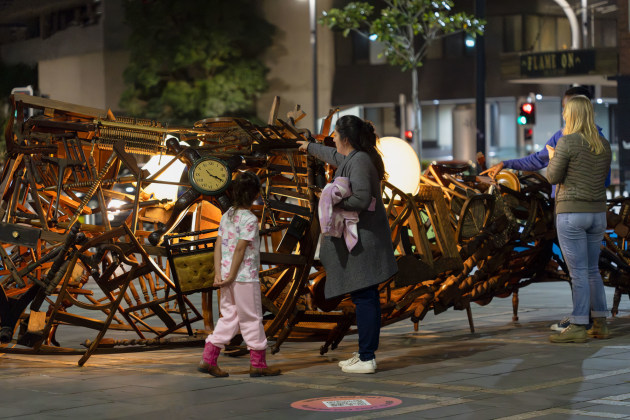
The sculpture was constructed using a series of ever reducing laminated pine hoops, in four demountable sections, tied together with bent laminated timber ‘straps’, providing the skeleton for ‘beast-like’ form. Components were then fixed to the outside of the skeleton, triangulating to touch at least three other points, leaving the inside hollow and for excellent rigidity and relatively low weight. Everything was uniformly stained ‘walnut’, oiled over and over to give a degree of longevity outdoors.
If you are reading this you are most likely a maker, artist or lover of beautifully made things. If you are a fine furniture maker like me, spending hours paring back microns of timber under a bright lamp placed 50mm from your face, there is nothing more liberating than letting go of the steering wheel, making work that is only semi-planned, placing and shaping things, stepping back, observing and continually reconfiguring. At close range, Morphology appears as a mess of intersecting parts, but stepping back, the shape and flowing forms reveal themselves. At night, audiences are drawn close, like moths to the flame.
With institutions offering courses in the art of fine making disappearing, I feel an ever-increasing responsivity to impart my woodworking knowledge, even a little bit. Projects like this are a great vehicle for this. If you also have this opportunity to teach, demonstrate of mentor, take it – when people discover they too can use their hands to create it is truly empowering.
Morphology was brought to life thanks to Newcastle New Annual Arts Festival and has just returned from being exhibited at the High Court of Australia for Canberra’s’ Enlighten Festival. Morphology is now looking for a forever home.
First published in Australian Wood Review, issue 127, June 2025
Lighting: Jarrod PakSoundscape: Dark Pattern
Photos: Edwina Richards Photography
Jono Everett @everett_creative is a furniture maker, artist and designer in Newcastle. You can read more about Jono’s practice here. In Australian Wood Review, issue 126, Jono wrote about his five design principles as applied to the making of his Tuned table. You can read that article here. Learn more at www.everettcreative.com.au

Morphology, a community sculpture project led by Jono Everett and Hannah Cheetham has been displayed in Newcastle and Canberra and now seeks a ‘forever home’. At night, lit from within and with its own soundtrack, the sculpture drew visitors ‘like moths to a flame’.