Mark Horton's mammoth ‘beginner’ project

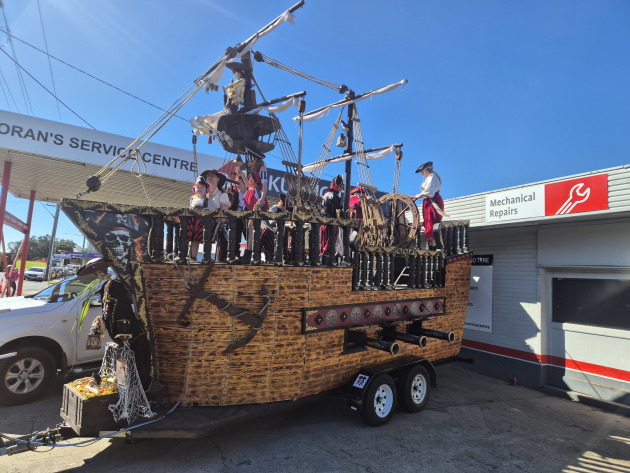
Mark Horton, Yamba, NSW with the Pirate Ship he built from recycled timbers.
Interview by Linda Nathan, Wood Review Editor
When I first received an enquiry from Mark Horton about entering a ‘pirate ship’ in Maker of the Year, presented by Hare & Forbes, I had in my mind’s eye something that sits on a mantelpiece. Not exactly a ship in a bottle, but maybe a cute model. When I saw the photo of the ship with people standing on it I thought, oh my goodness…
Mark says he had only made a coffee table before his 5.5m long ship came in, so to speak. Clearly, questions needed to be asked...
Mark, what in the world possessed you to make a large scale ‘pirate ship’?
Well, we have what we call the cane harvest festival and I wanted to make something that kids would admire so I came up with the grand idea of making a pirate ship.
It was certainly a grand idea! You say it took 14 months to make…
I’d only ever made a coffee table before that so I didn’t have much to start with. I had to borrow tools off a local builder and I was given a lathe. I’d never done a lot with timber so it was a real challenge creatively, artistically and I thoroughly enjoyed the experience.
I would have thought you could add ‘emotionally and financially challenging’ on to that?
Definitely, yes.
If you hadn’t done much woodworking, how did you know how to do everything?
I was a fisherman for 18 years. I had a little trawler. I watched a well known boat builder from our area – Eric Bail – rebuild my trawler from the waterline up so that’s where I started. I pretended the floor of my shed was the waterline and I built from there up.
Originally I went to the local mens’ shed to turn the stanchions. I said I had used a lathe at school (I’m 52 now), and they said ‘that’s a little bit hard, you might want to start with something easier’. I said ‘Well I like difficult, so I started making them and they said that’s pretty good, you’re talented’.’ Later, Eric Bail gifted me a lathe so I could do it on weekends. There are 65 stanchions turned by hand.
Is the ship sea-worthy?
No, it’s well known as the boat that doesn’t float. It’s made from pine. There’s a flat floor on the bottom of it. A lot people said I should have made it so it could float and that I could have made a fortune out of it. I’m limited with my woodworking.

The ship was literally built up from the ‘waterline’ of his workshop floor and sized to fit on a trailer.
Well, you’re definitely a woodworker now, you’ve proved that.
Well I knew I had 14 months and I sort of proscrastinated over a few things. I only did a month of it at school and then went to metalwork. I wish I’d stuck with it now. There was no way I could learn to carve so I got the carved appliques, painted the handrail black and gold to give a Spanish look. I had to find other solutions knowing my woodworking skills were limited.

Adding the deck and sides
Where did you get the plans for it?
I had no plans at all. I just thought this is what I need to do. I just got a pencil and stick figure drew what I wanted and thought it needs to fit on my mate’s car trailer so I made it 1.8 metres wide and went by sight. I came up with the plan for the structure in my mind and knew what I wanted.

Turning 54 stanchions was good practice for Mark Horton.
People can actually get on board?
Yes (at the festival) we had eight people up top and two underneath loading the canons with powder. We had an air compressor hooked up to the canons on the back of the ute and they let out puffs of smoke as we went up the street. We got ‘best float’ at the festival.
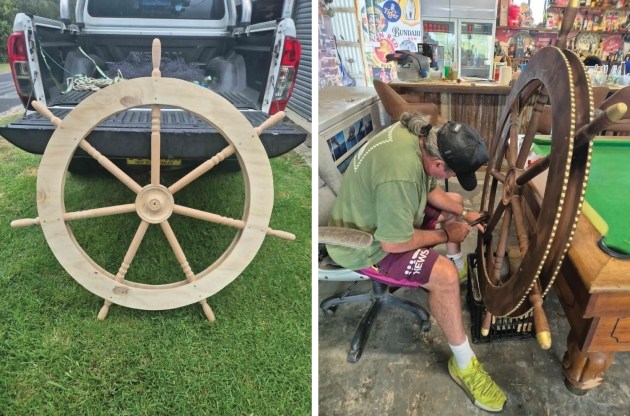
Back of ute and workshop scenes from the creation of the ship’s wheel.
How many hours a day did you work on the boat?
I’m thinking around 2000 hours all up. Because I lacked the experience with woodwork I really took my time.
Did it cost you a lot to do this?
If I had to have a guess, I’d say $15,000 to $20,000 all up. Getting the pallets was the cheapest part but it also made the process much longer workwise. You had to pull the pallets apart, check them for nails, put it through a thicknesser. Then I sanded it all smooth because you’ve got kids around, and I ran a router of the back edge so the panels would interlock.

Batchwork was the order of the day. Carving appliques were use to embellish the ship.
Where does the ship reside now?
It’s in one of the cane sheds. Rather than make money off it, I’m going to do couple of fundraisers for cancer research and probably at the local hospital where people can come and get their photo taken on it.
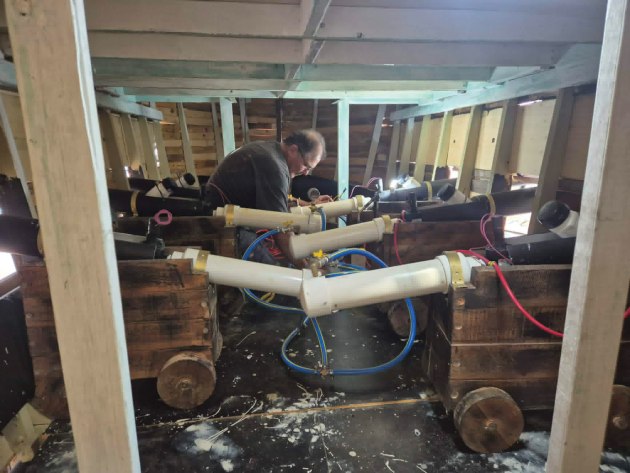
Helper Rob Hodson in the ship’s hold firing up the ‘canons’ with compressed air to give off puffs of ‘powder smoke’.
So what’s next Mark? Clearly you can do anything!
Well, that’s the funny part about it. Now my wife wants some jobs done around the house. When she says, ‘you can do this’, I go ‘that might be too hard’…and she says – ‘hang on, you made a pirate ship.’
Well, she’s got a good point there, Mark…
Mark Horton lives in Yamba, NSW on the cane farm owned by his family for over 100 years. His grandfather came from England and became a cane cutter. On 6 June, 2026 the Cane Harvest Festival, now known as the Clarence Harvest Celebration, drew a crowd of 10,000 people to River Street in Maclean, NSW. Next landfall for Mark Horton’s pirate ship is the Glenreagh Timber Festival which takes place soon 25 July at Glenreagh Recreational Reserve.
Enter Maker of the Year awards before 30 August, 2026 deadline. There are six categories and a prize pool of $20,000+ including $11,500 in cash awards. See www.makeroftheyear.com.au