Lloyd Brooke Anderson: A connection to place

Lloyd Brooke Anderson is a furniture designer maker who lives in Kerikeri, New Zealand. With a workshop adjacent to his home his life and lifestyle revolve around his work. We asked him to tell us about his background and professional aims.
Lloyd, can you fill us in on your background? Have you always been a professional furniture designer-maker?
My passion has always been art. In the early days, this led me to pursue my musical ambitions. In 2008, my partner Vanessa – now my wife – and I moved from Auckland to immerse ourselves in Melbourne’s creative arts scene. Together, we wrote and performed in various groups, but I began to long for something more tangible from my artistic endeavours.
The catalyst was William Morris’s book News from Nowhere. It gave language to something I already felt, that objects should have dignity, that they should be made with care, and that beauty belongs in ordinary life.
The transition from music into furniture making was gradual. In the early days, I worked from our single car garage, spending my evenings learning to sharpen and use hand tools, developing my design skills and sourcing predominantly reclaimed timber. As my practice evolved, I moved into larger workshops and took on more ambitious projects.

Finn coffee table in blackwood
Where and how did you develop your skills?
I’ve always been blessed with good fine motor skills and a propensity for detailed work. Given that, I found the transition from music to woodworking fairly intuitive.
My early education came entirely from YouTube videos and articles online. I didn’t have the money to invest in machinery, so I learned as much as possible about restoring and using second hand hand tools. Paul Sellers’ YouTube channel was a major influence. I’m not a huge fan of Paul’s design aesthetic, but I love his no nonsense approach to refurbishing old tools and getting them to perform like new.
Once I had established a foundation in hand tool work, I began seeking out mentors who had already travelled the path I wanted to take. Evan Dunstone of Dunstone Design has been instrumental in shaping my practice. Honestly, I’m not sure I would have succeeded without his help early on. More recently, I’ve also been guided by Stuart Faulkner of Heartwood Creative Woodworking and Neil Erasmus of Erasmus Designs. I would recommend that any aspiring woodworker find a mentor.

Arcana, ‘Inspired by the modular Danish shelving of the 1950s and my deep love of gothic architecture (this) shelving system has steambent brackets, handcarved inlays and a unique dovetailed holding/sliding system.’
What does your everyday woodworking life look like? What sort of workshop and setup do you have?
Monday and Thursday afternoons are reserved for administration and client communication. There are many facets to running a furniture making business, and because I work alone, blocking out time helps prevent me from being pulled in too many directions.
The rest of the time, I’m in the workshop making. I recently moved into a 186 m² workshop built from insulated chiller panels. It was once a fruit packing shed. I live in Kerikeri, Northland, in the heart of citrus growing country. One benefit of the chiller panels is that they minimise fluctuations in humidity, which makes working with solid timber far more predictable.
I have separate hand tool and machine areas. The machine setup is fairly straightforward: a jointer/thicknesser, tablesaw, 14-inch bandsaw, 17-inch bandsaw, lathe, drill press and router table.
Where possible, I like to work with locally grown timber which can be difficult to source in New Zealand. Native timbers are not readily available, and our forestry industry has not always planned for a diverse, long term supply of furniture timbers. Fortunately, I’ve built relationships with local farmers and suppliers, and I now work predominantly with locally grown blackwood and walnut.
Hand tools remain fundamental to what I do. Every surface is scraped and planed by hand. I cut my dovetails with a saw and chisel, and I assemble my joinery using hide glue. Machines are my word processor whereas hand tools are my sketchpad.

Revolve, ‘a vanity built with movement in mind’ made from locally sourced walnut, the ‘baskets’ are steam-bent. ‘Walnut dowels are used at every junction between the whorls and upright staves, adding a subtle and repeated joinery detail.’
How does your work reflect your identity as a New Zealand maker? How can makers develop a connection to place?
I think of community, history and culture as important touchstones. As an immigrant, I find this question challenging, but I’m intent on discovering my own answer to it. It’s also an answer that cannot be forced lest you run head first into obscene cliche or worse... cultural theft.
I cannot claim an inherited connection to this land, but I can build a considered relationship with it. Northland has a strong Māori presence, and we are fortunate to be part of a rich cultural landscape. Vanessa and I are learning te reo Māori, which has been both fascinating and enriching. Since returning to New Zealand in 2020, we’ve begun to feel this place settling into our bones. I hope that, as the years pass, this connection will continue to express itself through my work.
I’m drawn to the visual language of carved surfaces, both in Aotearoa and in other cultures. A carved timber surface can carry a deep sense of story, and I’m eager to explore that further.
Perhaps belonging is not something a maker simply possesses. It is something developed over time through reciprocity, openness and attention.

Can you tell us about the design of Lumen, the vanity unit you entered in this year’s Maker of the Year awards? What is the story behind it?
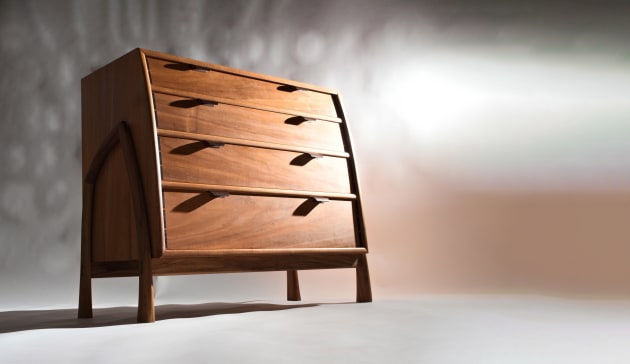
The Lumen vanity (shown above) was created in response to a very open brief from the client. The only firm direction was that it should be wall hung and should not feel too heavy aesthetically.
While designing, my thought drifted into concealment, the seen and unseen. Lumen (meaning light), is the light behind the veil. And what is a veil? Not something to hide behind but instead, a device to ensure not everything is released all at once. There is something profound and art like about the concept of a veil. In the Lumen vanity, the drawers are veiled. Perfect for a private and intimate space like a bathroom or ensuite.

Likewise, you’ve mentioned the ideas behind the Rere Sideboard in your entry. Can you tell us how you created the ‘falling water’ detail that sets it apart?
We live in Kerikeri, an inlet town in Northland where multiple rivers flow into the beautiful Bay of Islands. When guests come to stay, one of the first things we do is take them on local walks to see the waterfalls.
Shown above, the Rere Sideboard was made for a local client, and I wanted to create a piece that reflected where we live and what inspires me from day to day.
Rere is a te reo Māori word meaning, among other things, to flow or run like water. It is often used in relation to waterfalls.
The carved detail is created using a single gouge. I strike a series of crescents in alternating directions, then scoop out sections of timber from point to point to form the pattern.
A Curved Embrace, New Zealand grown blackwood. ‘I’m chasing a piece of furniture that feels welcoming and organic, soft yet precise.’
What is your starting point for a new piece? Is it about form, function or creating a narrative?
This can be all of the above. As a professional maker, every piece I make is primarily client driven. It starts with a conversation with the client about what they want, how they want the piece to make them feel and what connection it will have to their home and family.
I like open briefs the best, this is where a family story may be shared, a favourite artwork described and we drift (slightly) away from function and into the world of expression.
Because I’m working a wide range of projects, whether through form, function or narrative, it keeps my practice both interesting and challenging. I’ve learnt a great deal from my clients and they continue to inspire and push me outside of my comfort zone and into new material.
What is on the horizon for you?
The next few months I will be settling into my new workshop. I’m thinking carefully about workflow, efficiency and creativity. I want it to welcome and inspire.
I’ve been lucky enough to receive a grant from Creative New Zealand. This is towards developing a unique New Zealand identity in fine furniture making. I will be embarking on this journey as a departure from my client work, and it will allow me to dive into the history of Aotearoa, as well as enabling the development of designs that will hopefully resonate on a deeper level and challenge me to express my work in other forms.
Looking further ahead, I’d love to start sharing my discoveries with younger makers and pass the baton that I’ve been so blessed to receive from my mentors.
Learn more at https://lloydbrookefurniture.co.nz/
Wood Review’s annual showcase for fine woodworking and wood art is open to woodworkers all over the world – amateur, pro and student. The Top 100 shortlisted entries will feature in the December issue of Australian Wood Review. Award winners will be announced in this edition at www.woodreview.com.au There is a $20,000+ prize pool which includes $11,500 in cash awards. The deadline for entry is 30 August, 2026.
Enter Maker of the Year, presented by Hare & Forbes at www.makeroftheyear.com.au