Koen Van Dijck: Wood goes to Paris Fashion Week

From Belgium comes another recent entry to Maker of the Year, presented by Hare & Forbes. Koen Van Dijck has entered a beautifully detailed cabinet, and on top of that a remarkable full length Macassar ebony dress that was shown at Paris Fashion Week. We asked Koen to fill us in on his background and some of the work he does.
Firstly, your business name Slagwerk means ‘percussion’ in Dutch. Are you a musician as well as a furniture maker? Or what’s the meaning here…
Indeed I’m also a drummer, but it also refers to hitting my chisels with a mallet. Slagwerk is also the ancient Dutch word for furniture hardware, like the sculptural faceplates for cabinet locks in brass. So it’s a little bit of a wordplay on those two references.

Interior detail for Koen Van Dijck's Tall Collector's Cabinet in walnut. Photo: Karolien Bogaerts
You make fine furniture so how did the idea to make a wooden dress come about?
The wooden dress is actually a commission for Belgian fashion designer Julie Kegels. The concept for her collection for fall/winter 2025 was to take materials out of their context. There were clothes and shoes made from fabrics with wood prints. She wanted one dress that was actually made of wood. Besides furniture, I also make wooden objects and I work a lot with veneer, so she thought I was the right person to make the dress.
How did you settle on the design for the dress?
The big challenge was that the dress had to be worn and that a model could walk on the catwalk with it. The dress was actually presented at a fashion show during Paris fashion week.
Since wood and even veneer is fairly rigid, we had to give the dress a lot of leg space in order to be able to walk in it. On the other hand it had to be slim around the waist so that the dress could rest on the hips without sliding down. The back had a zipper and the dress had just enough flex so the model could slip into it. Together with the seamstress, we worked on patterns and the design organically grew to the final result. See a video of the dress 'in motion'.

What species of wood did you choose for the dress and why?
The fashion collection already had some fabrics with printed wood and it had to match this. Julie Kegels was looking for dark and warm wood tones. I have a nice stock of veneers and I made some samples. Eventually she chose Macassar ebony.

Did the making of the dress go to plan?
I didn’t have any real obstacles in the making process, but I think I was a little naïve in how long it would take. I had scheduled two weeks for it but in the end I worked a full month on it. It required a lot of fine tuning to make the all the pieces fit seamlessly.
Where did you learn your woodworking and design skills?
I did a five year course in furniture making at the Royal Academy of fine arts in Antwerp. This was evening school, three evenings per week, so a very intensive trajectory mainly focused on hand skills. We also had a lot of wood theory and art history.

Full view of Koen Van Dijck's Tall Collector's Cabinet in walnut. Photo: Karolien Bogaerts
How would you describe your style as a furniture maker? What are your priorities as a designer maker?
I have three criteria; furniture has to be beautiful, functional and durable. In my opinion these three criteria are essential for sustainability. I think I’m still looking for my own style but my designs always start with the specific beauty of a particular wood in mind.
I draw a lot of inspiration from the design combined with craftsmanship of 20th century furniture styles like Art Nouveau, Art Deco and Mid-century Modernism.
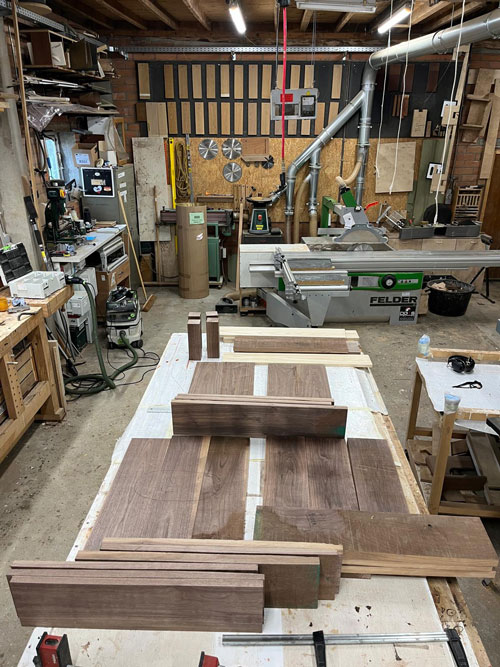
Koen Van Dijck'sworkshop in Belgium. Photo: Koen Van Dijck
Is this your main income producing activity? How long have you been working with wood?
Yes, I do this full time. I’ve been working as a self-employed furniture maker for eight years now. But I’ve been doing this for a hobby as long as I remember. As a kid I was always building stuff in the garage.
Highly detailed and crafted work is labour intensive. Do you make to commission, or to sell in galleries?
I mostly make to commission. I work a lot for interior architects and designers, but I also make own designs on a commission base. I have some of my own furniture designs, but it’s very difficult to find the right audience for that.

Koen Van Dijck, Tall Collector's Cabinet. Photo: Karolien Bogaerts
What’s the scene in Belgium like for designer makers? Is there a community you network with?
Belgium is a small country but it has a lot of creative people and there is a very vibrant scene for designers. But I feel it’s leaning more to industrial design. I’m more rooted in craftsmanship and don’t feel I’m a designer pur sang (pure blood). I’m not really good at networking but I have some colleague furniture makers with whom I can exchange some ideas or ask for advice.
What’s the best thing about the work you do?
The feeling of being creative and making something from A to Z all by myself. I start with a tree plank and I turn it in a piece of furniture, all within my own workshop. I have control over the full process and I always see the direct result of my labour. This really gives a lot of satisfaction.
Do you have any advice for others who are thinking about working with wood for a living?
Take the time to hone your woodworking skills, learn how to draw so that you can visualise your ideas...and have a lot of patience.
Learn more about Koen Van Dijck's woodwork at www.slag-werk.be and at Instagram @slag.werk
Entries for Maker of the Year, presented by Hare & Forbes, are now open. See https://www.makeroftheyear.com.au/