

Kate Stehr: Thinking Through Making

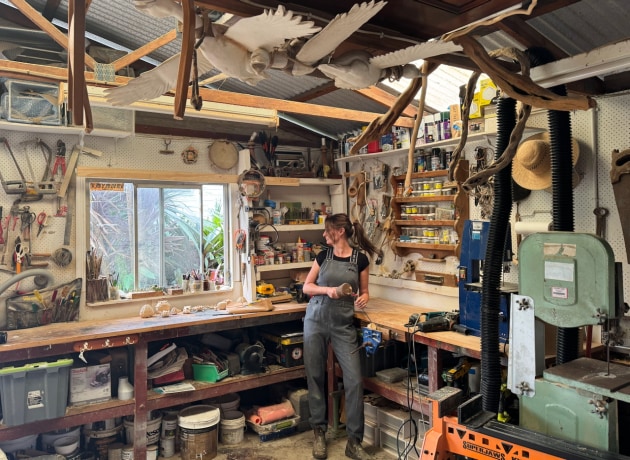
Above: Kate Stehr in her studio in the Illawarra, NSW. She would best describe this space as ‘organised chaos’ and generally prefers to put everything away at the end of each carving session, so the next one starts with a clean slate.
Kate Stehr is an Australian sculptor who works primarily in wood and draws on her own firsthand research and experience to produce a diverse range of highly original works. We asked her to tell us about her work and the things that influence her.

1. Scribing Tools are from a hand carved series that reinterprets traditional narratives for contemporary viewers. They imagine the tools that might have been used to reiterate the spoken narratives of old, morphing them into absurdist styluses, brushes and bowls for mark making.
Kate, please tell us about your background? Why sculpture, and why wood?
I studied Fine Arts for seven years and, after an initial introduction to a range of disciplines, found myself drawn to sculpture. I worked across clay, stone and mixed media, but kept returning to wood – particularly found and salvaged timber, and fallen branches with their own histories embedded in them.
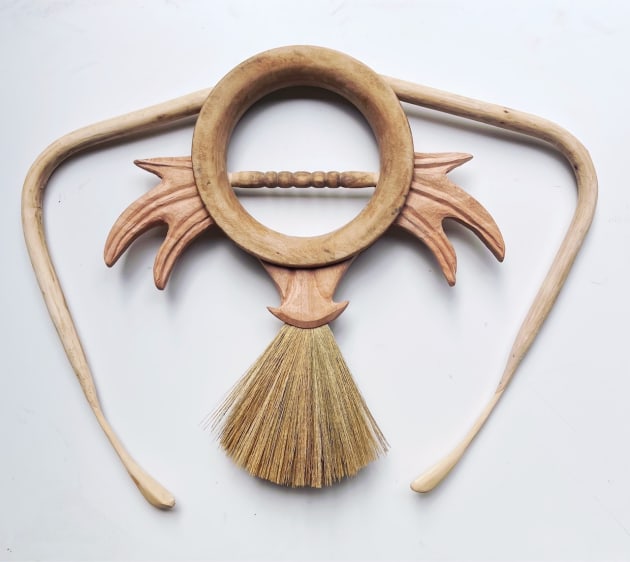
2. Calanoida I, timber cane, fishing reel, fibre, found objects, 460 x 60 x 4cm, 2023. This work comes from the Plankton series, which came about after a series of dives with humpback whales in Tonga. The series seeks to make the miniscule, visible. By shining a life on the unseen life forms, Kate hopes to reinforce our reliance and interconnectedness with the microscopic world.
Early on I discovered the work of Australian artist Ian Gentle, and was mesmerised by his use of jointed found gum branches and the humour in his forms. An even earlier influence was my grandfather, a carpenter. I have clear memories of sitting on the floor of his workshop, surrounded by timber shavings as he worked – those sensory experiences have stayed with me.

3. Domestic Arsenal (2025) glazed, hand-built ceramic, carved weeping mulberry branches. This series of works was made during a residency at Burnt Dirt at Clay Wollongong. ‘Perhaps not precious by today’s standards…useful objects would be repaired, handed down and treasured by generations of womenfolk in Australian households in contrast to our current consumer culture.’
Is wood sculpture your ‘day job’? Do you have other creative pursuits or work?
I’ve practised sculpture for over 20 years, but until recently supported my practice as a Visual Arts teacher and Head Teacher in a high school setting. Three years ago I made the decision to focus more fully on my own work.
I still work within education – teaching Visual Arts at university and delivering workshops – but my primary focus is now my practice.
I always wanted to be an artist, though I didn’t initially see it as a ‘real job’. Before returning to study in Fine Arts, I trained as a chef and worked in hospitality and retail. Choosing to pursue art was a risk, but one I’m very glad I took.
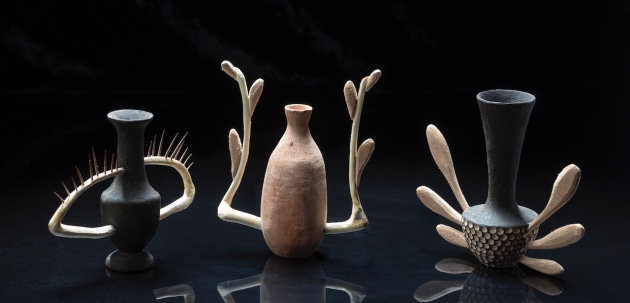
4. Growth Vessels series (2023), wood, found branches. This series of hand-carved vessels, were made in response to time spent in the Royal National Park, Sydney, NSW and featured in a group show. The vessels reflect the regrowth seen aafter bush fire and controlled burning.
You have degrees in fine art, education and creative art research. How has your research informed your practice as an artist?
My research helped clarify the conceptual drive behind my work – particularly the ‘why’ behind my material and construction choices. After working independently for some time, I had slipped into the kind of artistic silo that can become an echo chamber.

5. Kate Stehr with in-progress and completed works.
Both the written and practical components of my Masters pushed me to interrogate my process more critically and to move beyond existing boundaries in my practice.
Writing about my work was challenging and at times felt antithetical. As a visual artist, sculpture is my primary language, so translating that into text wasn’t always intuitive. But it was an important step in pushing the work into its next phase.
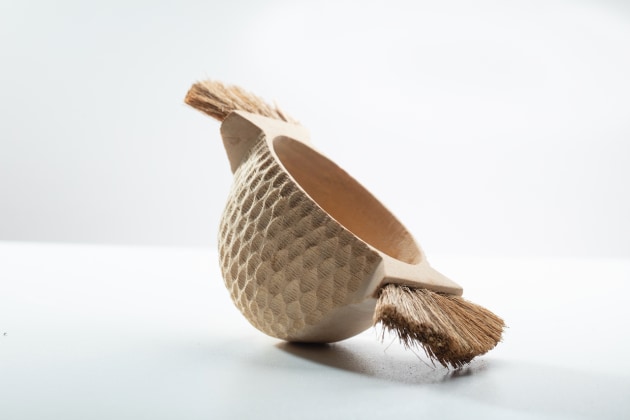
6. Brush Bowl, Scribing Tools series (2025), jelutong, fibre, 80 x 180 x 95mm. This work deliberately defies usage. The thwarting of purpose is a common theme in Kate’s works, which regularly celebrate the absurd.
Some of your vessels defy function and you describe them as ‘deliberately absurd and ludicrous’. What’s the aim here?
I’ve always been interested in making works that invite people to spend time with them. It’s common for viewers to only engage briefly, regardless of how long a piece has taken to create.
I’m drawn to forms that slow that looking down – whether through absurdity, scale, or construction.

7. The Bush Telegraph series, (2024), wood, antique ceramic inkwells, horsehair, fibre, found branches, thorns. Created in reference to the Australian country term for the informal network of news and gossip through regional and rural Australia. Following on from previous Scribing Tools series, they evoke ideas of writing tools, both in the disjointed brush toppers and of course, the inkwells themselves. Again, they are deliberately absurd, defying use.
I have a firm belief that we need to keep making, even in the face of the issues we’re confronted with. But there’s an inherent absurdity in spending hours carving small timber objects, and that tension often finds its way into the work as humour or awkwardness.
I like that my work can be slightly disarming. Art can feel intimidating or overly serious, and humour can open up a different kind of engagement.
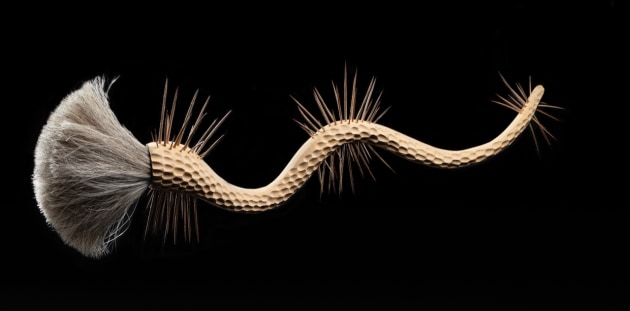
8. Serpentine Brush, Scribing Tools series (2021), jelutong, thorns, horsehair, 530 x 170 x 40mm.
Can you tell us about your ‘Domestic Arsenal’ series?
This series references the historical domestic roles of women. I created hand-built ceramic utensils – colanders, oven forks and pastry brushes – and paired them with ungainly handles made from weeping mulberry.
Their construction nods to traditions of ‘make do and mend’ that defined many women’s lives in previous generations. My nan, for example, repaired and repurposed everything – nothing was discarded if it could be reused.

9. Kate’s carving process is very much influenced by ‘thinking through making’. Whilst she loves to work in series, and each of these has an overarching concept that she wants to explore, she allows her carvings to shift and change as she makes them. The allowance for the carving process to influence the end work, is one of the wonderful elements that keeps her coming back to the studio.
These objects, while not necessarily valued in contemporary terms, were essential to the running of a household and often passed down through generations.
The awkward, bent handles of these utensils deliberately disrupt their function. They reference both the labour embedded in these objects and the relative ease of contemporary life, while also pointing to our current culture of consumption and disposability.
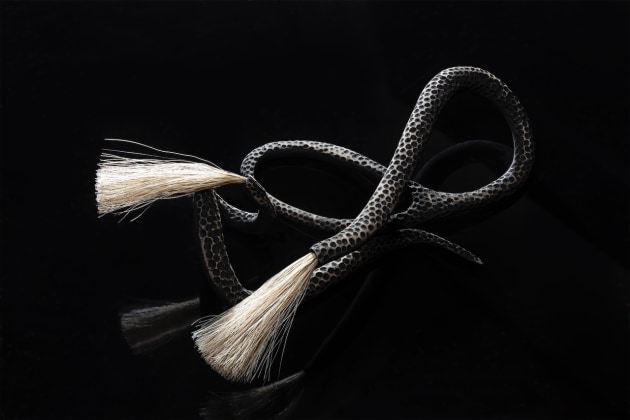
10. Gyre Brush, Scribing Tools series (2022), jelutong, horsehair
How did the Scribing Tools series come about?
The Scribing Tools series developed from earlier work exploring how traditional narratives can be translated into contemporary forms. During my Masters, I became interested in the idea that myths and folk tales need to evolve in order to remain relevant.
This led me to think about the tools that might have been used by storytellers – objects that sit somewhere between the spoken and the written word.
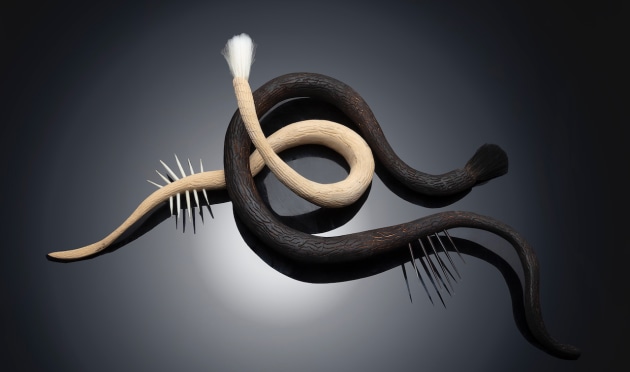
11. Futile Gestures II, Scribing Tools series (2022), jelutong, horsehair, porcupine quills. These final works in the series attempted to push the potential of the chosen timber to its tipping point. Materially, they verge on delicate in regard to structural integrity. Carved from solid, laminated block of jelutong and maple, there were a number of ‘failed’ attempts.
These imagined tools suggest gesture and movement. They invite the viewer to picture them in use, even though their forms deliberately prevent that. As with earlier works, they retain an element of absurdity that disrupts function.
Your wall sculptures reference natural, ritual and symbolic forms. Where do these ideas come from?
These works are largely inspired by traditional narratives. I grew up listening to stories – particularly Greek myths – and continue to collect tales from different cultures.
Unlike my freestanding pieces, these works shift away from the figurative towards abstraction. They draw on forms such as Nordic runes or simplified symbolic elements derived from characters and stories.

12. If I Lift My Eyes to the Horizon (2025), It’s You That I Might Miss. Timber, paint, natural and plastic fibres, plaster and paper beads, 1000 x 1000 x 90mm. Hand carved during a residency in Finland, these sculptural forms are informed by snow- and moss-covered rock mounds, the undulating terrain, and shifting northern skies.
Where or how did you learn your woodworking skills?
My art study was very hands-on, so I developed my practical skills during that time. Every time I enter the studio, I feel like I learn something new – particularly when beginning a new series.
I’ve also found Instagram useful, as watching other artists and craftspeople has exposed me to different tools and techniques. Much of my process has also been developed through trial and error. I’m sure I have methods that would make a trained carpenter shudder, and I’m always keen to learn more.
I’d like to undertake a more structured joinery course at some point, as my work has shifted towards more resolved finishes.
What sort of carving tools do you use?
Anything and everything. Each work requires different approaches, so I’ve built up a broad range of tools. I’m comfortable using power tools, and while many of my recent works have been smaller in scale, I’m keen to return to larger pieces.
I’ve recently invested in a new chainsaw and larger carving drums for my die grinder in preparation for that shift.
What are your most often used tools?
I couldn’t live without my die grinder, rotary tool, carving bits and power file. My bandsaw, chisels and sandpaper are essential too.
Residencies have made me more aware of what’s truly necessary, as I’ve often had to work with a limited toolkit. That said, having a well-equipped studio is always a pleasure.
What are your favourite woods and why?
I’ve always collected timber – particularly fallen branches with interesting forms. It’s probably gotten to the point where I don’t need any more, but you never know when a particular shape will be useful.
I’m also given a lot of reclaimed timber, from chair legs to cane furniture. More recently, I’ve been purchasing timber such as jelutong, Queensland maple, white beech and mahogany. Jelutong is a favourite – it’s incredibly satisfying to carve, and I love its pale colour.
What drives your work? Is it financially viable?
I just have to make. The carving process is almost meditative – it clears my mind while also creating space to think.
I’ve made a living from art, but it’s usually supported by a combination of roles. Ideally, my practice would fully sustain me, but there’s also a certain freedom in making work that isn’t driven purely by financial outcomes.
I’ll keep making for as long as I can. When carving is no longer possible, I’ll simply find another way to work.
What direction is your work heading in?
I’d like to return to larger-scale works. Recent pieces have naturally become smaller, which has been practical, but I’m keen to translate some of these ideas into more physically ambitious forms.
I have several upcoming exhibitions in Sydney and am hoping to undertake more residencies, following a particularly valuable month-long residency in Finland.
What’s your advice to emerging sculptors?
You find your style through making – and not everything you make will be successful. That process is essential.
My approach has always been ‘thinking through making’. The act of making often reveals solutions and new directions.
I’m also interested in challenging the idea that people are either ‘good’ or ‘bad’ at art. Like any skill, it develops through practice.
Finding your niche takes time, but also curiosity. Look beyond galleries – social media, conversations and everyday observations all shape your perspective.
My work has evolved over time, but it remains recognisably mine. That comes from sustained practice and a willingness to keep exploring.
Studio photography: Bernie Fischer
Portraits: Damien Cadwallen
First published in Australian Wood Review, issue 131, June 2026
Kate Stehr lives in the Illawarra, NSW. Learn more about Kate Stehr @katestehr at katestehr.com/