

Damien Wright: Reconciling Differences

Portrait of Damien Wright by Fred Kroh
Words: Linda Nathan
First published in Australian Wood Review, issue 97, December 2017
When Damien Wright, 48, talks about his work he peels back layers of meaning. The huge slab that his offsider Noah is power sanding on the morning I visit his Melbourne studio is a case in point
This 200kg piece of redgum, that for years lay on the ground sheltering a colony of fat skinks, would soon form a centrepiece for Red Gum, an exhibition mounted by Wangaratta Art Gallery, which would draw together ‘art, science and cultural landscapes’. This could almost be a metaphor for Damien’s everyday work where everything he makes seems to relate to his social and material environment.

Damien Wright, Ellen's Table and Chairs. Photo: Fred Kroh
‘What are you trying to say with your furniture?’ I asked. ‘It’s very much about the question “why?”’, Damien said. ‘I’m not as interested in how. I do have an idea about the importance of objects and material culture, and making things is an important contribution to that culture. Fundamentally that comes down to an idea about placemaking, about what the hell we’re doing here.’
‘As makers and woodworkers you are in the primary interface of colonialism,’ he continued. ‘You are it. You get off the boat and you start cutting down trees and you have to reconcile the difference between that colonial skill-set, that canon and value system and the reality of this continent. And that’s our tussle, to find material to suit that skill-set or develop the skill-set differently. And that leads on to ideas and enquiries about placemaking and settler society.’
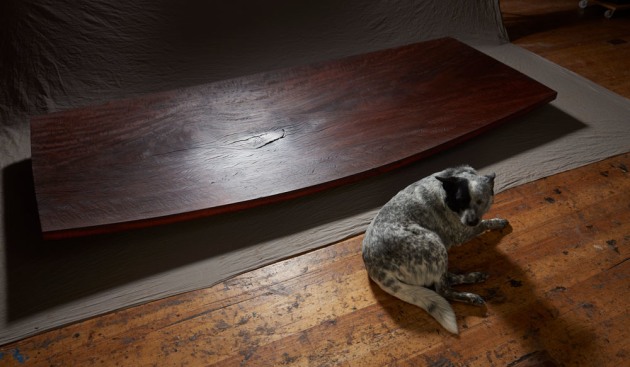
Food Bowl, 2800 x 1200 x 250mm, recovered redgum. ‘Cooked, cured, crazed and curved by the sun and rain. Oh, and it rocks.’ Photo: Fred Kroh
We may be in the midst of a craft revival with a ‘maker movement’ and the ongoing ‘rise of bespoke’ but here, in this country, our relationships to that culture are ‘infantile’, said Damien. ‘Are we living here or not? Mostly it looks to me as though our material and made culture is dominated by transplanted culture…imported values, imported timbers, imported design.’
So does he feel like an invader? ‘I totally feel I am on country and part of this land’, said Damien. ‘Born here – and that is a great gift – but I’m fascinated by the consequences of that and I’m driven to express that in wood. Wood and woodwork, for me, is the way I’ve been able to do that.’
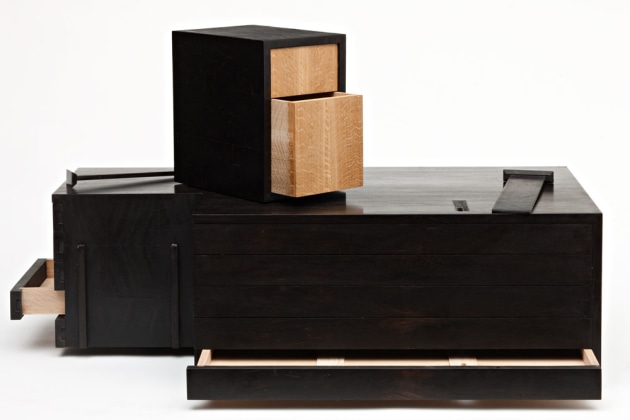
Made from ancient redgum, Japanese oak and celery top pine, Pama is a memory box – ‘a meditation on accessing and protecting the past’. Photo: Jeremy Dillon
The current craft revival is also a consequence of people seeking intellectual enrichment through the process of making, says Damien. ‘The hipster bespoke movement is about (younger people) wanting to feel something. Understanding the choreography of your body to be able to create something, rather than just go clickety-click. Craft describes that complex relationship between what goes on in someone’s head and then hands. (Makers) are lucky because they have that skill-set. It’s quite funny because people think craft is cool again. For years it was an absolutely stinking dirty word.’
If crafting and woodworking are about expressing the relationship of the maker to his or her social and physical environment through the development of a skill-set, for Damien it’s not however about displaying technical virtuosity. Expertise is a given, there are fine dovetails and complex construction techniques but the interest is secondary.
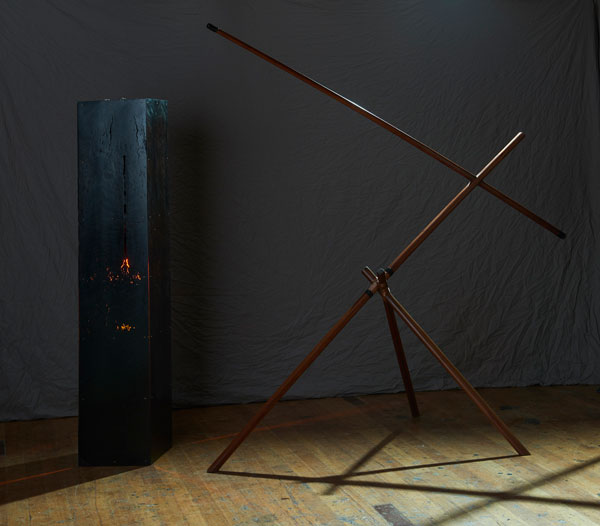
Bala Ga Lili (Two Ways Learning) is a collaboration with Bonhula Yunupingu made from 15,000 year old ancient redgum and gadayka. The cabinet stands as a ‘fortress of European hegemonic rectilinear narcissism’. The other part of the installation is ‘Bonhula throwing a spear with proportions that reflect indigenous concepts of measurement. Photo: Fred Kroh
For example, the blind mitre dovetails he often uses are all about achieving a visual flow of grain. ‘With the fetishizing of joints I don’t really get what people are trying to prove. For me it’s a personal thing, I don’t need to tell people about it. Aesthetics and the joinery decision matter to me, but they’re not part of the same argument.’
As for many, money has not been the driver in determining woodworking as a career choice. Damien laughed when asked if he made enough out of the business. ‘I always say I’m in the business of going broke slowly…really slowly! But I’ve always got work and I’ve got great clients. I had a clear idea right from the start about having a commission based practice. I’ve avoided retail and galleries and I’ve been able to get by. I have flexibility and you’re supporting a family, but you’re not going into it for a million bucks.’
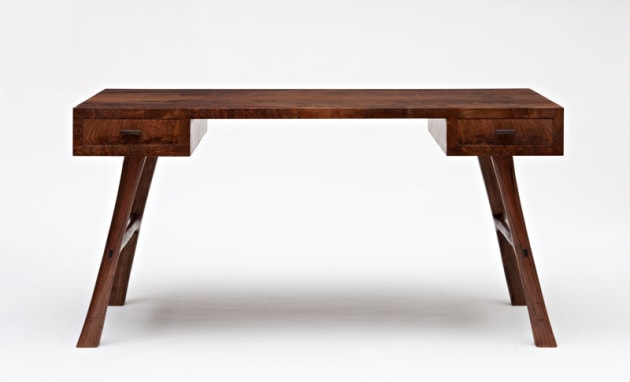
Harry’s Desk, Wodonga walnut. Photo Jeremy Dillon
Damien’s striving to resolve his connection to place as a maker has led him much further than most others. In 2010 he lived in Arnhem land in the Nhulunbuy region for around eight months and was invited by the Gumatj Corporation to set up a furniture making workshop which continues to operate to this day.
Initially the idea was to capitalise on a forest resource that was being sacrificed to land clearing activities for local bauxite mining. Gadayka or Darwin stringybark as a dominant species has proved well suited to furniture making, and in recent times the workshop has also produced truss componentry needed for repairing damage in Milingimbi after Cyclone Lam in 2015.
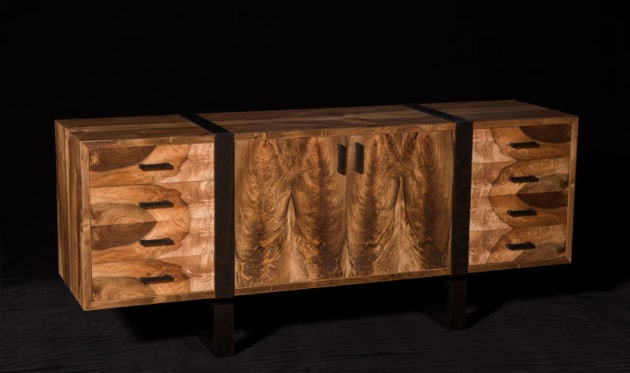
There was movement at the station, Snowy River walnut, ancient redgum. Photo: Fred Kroh
When Damien arrived in Gunyangara he was left in no doubt as to what the dynamics of the relationship would be. ‘When we got there the elders sat me down and said, “This is not going to work if you’re just another white fella who comes up here and tells us how it is. You have to be the student here.” The whole logic of it was: “There is nothing wrong with us – don’t come here thinking there is anything wrong with us”’.
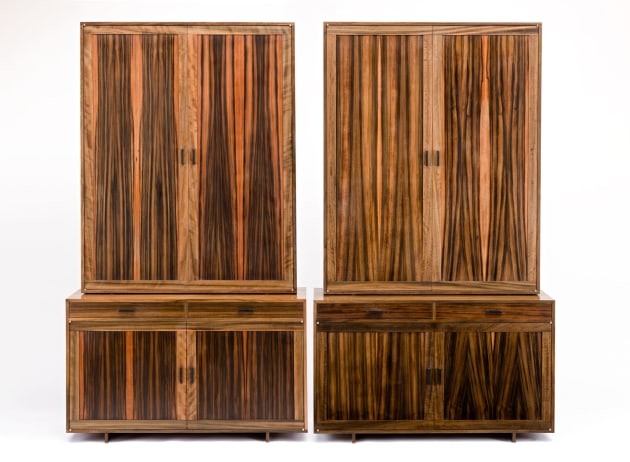
So There You Go, recovered Qld walnut, ancient redgum. Photo: Jeremy Dillon
The relationship with the workshop and the community continues to this day. For example, Bonhula Yunupingu, a Yolngu man, travels to Melbourne to work in Damien’s studio a couple of times a year. Recently the two collaborated on a piece which was shortlisted for an Australian Furniture Design Award. Bala Ga Lili (Two Ways Learning) is a jointly designed and made piece that combines differing cultural concepts.
Damien Wright’s thirty year journey as a maker has taken him far afield and within to understand his own connection with the history, people and environment which he draws inspiration from and seeks to express.
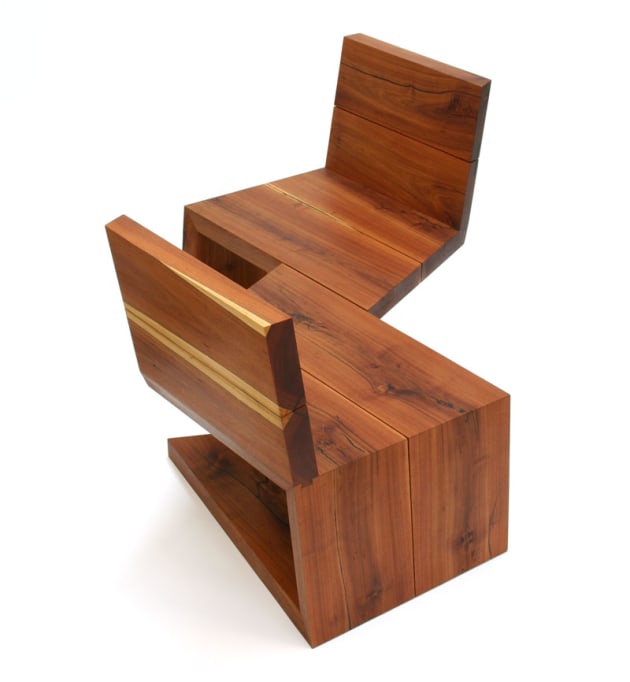
Love Seat 38:52, being the latitudes of Melbourne and London. Made from brigalow for the Immigration Museum in Melbourne. ‘It is a memorial to the British child migrants. One tree broken, folded and reconstituted.’ Photo: Terence Bogue
Q&A with Damien Wright
What makes you happiest when you make a piece?
The doing, when you’re actually in that groove, the choreography of the making. By the end of it though you can’t stand it because all you see is the struggle.
Favourite wood species?
Gidgee
Are you a hand tool nut?
I find it fascinating, that tool fetish. I don’t do the tool porn thing. My tools are for working. I use them and love the feel of them but that’s not what I do.
Yes, but what’s your favourite hand tool?
My stumpy chisel.
Favourite machine?
Messian 24" thicknesser. It loves me and I love it.
What’s the best thing about making things?
The best thing is there is always work to be done. Wood to be cut. And the doing helps me manage the constant doubt.
Worst thing?
The worst thing is the doubt. The self doubt and anxiety.
Favourite piece of woodwork?
A clock made by Will Matthysen. The idea of building a precise instrument. It’s not something I want to do, but there’s a level of skill and control, and it’s about time and the time taken.
What’s the most important thing makers need to take account of when starting out?
Have something to say – there’s got to be a point. Even if I vehemently disagree, have something to say.
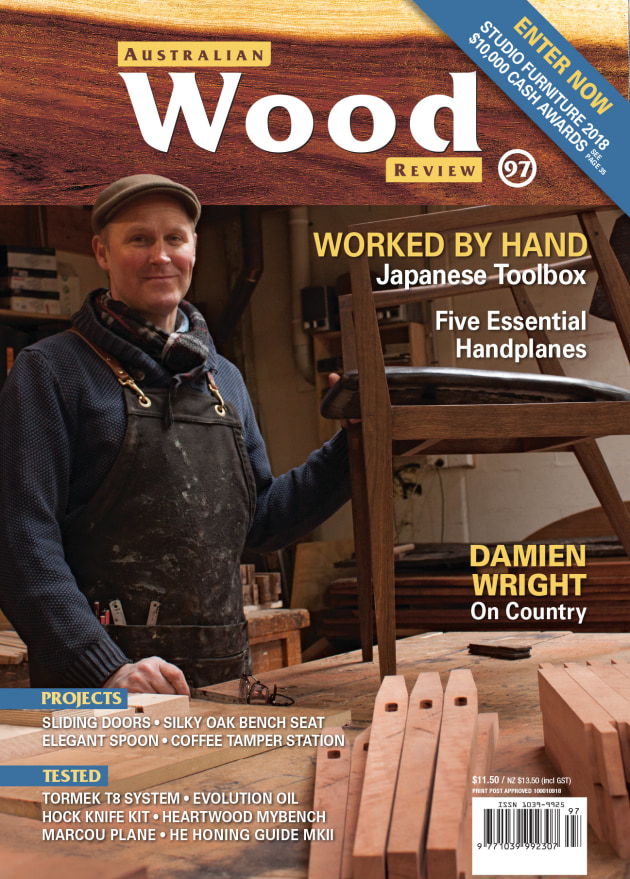
Damien Wright on the cover of Australian Wood Review in 2017, the issue this article appeared in. Photo: Raf Nathan
Learn more about Damien Wright at: www.wrightstudios.com.au