Adrian Duyn: "The best part of my job is the unknown!"
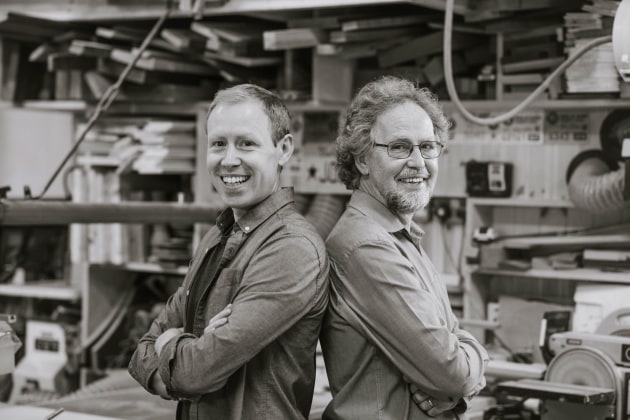
Father and son: Adrian and Joop Duyn in the Joop Duyn Studio in Kenmare, Ireland.
Maker of the Year Awards, presented by Hare & Forbes is a global platform for the latest in contemporary fine woodworking. Entries are directly uploaded and viewed on the Maker of the Year website. We also feature many entries on Wood Review’s Instagram and Facebook pages and additionally interview some entrants on this website as well.
Joop Duyn Studio is a family business based in Ireland. As well as restoration and conservation, the studio creates bespoke pieces for a range of notable clients that afford them creative licence to conceive and execute captivating work like "Daisy", now entered in Maker of the Year 2026, presented by Hare & Forbes.
We spoke to Adrian Duyn to learn more about the Studio and the work it creates.
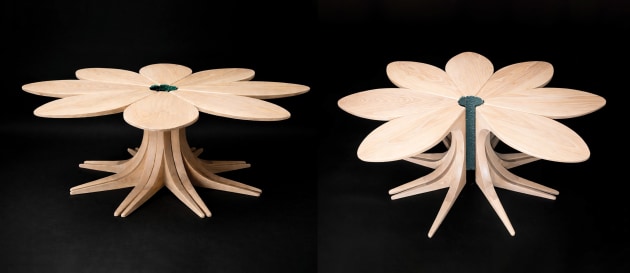
Above: Joop Duyn Studio’s ‘Daisy’ is a set of occasional tables whose ‘petals’ separate to function independently.
Adrian, can you tell us a little about Joop Duyn & Sons? Where are you located and what’s the main focus of the JDS workshop?
Joop Duyn & Sons is a family business that has its origins in antique furniture conservation and restoration. Joop originally from the Netherlands came to Ireland for a holiday in the 1970s and fell in love with the country while spotting a niche in the market for his skills. We are located in Kenmare, County Kerry on the South West coast of Ireland. A charming tourist town that comes alive in the summer but has its charm all year round.
The modern day make up of JDS is focused on high end one-off design for a range of clients from Michelin star restaurants to high end hotels to private individuals and state bodies. We still offer furniture restoration but the majority of work now comes from the in-house design aspect. We are a tightly focused team at the moment but are ever expanding in various ways. We offer truly bespoke, meaningful solutions in design.
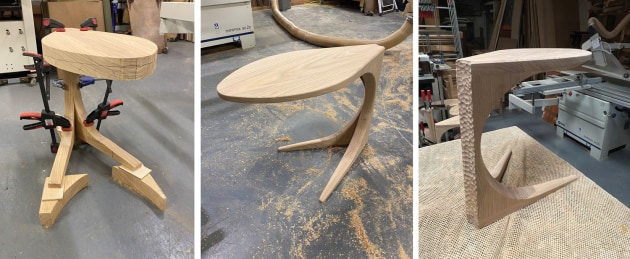
Above: Stages in constructing each of the eight tables that together form a whole for Daisy.
Yours is a family business. Were you trained by your father? Or where did you learn your skills?
I guess a son is always trained by their father, consciously or subconsciously. As the saying goes, ‘I didn't lick it off a stone’ or ‘the apple doesn't fall far’. I spent all my summers in the workshop growing up and knew I wanted to follow along in Dad’s footsteps.
After finishing Second level school I trained in College gaining a degree in Furniture Conservation & Restoration from The National Centre for Excellence in Furniture Design, ATU Letterfrack in the West of Ireland. Coming back to the family business I then introduced a more bespoke design branch to the business, which has continued to grow and develop over the recent years.
Furniture conservation and restoration is still the backbone of the business, and interestingly a lot of skills, techniques and designs are highly transferable to bespoke furniture. Seeing what lasts and what areas fail, we get to see an insight into the future and can design our pieces with this knowledge in mind to last even longer than a lifetime.
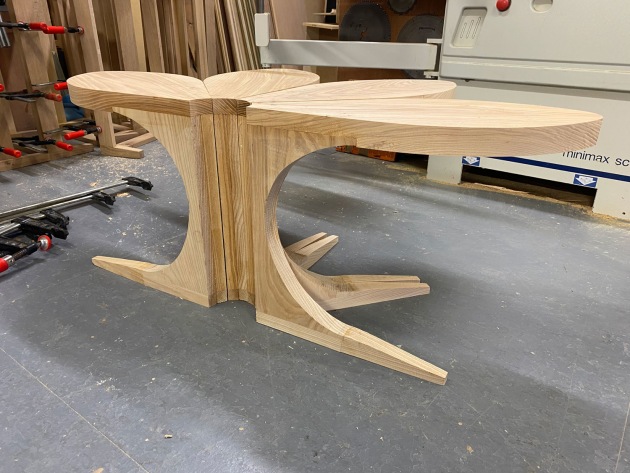
Half base assembly for Daisy
How is it working with your family?
I won’t lie, it has its moments, as with all relationships but overall it is fantastic – we are always on the same page. We might approach things differently, stemming from our vastly different skillsets, experience and training but this in itself is inspiring and we always seem to end up with the same goals. The pros are overwhelmingly positive, the support and joint up-thinking is invaluable. The cons are: never being able to pull a sick day!
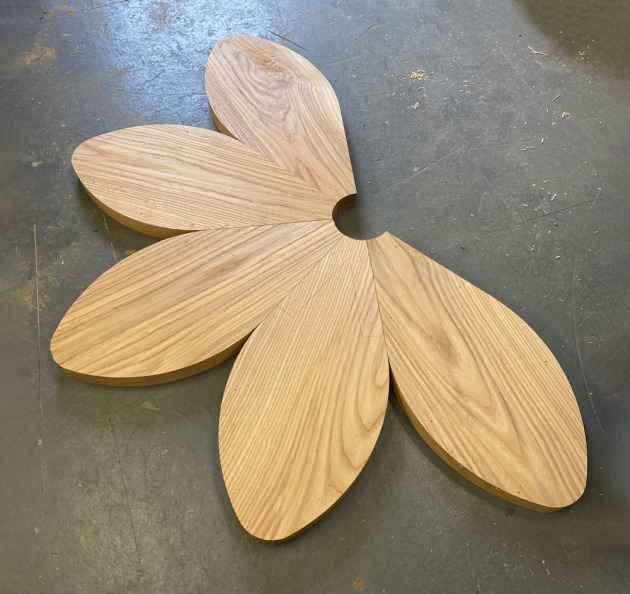
Overhead view of ‘leaves’ that form the top, and below, the base.
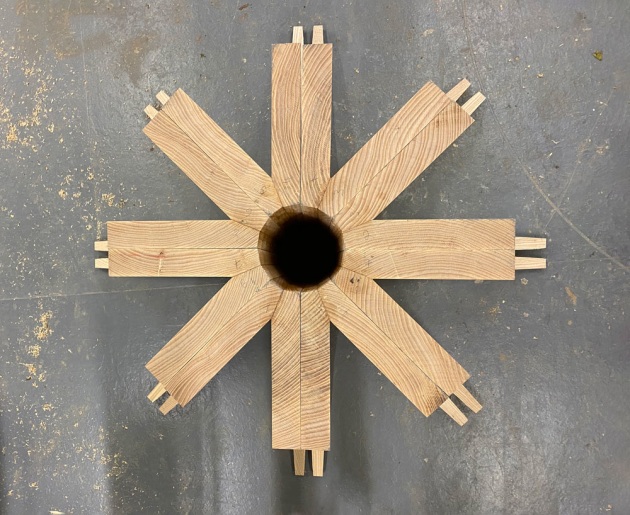
We are very lucky you have shared your work on the Maker of the Year platform? Your designs are creative and highly individualistic. What (and who) drives these designs? Do your clients give you free reign?
Firstly, thank you. I closely watch the Maker of the Year entries each year and am always in awe of the incredible talent worldwide, so am delighted to have entered again this year.
In most cases the designs are all in-house from my thoughts and inspiration, which can come from the smallest spark or the most unusual place. Luckily the area we live in is one of Ireland's most beautiful locations, with native forests, mountains, a rugged coastline, and the bounty of the ever changing weather on our doorstep, so the landscape is never the same. Step outside the workshop door and the senses can be renewed with nature’s organic inspiration.

A custom made console table by Joop Duyn Studio made from veneered burr oak. ‘The Sheraton influenced architectural elements of the table were used to keep the look clean, elegant and timeless.’ Photo: Eoghan Kavanagh
Each piece we craft is infused with a sense of harmony and balance, reflecting our belief that furniture should not only be functional, tactile and visually pleasing but also evoke an emotional response. We collaborate with our clients from hotel and restaurant managers, chefs, private individuals and interior designers to involve them in this process whenever they are open to it. We feel it creates a better trusting relationship, both ways. It also allows the client to feel ownership of a project and a sense of pride over the finished item. It is so important to understand your clients – their ways of living, little quirks, and more importantly, sometimes the things they don’t like.
Viewing a client's home is a sure way to understand a person’s way of living and culture. So to answer the question, it all depends on the client, the brief and the relationship to determine the process of design. Some guidance is welcome but a free hand to go away and wow the client with a presentation of our own thoughts is always a welcome and exciting creative challenge.
Daisy seems like a fun piece! How did this commission come about? Why did you settle on the flower motif for these tables?
We have a great client we have been working with for many years, our relationship is a professional but friendly one. As he travels globally I might get a random WhatsApp message or image saying ‘can we do something for this space’, or ‘I like the look of this’.
The answer is always of course and no problem, as this is the challenge I love and realistically there is always a solution to every problem, even if it means learning a new skill or product – this keeps things invigorating. It's then up to me to interpret the brief into something that pleases his tastes, suits the space, is truly unique and goes in line with my own design style. There is never any pressure with time as he understands the process has to happen organically to achieve the best results, which is a really lovely feeling – to have the space to breathe and let the design speak for itself.
Being a huge Rolling Stones fan, our client must be inspired by the flower power era. Flowers and organic shapes are a favourite, something which is always a joy to have as a brief, organic shapes and forms and endlessly inspiring. A daisy flower was an obvious choice for these tables, as the delicate uniform beauty of the petals speaks for itself. When the eight tables are assembled, the flower appears whole. Balanced, symmetrical, and grounded. Yet remove a single petal and the delicacy of each element becomes clear. Each table stands lightly, almost precariously, echoing the fragile balance of a flower and its petals in nature.

Adrian Duyn, Petit Fours Mystery Box. A special commission for three star Michelin Restaurant The Connaught Hotel, London. Each Petit Fours Mystery box contains 44 individual gears over two layers that interact in unison to smoothly and quietly open and close six alternating drawers. Photo: Nick Cavanagh
How long does it take to produce a piece like Daisy?
Daisy took 143 hours of design and production time from start to finish. It’s hard to calculate the actual design time as once you have a spark of an idea it seems to consume you, working out the little issues, joint details etc. The design seems to develop organically over days or weeks until one day all the issues and choices are resolved – then comes the hands on making part. I am a firm believer of evolving the design as it goes, it just feels right to flow with the actual process and not get bogged down and fixated on an original idea. If at all possible I never put an end date on a project, sometimes it's best to put it away for a week or so and come back to it fresh with a new set of eyes.
How did you achieve the texture and finish in the central ‘stem’?
This was carved using the Arbortech ball gouge, especially developed for carving hollow concave textures. I love using it, as you get lost in the process and time seems to stand still. I always have to choose carefully what music I play in my headphones though as the carving often reflects the tempo of a song. This was then tidied up using hand carving chisels and lightly sanded.
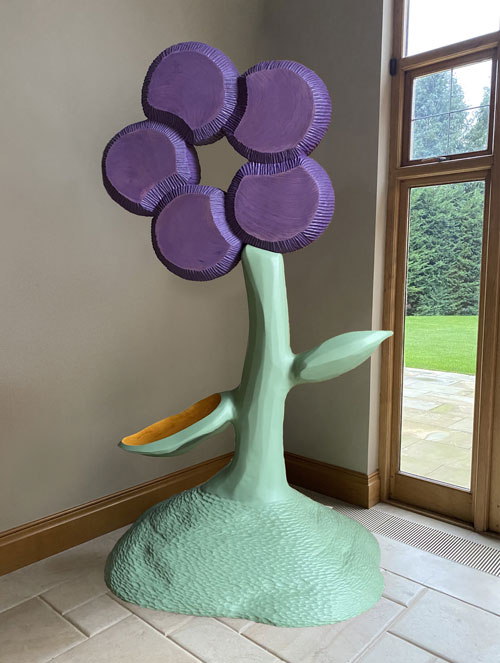
Dancing Flower, handcarved from local storm felled Monterey cypress and Spanish chestnut, 2.4 metres high. ‘Following themes of 20th century pop culture and the outspoken Pop Art movement with background notes of 1960s flower power. Inspiration came from the likes of Andy Warhol and more recently Annie Morris and Mickael Lindeberg. Photo: Adrian Duyn
What’s the scene like in Ireland for bespoke makers?
Ireland in general is a small market for bespoke furniture. A lot of makers carry a range or line of furniture for sale to sustain business while also accepting bespoke commissions.
We design on commission for each individual client but have our restoration side to back us up. Thankfully we have built up great relationships with high end hotels and Michelin star restaurants throughout Ireland and the world while also having a lot of international private clients. Networking wise, Ireland is great and there is always a connection to be made between makers and designers with a lot of associations and groups, many online where people can showcase their work, make new connections and collaborate. This only seems to be getting stronger in the last few years thankfully with the help of Instagram and various events throughout the country.
What’s the best part of your job?
The best part of my job is the unknown! Every moment of every day is different so it never gets boring, there is always a new challenge to resolve. Our clients are a close second, I love the working relationships we develop and the opportunities that continue to arise. Day to day when emails appear in our inbox I am always amazed by the far flung locations around the world that choose us and trust us. Thank you!
What’s next on the drawing board for you Adrian?
We have a lot of exciting projects on the go at the moment, we are currently handling 71 projects in various stages, from working with some of the top hotels in the world such as Adare Manor, creating bespoke showstopper pieces for Michelin restaurant services to one particular project I am really excited about and have been working on it for about a year: creating total one-off pieces of furniture for what will be (when it is launched next year) the largest superyacht in the world. Watch this space.
See Adrian Duyn’s entry here
Find out more about Maker of the Year, presented by Hare & Forbes