Story by Peter Pauls, WA
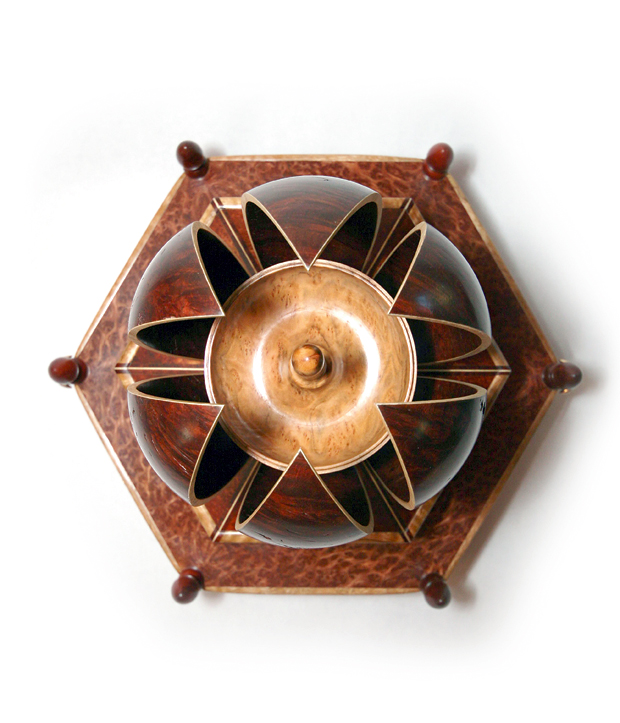
A couple of centuries ago, every Easter-time, Carl Faberge made jewel-encrusted ‘eggs’ that contained a surprise for the family of the Czar of Russia. My version was inspired by his work, but has no diamonds or gold, although I hope it will hold some cherished pieces of jewellery. It took 12 months to complete from 355 pieces of veneer and 215 pieces of wood…in how many hours?…who knows?
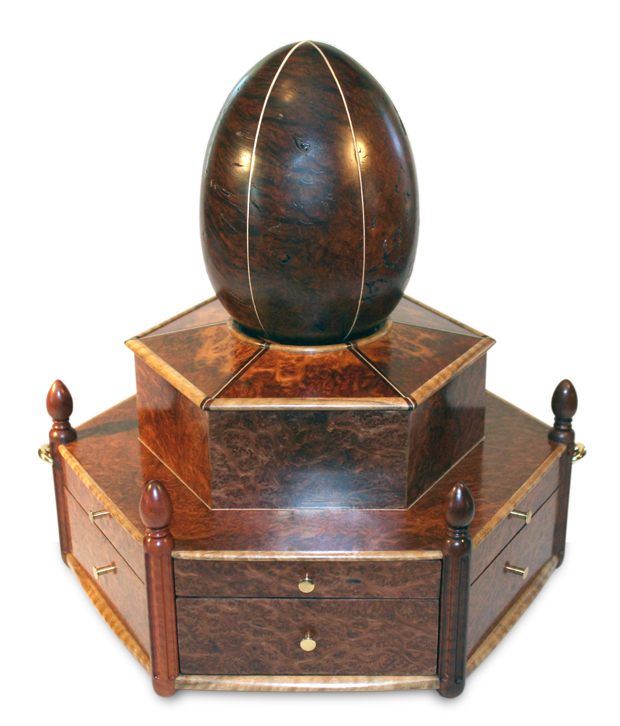
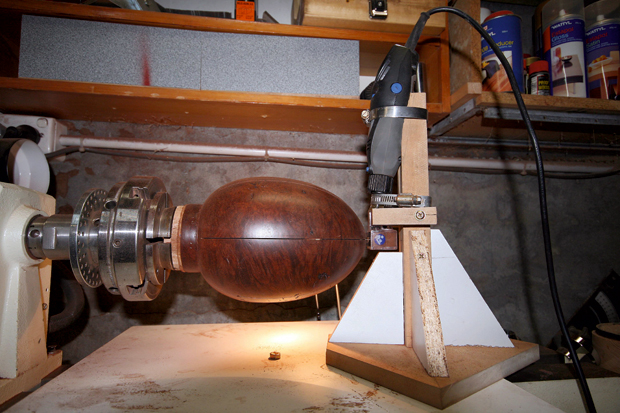
The ‘egg’ was turned from a large block of jarrah burl on a Jet midi-lathe. I worked on the exterior first, leaving a spigot for reverse turning later on. A large forstner bit next took out waste from the centre, going through the base end.
The deep hollowing was done with a homemade tool* made from 25mm bright steel round bar welded into a Y-shape with a HSS capped cutter bolted onto the end, that can swivel into the contours of the egg. A laser pointer was added as an external frame on the tool handle to give a thickness reference.
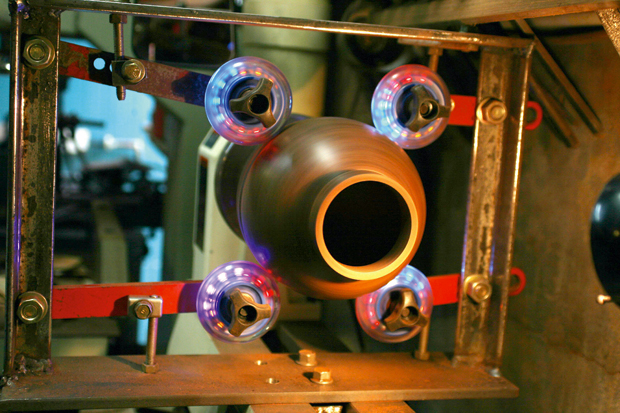
To counter vibration I welded up a crude but effective steel frame that then surrounded the vessel with four wheels taken from my son’s discarded roller skates—these had LEDs that lit up like a Christmas tree when they spun. The interior and exterior were smoothed, sanded and sealed, and the egg was left to stabilise for nine months while I worked on the rest of the box. The final clean up of the inside was done after cutting the egg open.
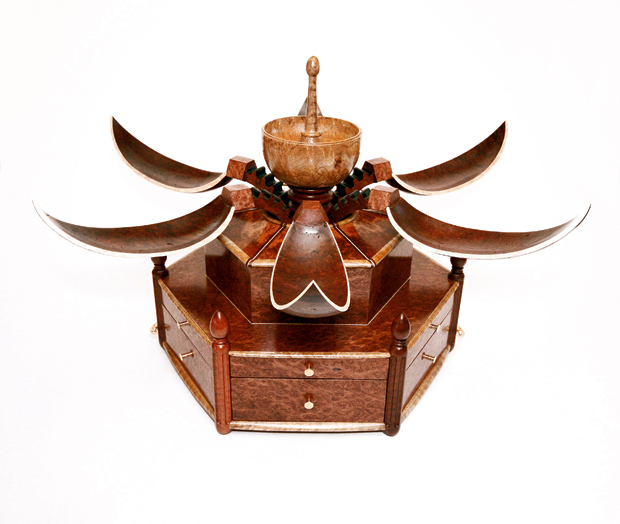
I was filling the car with fuel when the final solution to constructing the hinge block came to me. It was right in front of me, cantilevers pivoting from the underside would work perfectly. These would have to be as good as machined gears so they were CNC laser cut from plywood by a company called Laser Sharp Engraving. Each lever was glued up with two-pack resin from five laser-cut pieces. The teeth were stained black and veneered on flat surfaces with vavona (Sequoia sempervirens).
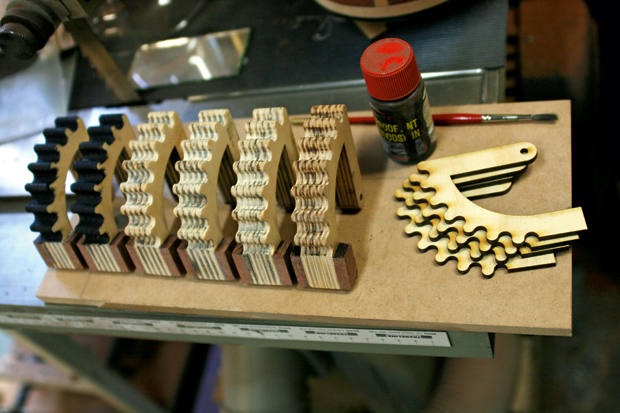
The central drive gear had to be very accurately turned and a central slide hole drilled out to accept a stainless steel guide tube. The six levers were glued with six triangular support blocks of jarrah onto an MDF disc to form the hinge block that then had a guide hole cut for the central drive gear. A laser-cut perspex template allowed me to cut gaps for the levers on the router table. Provision for adjustment was made for each lever to allow for wood movement. An MDF cover for levers was made, veneered and inlaid with blackbutt.
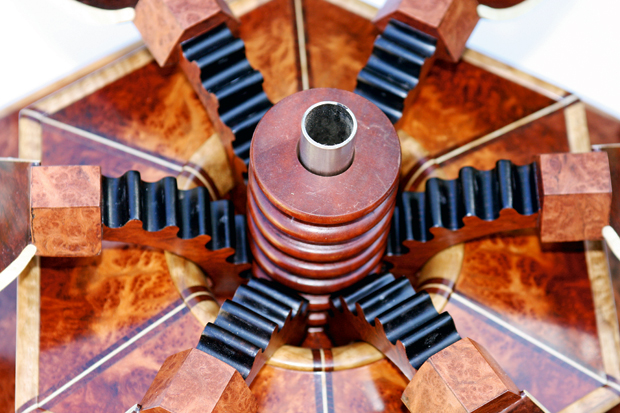
The hinge block fits into the hexagonal box carcase made from ply that was veneered in vavona and birdseye poplar (inside the drawers) with jarrah drawer slides. Internal pine-veneered ply walls support the structure and the drawers. The drawers were made, fitted, lined with leather and pre-finished. I made the brass handles from dome-headed slot wood screws.
When it was time to cut the egg open I had thoughts of Humpty Dumpty shattering in my head but I planned my attack. I made a stable stand and used a thin-kerfed blade to finally slice the egg almost three ways through. The next heart-pumping stage was gluing the egg to the hinge block levers. When the two-pack resin had hardened I used a fine-toothed handsaw to separate the six egg shell pieces which were then cleaned up and sanded.
I fully assembled and finished off the whole jewellery box just in time to enter it into last year’s Out of the Woods exhibition, held annually at
the WA Wood Show. The box received many wonderful comments that made all the effort worthwhile, and it also won first place in the box category and people’s choice.
Photos of the finished piece: Theron Kirkman. In-progress shots by Peter Pauls.
* Readers are warned that deep hollowing can be hazardous. AWR recommends buying purpose-designed and made tooling systems. Always seek expert advice (as the author did) before building your own systems.
Reprinted from Australian Wood Review magazine, issue 70.