

Valdas Brucas: In hand with technology
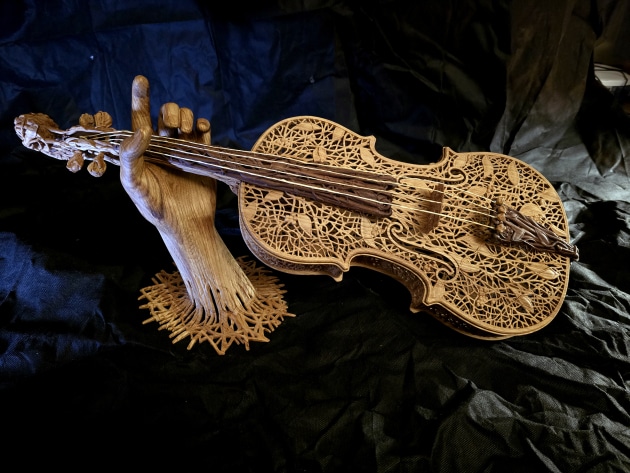
Above: Valdas Brucas’s Oak Violin is life size. ‘It will never play and you will never hear its sound. This is music for the eyes.’
Words and photos: Valdas Brucas
My name is Valdas Brucas. I am 60 years old. I live in a small town of Panevėzys, Lithuania, where I have my modest workshop. I am an artist-craftsman specialising in artistic woodcarving. I have a loving wife, Laimutė, who is a doctor, two children – Austeja and Eimantas, and one of my life’s greatest miracles – my grandson Kristijonas.

My journey in woodworking began with handwork: carving decorations with chisels and knives, making furniture, drawing and searching for form through sketches. Then life led me into advertising – creating logos, designing printed ads, working with publications. I made large advertising billboards and worked with various vinyl-cutting machines and processing equipment. During that time, I learned to work with different photo editing and design programs. It was a useful skill – one that later helped me transition to a new stage of creativity.
The next chapter of my life was interior design. For many years I created interiors – for private homes, cafés, restaurants, and offices. Over 20 years I created about a hundred interiors in Lithuania, Russia, and England. I usually sketched my visions by hand; I used computer programs as well, but drawing remained my language. Working with interiors, I noticed that designers and furniture makers often lacked carved or machined wooden decorations – details that bring character and depth to a space. That’s when I made a decision: I bought my first CNC machine and began creating 3D wood decor.

CAD and CNC technology were used to design and fabricate the Oak Violin. Design, machining, assembly and hand detailing for the violin was carried out over a six month period.
This was a new beginning. Although I had experience with various programs, 3D design and CNC machining was like an entirely new science. I learned to work with 3Ds Max and other 3D tools – I watched countless YouTube tutorials, made countless mistakes, but persistence won.
Designing is only the first half; the other half is making sure the machine ‘listens to you’. I had to learn which router bits to use, what speeds work, how different wood species behave: some are brittle, others extremely hard; some give a clean surface, others tear violently. I ruined many pieces. But that’s research: once you understand the technology, it becomes a tool – and your eyes and hands remain the primary instruments.

My first CNC machine was a simple Chinese model I bought 14 years ago – and it still works. Now I have six CNC machines: one is a four-axis machine for round decorations and columns, but I mostly work with 3-axis machines. You can create so much with them – and many people don’t realise how much creative potential lies in technology. Some say, ‘This is not handmade work’. I see it differently: the machine creates nothing on its own. 3D design, the birth of an idea, the drawing – that is the work of a human. The machine only performs the physical part; and after milling comes meticulous handwork: carving, sanding, preparing for finishing. CNC is about 30% of the final result – the rest depends entirely on the craftsperson.
Every piece I create has its own story. I remember my first milled rosette – a moment of family celebration: my son and I were thrilled when it succeeded. Each new piece became a bigger challenge, each more complex than the last. One of my most significant works is a Louis XVI-style table, recreated almost entirely from a few photographs. I designed it in 3D, made the components, and talented Lithuanian carpenters assembled it. Today, the table stands in Užutrakis Manor. It felt like reviving history from traces – a long and intricate process.
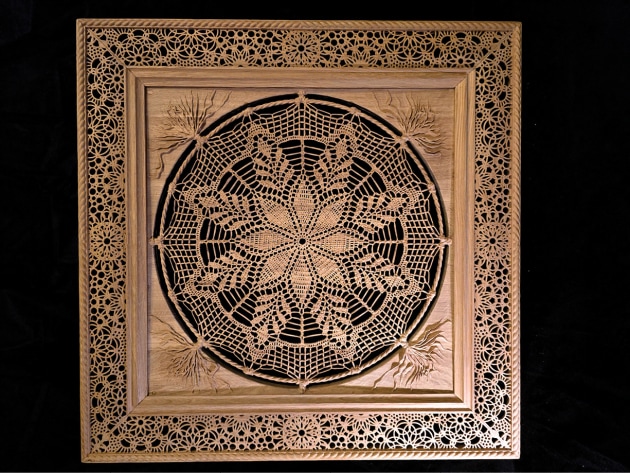
Crocheted napkin in oak frame: inspired by his mother’s handiwork.
One piece especially dear to me is an oak lace doily, created in memory of my mother. She loved crocheting. I remember her on winter evenings, with a crochet hook or knitting needles in hand, surrounded by colourful threads and handmade textiles. She left us so many things embroidered, knitted, and crocheted with incredible care. This work was inspired by her beautiful creations, by memories and longing. Modern 3D scanners could not capture the detailed texture of her doilies, so I searched online for a similar pattern.
The frame was designed by me, inspired by my mother’s lace designs. Both the frame and the doily are made from oak. Both sides were machined, so the ‘threads’ meet as in real lace. The size is 400 × 400mm, and some threads are only 0.4 × 0.4mm thick. It was extremely delicate and required tremendous precision – it took me two months to achieve the right form and texture.
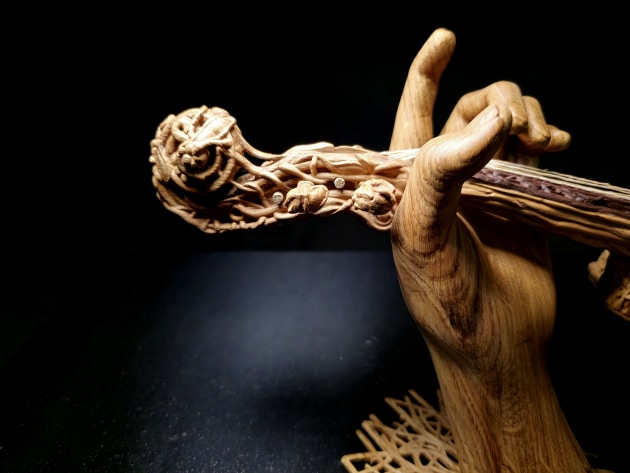
Another complex project was the Oak Violin, created in honour of my grandfather. This is not just a violin. It is a story about a man I never met but have always carried in my heart. My grandfather played the violin – that’s what my mother told me. She spoke of how he not only played but also repaired these delicate instruments, patiently restoring them with love. I never saw him, never heard his music, but those stories were like a melody I gradually began to hear within myself.
Wanting to touch that world I never knew, I created this violin. I wondered for a long time how to bring such a deep and emotional family story to life. I chose oak, symbolising strength, memory, and time. It’s an unusual choice – violins are not made from oak. But I cared not about the sound, but about meaning. The violin’s strings are also made of wood, fragile and silent. It will never play, but it will quietly tell the story of a man whose music still lives in me.
This violin is a silent monument. Its music is not heard by the ears, but by the eyes and the heart. Was it worth it? That is for you to decide. But when people hold it, they feel a shiver – an emotion I never expected.
From the first sketch to final assembly, it took over half a year – countless milling hours, many corrections, and some details were finished by hand carving. The violin consists of 46 parts, all of which had to be assembled. I made several moulds, a special sanding table, and even glued some pieces using tweezers... To sand the open work ornament, I wore magnifying glasses – my hands could not be allowed to tremble. It felt like being a wood surgeon. The strings are made from thin pine shavings, rolled into tubes and reinforced with glue.
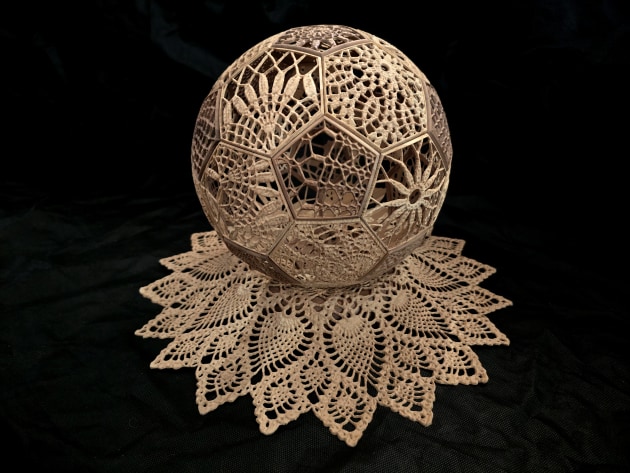
Soccer ball on a napkin, oak. ‘A ball that reminds us that Lithuania never had strong football achievements – but perhaps this one shows we can be winners elsewhere.’
I have made more unexpected works too: a soccer ball created from crocheted doily fragments – 32 segments from eight doilies, crafted from oak and walnut. A ball that reminds us that Lithuania never had strong football achievements – but perhaps this one shows we can be winners elsewhere.
Recently, I completed a new piece – a self-portrait made from around 1600 wooden sticks. A long and monotonous gluing process – a forest of sticks, each sanded to match the shape of my face. Only with a specific lighting angle do all the facial features emerge. No CNC was used here, though some other technologies played a role — which ones, I’ll leave for the viewer to guess.
My creative philosophy is simple: mastery and respect for wood, combined with openness to innovation. I can carve by hand or create with CNC – the essence lies not in the tool but in the idea and the ability to bring that idea to life. Every day is a lesson. And even at sixty, I’m still learning.
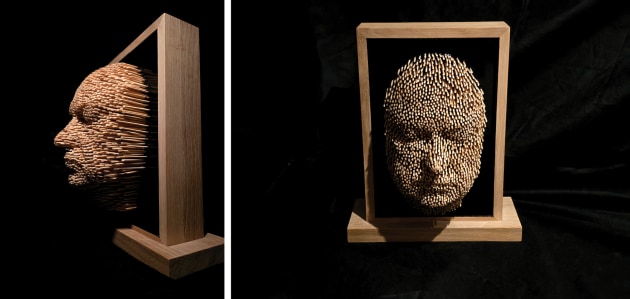
Self portrait made from around 1600 wooden ‘sticks’. ‘A reminder that a man is always made up of many fragments – and that only by hands, over time, can they be joined together.’
In Lithuania we have a saying: ‘The deeper into the forest – the more trees you find’. That is how I feel: the deeper I go into my craft, the more possibilities appear.
Besides large projects, I also create smaller items: Christmas ornaments, unique jewellery for women, and soon I will introduce a series of men’s wooden jewellery inspired by Baltic motifs and ancient runes. Small in form, but full of symbolism and authenticity.
My machines and my hands – these are tools with one purpose: to draw out history, form, and feeling from wood. My motto remains the same: What can one person do? The answer is everything, or nothing.
First published in Australian Wood Review, issue 130, March 2026
Valdas Brucas lives in Lithuania. Last year his Oak Violin was shortlisted in Wood Review’s Maker of the Year Awards.See more of Valdas Brucas’s work on Instagram @valdasbrucas