

The Test of Time: Danish Design in Australia

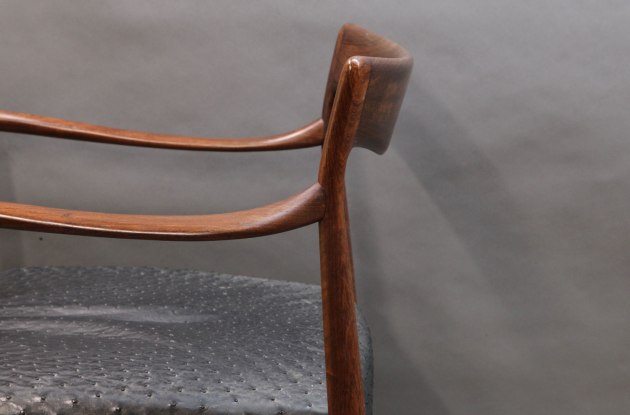
Above: One of the author’s vintage and long-used dining chairs, made by Danish Quality Furniture.
Words and photos: Robert Howard
Photos of Danish Quality Furniture chair: Robert Howard
Right: Details of the finely shaped elements. The front leg is around 23mm wide where it joins the armrest, showing how fine chair components can be without compromising their longevity.
Top: The Round Chair (1949) is of Hans J Wegner’s most famous chairs. Photo: Getty images
Above: Finn Juhl was famous for the sculptural beauty of his chairs – his Easy Chair #45 (1945, 1946) is shown. Photo courtesy House of Finn Juhl
Danish Quality Furniture (DQF) is both the name of a small, Brisbane manufacturer of Danish style furniture, and an apt description of the furniture that they produced during the 1960s and 70s.
The company was started by a Danish couple, Erik and Inga Petersen, who migrated to Australia, looking for a better life for their family soon after the end of World War II. They had already begun a business in Denmark making shelves for sound systems such as Bang and Olufsen. They flipped a coin to decide between Australia and Canada, paid their own fares, and, because the Danish Government would only allow a limited amount of money to leave the country, they used some of the proceeds from the sale of their home, to bring a couple of tons of woodworking machinery with them.
With their two daughters, they arrived in Melbourne in 1956, then travelled to the immigration centre in Wacol, midway between Brisbane and Ipswich. In 1958 they bought a house in Bulimba, a suburb of Brisbane, installed their woodworking machinery underneath, and began to produce their Danish style furniture.

It wasn’t long before they needed to build a shed in the backyard to accommodate their growing business, and by 1963, they built their first factory in Murarrie, further out in the eastern suburbs of Brisbane. By this time, they had established a reputation for the quality of their furniture, both with the public and with local architectural firms.
Lived experience
My partner’s family in Brisbane has some Danish heritage, and possibly because of this lived with a dining room suite made by Danish Quality Furniture. This was my first contact with it. My only previous experience with what is now known as Danish Modern furniture was with the Chiswell or Parker furniture of the same era, while I lived in Sydney.
Courtesy of eBay, we now live with eight DQF carver chairs around our dining table. Every time I look at them, I marvel at how they have managed to survive for over 50 years. To fully appreciate this achievement, you need to see how incredibly fine their structure is.
Dimensions and structures
In particular, the joint between the top of the front leg and the front of the arm is only 25mm in diameter, while the back leg, between where the arm and the backrest joins it, is only 22mm in diameter. The maximum diameter of the front leg is only 32mm, while the back leg is beefed up to 34mm.
These are astonishing sizes that might tempt you to think the wood must be some variety of very strong Eucalyptus. But no, it is black bean, a courageous choice given that many people have strong allergic reactions to its dust.
The structure of carver chairs is strengthened by the addition of the arms, and additional strength was attained by fitting and gluing a piece of thin plywood to the top of the four rails supporting the seat. The plywood bends to match the curves cut into the top edges of the side rails, but most importantly, it locks the rails together at each leg joint. It is a simple and effective way of adding strength to each joint.
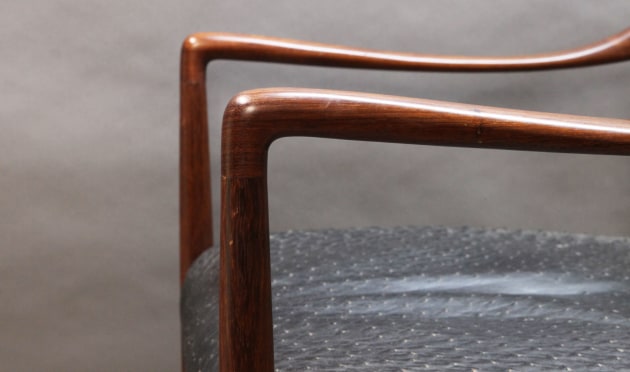
The front of the arm includes a 19mm deep section of short, horizontal grain wood, shaped to match the 25mm cross-section of the top of the front leg. The joint is made by a dowel, but I cannot say for sure whether the dowel is turned as part of the leg, or is a separate piece glued into the leg.
The rear end of the arm is coped, or shaped to match the curve of the leg, then fixed in place with glue and a screw through the leg. The head of the screw sits in a hole that is then filled with a wooden plug.
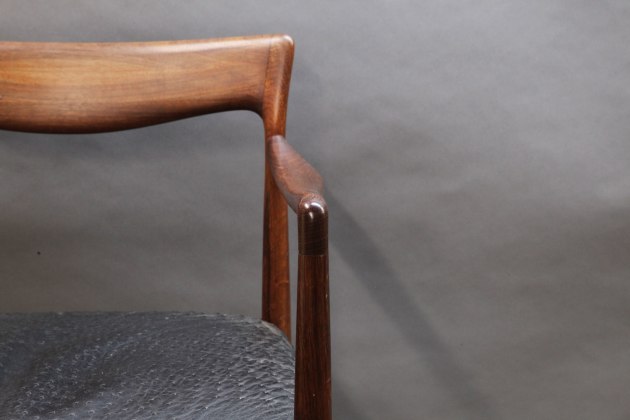
The most striking thing about this joint is that the leg is a mere 22mm in diameter at this point, with that small amount of wood further reduced by the screw and plug holes.
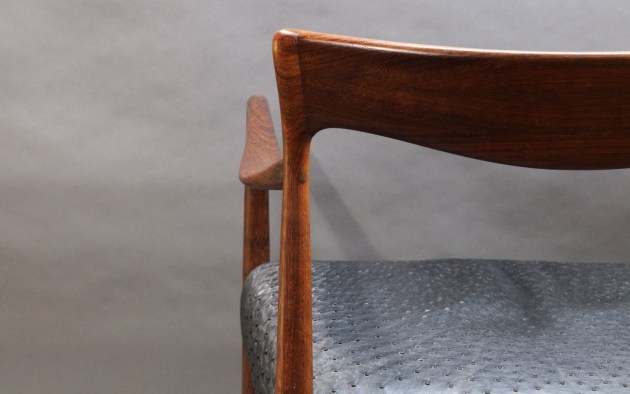
The stress on this joint has been minimised by joining the chair back to the leg immediately above the arm joint, thus reducing the leverage of the back on the joint when someone sits in the chair. However, the leg is not bent to the angle required to accommodate the back, but is cut from a straight board, so there is a section of short grain where the bend is. This is also in the 22mm section of the leg, or, in other words, in the weakest part of the leg.
The back has been shaped and angled with careful consideration of the comfort of the sitter, and the whole chair works exceptionally well.
Life expectancies
There is probably no way to know how many of these chairs were made, either as carvers or as side chairs. It is possible – even probable – that some have been broken. That enough have survived for us to be able to purchase the ones we have without too much trouble, suggests the design is much stronger than it looks. Without seeing these survivors, though, it would be easy to believe that such a chair could not possibly survive so many years of normal, domestic use.
Danish design
In order to try to understand how Erik Petersen came up with such a daring design here in a foreign country in the early 1960s, I decided to look back at some of the earlier history of Danish chair design. I already had some familiarity with the chairs of Hans Wegner, courtesy of one of my students who made for himself some of Wegner’s most famous designs. The most important fact to emerge from this exercise was that the apparent simplicity of these chairs was exactly that: apparent. In fact, the designs were full of subtle complications that made the making of a single chair a long and difficult process.
Danish manufacture
The beauty of Danish design and manufacture, as I see it, is that these difficulties disappeared once all the special jigs were made to manufacture each particular design. The jigs meant that the best parts of each design, which were usually the parts that made them so special, did not need to be sacrificed in order for them to be mass produced. The cost of doing this was then spread across the number of chairs they expected to make, which helped keep the cost of each chair reasonable, and the making relatively straightforward.
Classic Danish chair designs
Jens Bernsen’s book, Hans J Wegner, contains reduced size copies of the design drawings of some of Wegner’s most famous chairs, including The Round Chair (1949), often simply referred to as The Chair. Using a magnifying glass and a digital Vernier caliper to measure from the drawings, I am reasonably confident that the top of the front leg of this chair, where it joins the arm, is 30mm diameter. The rear leg is the same, so both are significantly heavier than the DQF chair.
A wide range of Danish chair designers, both before and after Wegner, is contained in Noritsugu Oda’s book, Danish Chairs. The first example of a similar, but not as fine, joint at the front of the arm was on Kaare Klint’s Red, or Barcelona Chair (1927), although the construction was quite different, in that the arm was not attached to the top of the front leg.
Ole Wanscher used a similar construction method on his Easy Chair (1949), and this is probably the one closest to the DQF chair in fineness of the components. The Jakob Kjaer Dining Chair (1950) does join the arm to the top of the front leg but adds some extra material to the joint by making it with a larger radius on its inside curve. The top of the leg also seems slightly larger to me.
The final two examples are designs from Finn Juhl, who was famous for the sculptural beauty of his chairs. But, like Ole Wanscher, he also added extra material on the inside curve of the joint on both his Easy Chair #45 of 1945, and his Easy Chair of 1946. According to Oda’s book, the arms of the first ‘have been called the most beautiful in the world’. They are very sculptural, and very beautiful, and more complex in their shape to any of the others, including those of the DQF chair.
I should emphasise that this is not intended to be a competition to see who has designed the finest arms in the world. What I am trying to do is to draw attention to how fine chair components can be, without compromising their longevity. Too many contemporary chairs appear to have been designed by engineers to withstand loads way beyond what they are ever likely to experience, even with our rapidly expanding waistlines. They are very heavy and clunky by comparison.

Left: Finn Juhl was famous for the sculptural beauty of his chairs – his Easy Chair #45 (1945, 1946) is shown. Photo courtesy House of Finn Juhl Right: The Round Chair (1949) is of Hans J Wegner’s most famous chairs. Photo: Getty images
The Windsors
The only other chairmaking tradition I am aware of that fully appreciates just how strong wood is, is that of the American Windsor chairmakers. These American Windsors have always been much finer than their English counterparts. The closely related stick chair tradition, championed by makers like Bern Chandley in Melbourne, and Chris Schwarz in the USA, has a similar potential.
These DQF chairs are a relatively unknown, and certainly under appreciated part of our Australian furniture history. They were only part of the range of furniture made by the company and were only made for relatively short time. The market for DQF furniture was small, and although it gained an early following from architects and a few discerning members of the public, eventually economic realities forced the company into the more lucrative shopfitting business.
With thanks to my wonderful neighbours, architect Don Watson, and cultural historian/curator Dr Judith Mackay, for their help finding historical details of DQF in Brisbane.
First published in Australian Wood Review, issue 129, December 2025
 Robert Howard is a Brisbane based woodworker who teaches woodcarving from his South Brisbane studio. He is a long-time contributor to Australian Wood Review. Learn more at roberthoward.com.au