

How to make the Ranch chair

Words and process photos: Lachlan Park
I live in the small country town of Newstead, Central Victoria and work as a designer maker of one-off pieces, from small wall-hung cabinets and other furniture to structures such as cabins, sheds and barns.
Early learnings
An early interest in making things had me seeking out teachers and places to learn. I graduated from RMIT in 2008 with a diploma in furniture design. At RMIT I did what all good young designers do, be bold...with various levels of success.
My first chair attempt was a one-armed, red upholstered number. Interesting, but without nuance or great craftsmanship. Splines and dowels made up for the lack of mortise and tenon joints and bland Victorian ash was all I could afford as a 19 year old uni student.
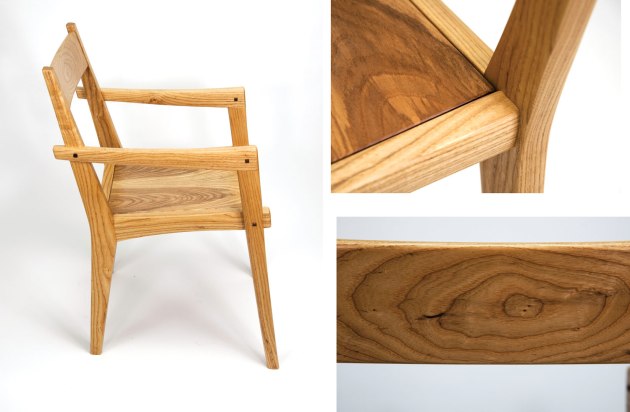
Top and above: Different views of Lachlan Park’s Ranch Chair, designed and made during a residency at Anderson Ranch Arts Centre in Colorado, USA. The chair is made from American white ash. Photos: Kyra Stickford
Across the ditch
Wanting more, I soon travelled to New Zealand to learn from renowned makers John Shaw and David Haig. Chairmaking was a six week component of the full-time program in 2009 at the Centre For Fine Woodworking in Nelson. Starting small with hand cut mortise and tenon joints, we were then guided through the designing and making of a chair by John Shaw, a master chairmaker in his own right.
From the ground up
Workshop scraps of pine, plywood and cardboard were cut, shaped and stuck together to form mock-ups. We were limited only by our own creativity, the strength of an 8-gauge screw and the stickability of double-sided tape and hot glue. Whilst flimsy and unrefined, these mock-ups are integral to the design process and allow the maker to quickly find form and proportion, something to react to and refine. And also test, because sitting comfortably is after all the ultimate goal. From there measurements can be taken, a full-scale drawing made and joinery decisions considered.

Adam Webb, Captain's Chair
I remember looking on in awe as fellow student and friend Adam Webb meticulously and patiently adjusted and tinkered with his design for a Captains Chair. A challenging chair to not only design but make, with its solid wood seat into which the legs are jointed.
Travels with wood
After time spent working in New Zealand, Australia and North America, both woodworking and earning a crust, pouring beer and chasing sheep, I returned home in 2014 to begin building my workshop. Traditional timber framing has been a major component of my building efforts since, and I will be forever thankful to Steve Stoodley at Timber Frames Australia for his teaching and mentorship.
Since that splendid year in New Zealand, I have reflected on chairmaking often and the challenge that is making a chair of one’s own design. A challenge where ultimately the final piece will not only live or die on aesthetics (which are arguably subjective) but also on its ergonomics. My aspirations were and are to make chairs which are not only considered beautiful but offer care and comfort for the user looking to rest awhile.
Although I had made other chairs since those halcyon days in NZ, these were either simple dining chairs with upholstered seats or poor attempts which were relegated to the burn pile. An itch that needed to be scratched, but how? I would need weeks if not months to properly go down that rabbit hole again.
The Ranch Chair
Artist’s residencies are a great opportunity to explore ideas with other craftspeople in a stimulating and supportive environment, and I can’t think of a better place for that than Anderson Ranch Arts Centre in Colorado, USA. I was fortunate to have this opportunity in 2018. So, with 12 weeks to spend as a resident at Anderson Ranch it was time to go back down the rabbit hole.
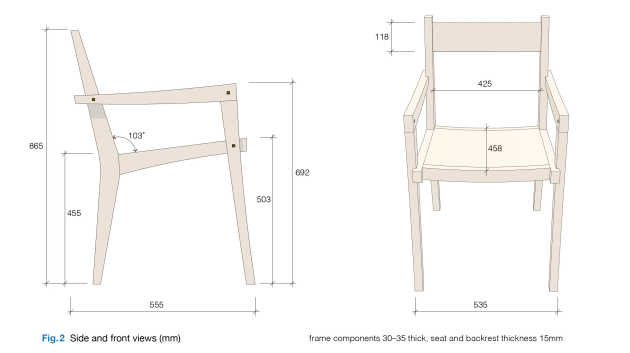
The brief I set myself was to design and make a one-off chair. The chair had to have arms, a solid wood seat, be strong, pleasant looking and comfortable. The kind of chair that sits humbly and quietly in the corner of the room but could handle being kicked around a bushman’s cabin or farm kitchen.
A 12-inch wide x 2-inch thick piece of American white ash (Fraxinus americana) with a hint of dark brown heartwood caught my eye and chose itself. It was wide enough to yield rift-sawn sections for legs and also some flat-sawn for a seat.
Scribbles on a napkin were enough to get started – perhaps only scribbles, but the culmination of years spent pondering that next chair. Then I moved on to mocking up with scraps of poplar and chipboard that were quickly put together.
My fellow residents and passers-by did the R&D: ‘Please sit, are you comfortable? If not, why?’ When this became tiresome for both maker and guinea pig, it was time to make a full scale drawing and cut wood!
Making the Ranch Chair
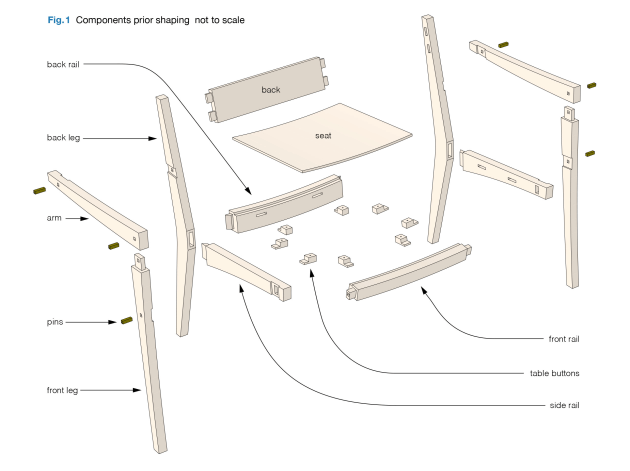
Timber breakdown. Templates were made by tracing over the full scale drawing. These were then arranged on that special plank of ash. It was a tight fit but sufficient wood to yield all the parts needed and a few spare rails. After some careful bandsawing there was no going back, that special plank was now reduced to a pile of parts.
Joinery. After the wood was machined to final dimension, the mortise and tenon joinery was cut, the rails into legs, front legs into arms, and then arms into back legs. Once clamped tightly together, the crest rail could be cut to length and then fitted between the back legs. It was looking like a chair, albeit a rough one.

Krenov style planes made by the author
Shaping. With parts unglued and thus easier to handle, things could be shaped. It was a back and forth process – a little more off, re-assemble and reconsider. For this shaping I used a flat sole spokeshave, wooden planes of different lengths and widths, rasps, files and cabinet scrapers. I love the fine slightly burnished tool marks that are left by files, honest makers’ marks. The aspiration was a for a slight pillowing of all surfaces, domed, rounded but not without soul.
The seat. A solid wood seat called for a curved sole plane. Well not entirely, as a saddle could be shaped by other means, but making ‘Krenov’ planes is close to my heart and lots of fun. A simple plane was made from European beech with a wenge cross-pin. How much curve for the seat? Well, the thin chipboard seat on mock-up provided a nice answer as it bent into shape when sat on.
Details. Small square shaped walnut pins were fitted through the face of arms and legs. A nod to Greene & Greene architecture which I was fortunate to ponder at a San Francisco Frat House on a previous trip to the USA. It’s fair to say the college students who gave us the tour were more into brewing beer than architecture.
Glue-up and assembly. A dry run was carried out of course. When confident, I glued the legs to side rails and then leg assemblies together with front and back rails and the crest rail. Glue of choice was Titebond Ultimate.
Finishing. Three or four hand rubbed coats of Danish oil were applied with the first thinned with white spirits.
Journey’s end?
As my time at Anderson Ranch drew to a close and more than one beer had been spilt on the freshly oiled chair, I reflected on my efforts. Was the chair beautiful? Was it comfortable? Was my joinery strong enough, and would the chair stand up to generations of slouchers? These existential questions from an insecure maker. Honestly, I think it is okay. A not quite resolved design but a worthy effort.
I am proud of the wood selection and harmony between elements. For example, I like how the concentric annual rings of the tree are revealed in the crest rail and the arrangement of darker heart wood on the seat. I regret not slimming down the back legs and side rails a little more – it’s always surprising how differently parts of exact dimensions can appear in different woods. In this case the oiled ash appears heavier and larger than the unfinished poplar from which the mock-up was made.
I feel like I have unfinished business with this chair, perhaps this is just prototype #2 and I need to go down the rabbit hole once more. Here’s hoping, to be continued...
As the writer and designer Colin Bisset wrote ‘Surely the chair which nurtures us most is the chair which is actually comfortable. And perhaps they are only complete when someone is sitting in them.’
First published in Australian Wood Review, issue 129, December 2025
 Lachlan Park @lp_woodwork lives and works in Newstead, Victoria. He teaches woodworking and timber framing, and also offers short courses with visiting teachers. Learn more at www.lpwoodwork.com and see here for details of an upcoming workshop in Newstead with John Shaw (NZ) and David Fleming (USA).